
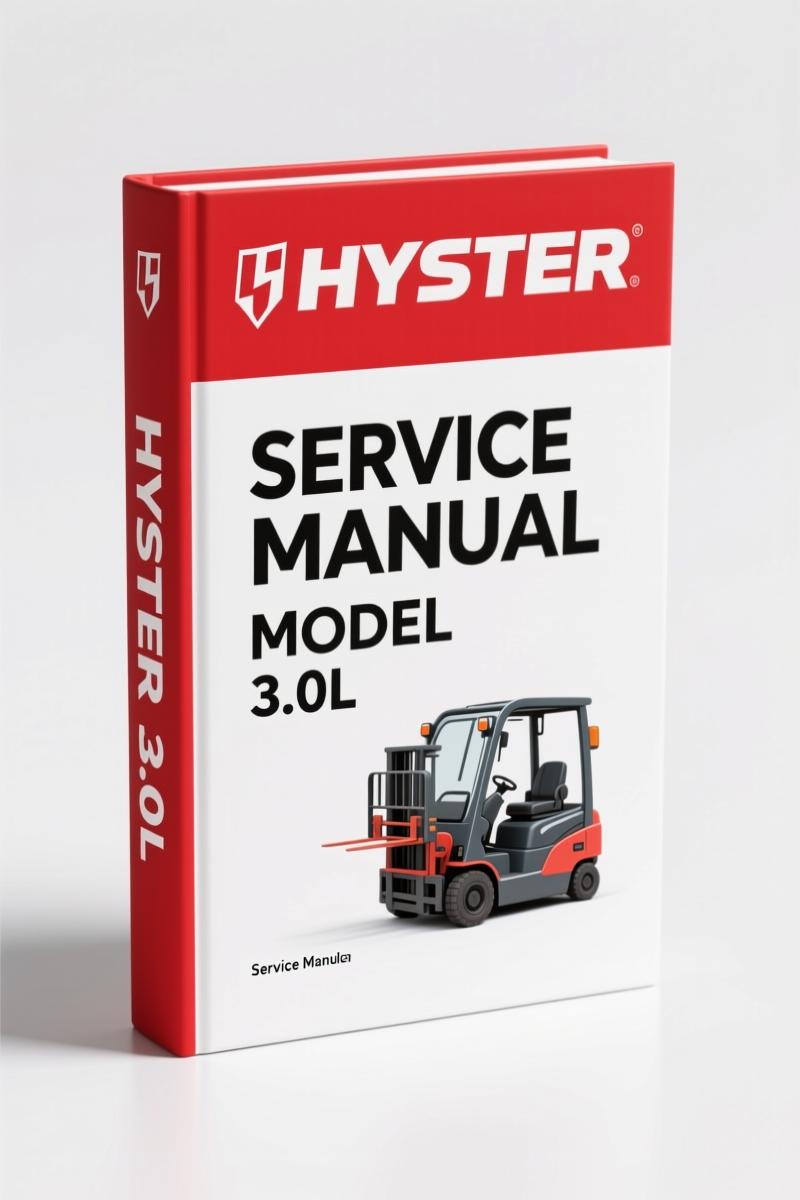
Hyster 3.0L, 4.3L Service Manual – MSTS Diagnostics
Original price was: $32.25.$25.00Current price is: $25.00.
OEM service manual for Hyster 3.0L & 4.3L LPG engines. 48 pages cover MSTS, DTCs, sensor repair, ignition timing.
Description
Hyster 3.0L, 4.3L Service Manual – What You Get
If you have spent any time with LPG-fueled industrial engines, you already know the frustration of chasing a no-start that leaves you swapping parts blindly. The Hyster 3.0L, 4.3L Service Manual fixes that. It is a 48-page OEM document straight from the factory, not some aftermarket rewrite that swaps pinouts and guesses at clearances. I have been turning wrenches for 28 years, and I will tell you straight: without the MSTS diagnostics in here, you are shooting in the dark on those GM-based LPG engines. Page 2 lays out the full safety procedure before you even pull a spark plug wire – read it, because static discharge will kill the MSTS module faster than a dropped socket.
Microprocessor Spark Timing System: What the Manual Covers
The MSTS chapter (starting page 3) explains exactly how the system initializes when you turn the key. It covers the distributor, ignition coil, ignition module, MAP sensor, and ECT sensor. The manual breaks down each component’s operation – what the MSTS module does with the signal from the MAP sensor, how the ECT sensor trims the timing during cold starts. Every circuit description is paired with a test description. You get the diagnostic flow, not a generic wiring color list. The table of contents lists “When Engine Is Being Started” and “When Engine Is Running” as separate subsections – because the spark timing strategy changes completely between crank and run.
Read the Safety Precautions on Page 2
I have seen technicians skip the safety page and then complain about a fried ECM. Page 2 of this Service Manual has the warnings in bold: disconnect the battery ground on internal combustion lift trucks, use Hyster-approved parts, and always fasten a DO NOT OPERATE tag. LPG is flammable – gasoline, diesel, CNG too – so the manual calls out ventilation and fire safety. Wear safety glasses. Use correct blocks. These are not suggestions; they are the difference between a clean repair and a trip to the ER. The manual also notes that batteries generate flammable gas when charging – keep sparks away. That kind of detail is exactly why you want the OEM version.
Does the Manual Cover DTC-14 and DTC-15 for ECT?
Yes, and it goes beyond just listing the code. DTC-14 indicates low temperature indication from the engine coolant temperature sensor; DTC-15 indicates high temperature. Each has its own circuit description and a step-by-step test description. You get the specific voltage ranges and resistance checks without having to cross-reference a third-party spreadsheet. The same treatment applies to DTC-34 (MAP sensor), DTC-41 (EST open circuit), DTC-42 (EST grounded circuit), and DTC-51 (MSTS failure). If you have a CodeMate tester, the manual tells you which pins to probe on the MSTS module – Table 1 lists all the module connections. Page 3 has the start of the operation section where you learn how the ignition module works during cranking. This is the kind of depth that saves you from replacing parts that are still good.
48 Pages of Diagnostic and Repair Procedures
The manual does not waste space. After the troubleshooting sections, it walks you through distributor repair: remove, disassemble, inspect, assemble, install, and set ignition timing. The ignition module repair section gives you a test-for-fault procedure before you replace anything. Same for the sensing coil, ignition coil, and MSTS module. You also get ECT sensor replacement and MAP sensor replacement. Every repair section tells you which tools to use – for instance, the distributor repair expects you to have a timing light and a distributor wrench. There are no generic instructions telling you to “remove the bolt” without specifying the socket size. The manual also includes a pressure conversion chart (Table 2) for MAP sensor testing, and a complete MSTS diagnostic codes table (Table 3). All 48 pages are focused on one engine family – the GM 3.0L and 4.3L LPG engines used in Hyster lift trucks. That specificity means you are not flipping past irrelevant chapters.
Distributor and Ignition Module Repair Steps
When you get to the Distributor Repair section, the manual takes you through removal, disassembly, inspection, assembly, and installation. It calls out the ignition timing specification after installation. For the ignition module, the test procedure uses an ohmmeter and a known-good MSTS module to isolate faults. The sensing coil repair includes a resistance test. The ignition coil repair tells you to check for spark at the coil wire first – a step many DIYers skip, then wonder why the engine cranks but won’t run. The MSTS module repair covers removal and installation, with a note about static discharge damage. If you have ever zapped a module by touching the terminals without grounding yourself, you know why that warning is there. The manual also includes the starter-rotates-engine-but-engine-does-not-run troubleshooting – a common problem on LPG engines with worn ignitions. It walks you through the test description step by step, eliminating guesswork.
FAQ
- Can I use this manual on a standard GM 4.3L V6 from a pickup truck?
- No. This covers Hyster industrial LPG engines only. Aftermarket conversions differ.
- What diagnostic equipment do I need to read the MSTS diagnostic codes?
- The manual specifies using the CodeMate tester (or equivalent) connected to the MSTS module connector. Table 1 shows the 12-pin module connections – you need a digital multimeter with duty cycle capability for some tests. The troubleshooting section also requires a timing light and a vacuum gauge for MAP sensor verification. If you have the MSTS module with a malfunction indicator lamp, you can read DTCs by counting MIL flashes after grounding the test terminal. The manual gives the full procedure for connecting the tester, reading codes, and clearing them. Without the CodeMate, you still get voltage and resistance checks for each sensor. The pressure conversion chart (Table 2) helps if you are using a manometer instead of a scan tool. So the answer is: a basic multimeter, a timing light, and the ability to follow the circuit descriptions on page 3 onward.
You want to stop swapping parts and start fixing the actual problem. The Hyster 3.0L, 4.3L Service Manual gives you the factory flowcharts, the correct DTC tables, and the torque specs that aftermarket books leave out. Whether you are rebuilding the distributor or hunting a DTC-34, this is the document you keep on the workbench. Do not waste time with half-copied reprints. Access the Factory Manual now and get the OEM procedure.
Related Manuals
- Hyster A513 A514 A613 A614 A702 2014 Service Manual
- Hyster S4.0, 4.5, 5.5FT, S5.5FTS, S80 2012 Service Manual
- Hyster S6.0FT, S4.0, S7.0FT, S135FT, S155FT 2013 Service Manual
If you are working on the Engine, do not confuse the MSTS diagnostics with the Manual Transmission service intervals for these trucks – transmission work uses a different manual. Also, while the MSTS controls ignition timing, the gearbox is a separate system; see the Manual Transmission section if you need clutch or shift linkage specs.
Additional information
| Brand | Hyster |
|---|---|
| Language | English |
2 reviews for Hyster 3.0L, 4.3L Service Manual – MSTS Diagnostics
You may also like…
-
Sale!
Hyster H4.0FT5, H4.5FTS5, H4.0FT6, H4.5FT6, H5.0FT Service Manual 110 Pages
Original price was: $54.90.$45.00Current price is: $45.00. -
Sale!
Hyster S2.0-3.5FT, S40-70FT, S55FTS, H2.0-3.5FT, H40-70FT Service Manual – 76 Pages
Original price was: $59.85.$45.00Current price is: $45.00. -
Sale!
Hyster H4.0FT5, H4.5FTS5, H4.0FT6, H4.5FT6, H5.0-5.5FT Service Manual
Original price was: $56.70.$45.00Current price is: $45.00. -
Sale!
Hyster S4.0FT, S5.5FT, S5.5FTS, H4.0FT5, H4.5FTS5 Service Manual
Original price was: $71.55.$45.00Current price is: $45.00.
Related products
-
Sale!
2004 Acura TSX Wiring Diagram – 73-Page Factory Electrical Schematics
Original price was: $15.88.$9.99Current price is: $9.99. -
Sale!

2011 Parts Catalog – International 7400 SFA 6X6 – 1886 Pages of OEM Part Numbers
Original price was: $32.00.$25.00Current price is: $25.00. -
Sale!

2005 Parts Catalog – International NGD 3.0 L Engine (77 pages)
Original price was: $44.70.$30.00Current price is: $30.00. -
Sale!

1992 Electrical Schematic – International 1000/3000/4000/2554 OEM Wiring Diagrams (132 Pages)
Original price was: $26.40.$20.00Current price is: $20.00.
Michael T. –
Great buy! The scan is high-quality and easy to navigate. Every torque spec is included for Hyster 3.0L,. Saves me a lot of dollars.
diy_master –
I am so happy with this transaction. It is easily zoomable on my iPad without blur. Contains clear schematics for Hyster. Saved my weekend project! Thank you.