
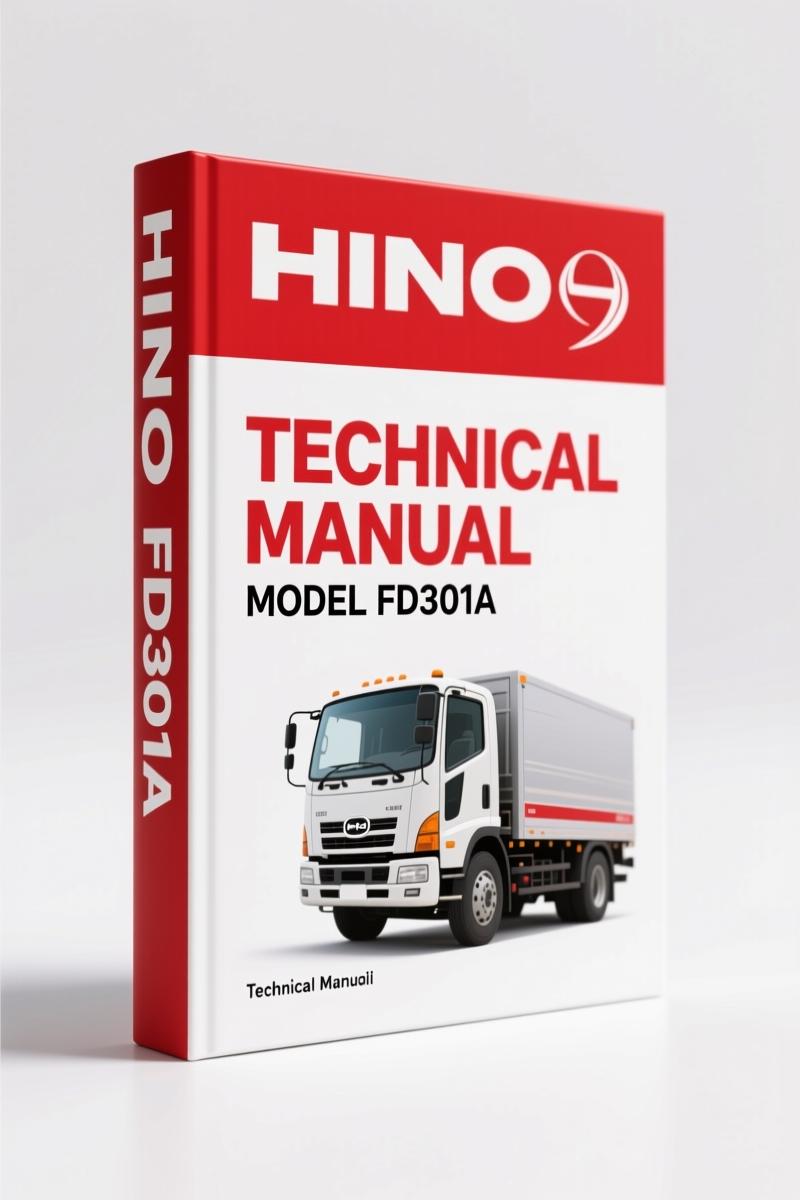
Hino FD301A, FD7J Technical Manual – OEM Body Mounting Specs
Original price was: $39.50.$25.00Current price is: $25.00.
OEM body mounting manual for Hino FD301A, FD7J. 295 pages covering chassis, wiring, PTO, suspension, and Euro-5 compliance.
Description
Hino FD301A, FD7J Technical Manual – Body Mounting Specs
If you are bolting a dump body onto a Hino FD7J chassis without the factory specs, you are asking for a frame crack or a brake line pinch. That is not opinion. That is what happens when you guess on U-bolt positions or ECU precautions. This specific manual—295 pages of OEM data from Hino—covers exactly those details. The Hino FD301A, FD7J Technical Manual is the body builder’s reference for the Hino 500 series medium duty truck with EURO-5 emissions. You want to weld on a fire shield? Page 26 has the clearance rules. Need to run additional wiring through the engine compartment? Chapter 6 spells out the fuse block layout and the spare power terminals. Skipping those steps gets you a fried ECU or a cab that won’t tilt.
What This Manual Actually Covers
This is not a general repair guide. It is a body mounting manual written for manufacturers and intermediate stages who modify the chassis. It starts with model code identification and chassis specs (Chapter 1), then dives into the safety-critical stuff: fire shield clearance, U-bolt positions, exhaust system precautions, antenna placement, and the big one—precautions for the Engine ECU. Chapter 5 covers PTO provisions and engine control for body equipment. Chapter 6 gives you the electrical Wiring diagrams, rear combination lamp wiring, and semi-trailer electrical connection. If you are adding a wet kit or a hydraulic pump, you need the transmission side PTO specs from that chapter. The manual also includes frame section modulus data (Ch. 3) and spring characteristics (Ch. 4) so you know your frame will not twist the first time you load it.
Engine ECU and Wiring Precautions – Not Optional
Chapter 2 has a dedicated section on precautions for the engine ECU. That means no welding near the control unit without disconnecting the battery and pulling the connectors. Same section covers additional wiring in the engine compartment—routing, grommets, fuse ratings. I have seen shops burn out a $2,000 ECU because they ran a power wire next to an exhaust pipe. This manual tells you exactly where to drill and what to avoid. For related chassis specs, see the Hino 155, 195 2011 Technical Manual – OEM Factory Specs if you work on those lighter models. Different frame, same attention to detail.
7 Systems Addressed in the Body Mounting Process
Nine chapters (excluding the intro) each address a specific system. Chapter 1: model codes and identification. Chapter 2: chassis modifications (fire shield, ECU, exhaust, welding, wiring, lights, air bag, FUP). Chapter 3: mass and frame modulus. Chapter 4: suspension geometry and travel limits. Chapter 5: PTO and engine control. Chapter 6: electrical—fuse blocks, relay panels, wiring diagrams, back-up buzzer. Chapter 7: painting and cab parts removal. Chapter 8: dimensional drawings of cab and chassis. Chapter 9: fuel tank, air tank, battery, exhaust. Chapter 10: brake piping and license plate bracket. Chapter 11: catalyst muffler handling and ADR requirements. That is 295 pages of OEM data with no aftermarket shortcuts. The Hino W04D W06E Technical Manual covers engine repair if that is your next job, but for body mounting, this is the only reference you need.
Who Needs This Manual?
Body builders, fleet mechanics, and advanced DIYers who are installing a flatbed, dump body, or any equipment on a Hino FD7J chassis. If you are modifying the frame, adding a PTO, or tapping into the electrical system, you need the factory clearance specs and torque values. I have seen too many cobbled-up jobs where the body sits too close to the cab and rubs through the firewall. The clearance between cab and rear body is specified in Chapter 2 with minimums and maximums. The manual also includes the calculation for frame upper surface height from ground (Ch. 4) so you can set your body mount height correctly. Beginners should not skip the warning pages—there is a reason Hino printed them in bold. For a deeper look at bus chassis work, check the Hino RB Rear Engine Bus Technical Manual—different platform, same OEM philosophy.
OEM vs Aftermarket Documentation
Aftermarket manuals for body mounting are dangerous. They reprint generic frame rail dimensions and guess on ECU locations. This manual comes directly from Hino Motors, Ltd., Tokyo. Every dimension, every precaution, every wiring color code is verified. The record of changes in the front shows this is revision KK-FD301A, superseding the earlier CD-ROM. That level of traceability keeps your liability low and your work safe. When you are dealing with a chassis that will carry 10 tons, you do not guess on U-bolt positions or exhaust routing. For more on how a Manual Transmission interacts with the PTO, the manual details the transmission side power take-off in Chapter 5. And if you are wiring a backup buzzer, the diagram is right there in Chapter 6—no generic schematic, factory only.
- Does this manual include engine specifications or only body mounting?
- It covers chassis specs and mounting, not engine repair. No rebuild data or internal engine torque values.
- Can I use this manual for a different model like the Hino 155 series?
- No. The FD7J has a different frame, different ECU precautions, and different suspension travel ranges. Using this manual on a 155 series will give you wrong U-bolt positions and incorrect light axis adjustments. The Manual Transmission section is model-specific—do not cross-apply. For the 155 series, get the dedicated OEM manual. Hino’s chassis dimensions vary significantly between models, and the aftermarket generic books ignore those differences. Stick with the factory manual for each chassis.
That is the kind of detail that keeps a chassis from cracking at a weld joint. You paid good money for a Hino—now give it the documentation it deserves. Access the Factory Manual and keep it on the workbench next to your torque wrench. You will use it on every body mount job, and it will pay for itself the first time you avoid a rework.
Additional information
| Brand | Hino |
|---|---|
| Language | English |
4 reviews for Hino FD301A, FD7J Technical Manual – OEM Body Mounting Specs
You may also like…
-
Sale!

Hino FR1E, FS1E, FY1E, SH1E, SS1E Workshop Manual – 596 Pages
Original price was: $68.40.$45.00Current price is: $45.00. -
Sale!
Hino RB 14 Workshop Manual – 266-Page OEM Service Document
Original price was: $70.20.$45.00Current price is: $45.00. -
Sale!
Hino FC6J, FC9J, FD8J, GD8J, FG8J Workshop Manual – 382 Pages
Original price was: $61.65.$45.00Current price is: $45.00. -
Sale!
Hino FD, FE, FF, SG 2002 Workshop Manual – 374 Pages OEM
Original price was: $54.45.$45.00Current price is: $45.00.
Related products
-
Sale!

International 1000-3000 Series Operators Manual – 132 Pages of OEM Specs
Original price was: $14.40.$10.99Current price is: $10.99. -
Sale!
Acura NSX 1991 Service Manual – 1420 Pages OEM
Original price was: $102.05.$65.00Current price is: $65.00. -
Sale!
2004 Acura TSX Wiring Diagram – 73-Page Factory Electrical Schematics
Original price was: $15.88.$9.99Current price is: $9.99. -
Sale!
1991 Electrical Schematic – 112-Page OEM Wiring Diagram for International 1000-3000 Series
Original price was: $22.75.$17.50Current price is: $17.50.
workshop_guy –
Excellent factory service manual. It is easily zoomable on my iPad without blur. A must-have for any Hino FD301A, owner doing repairs. Saved my weekend project! Thanks.
John S. –
Great factory service manual. The document is high resolution. Every spec sheet is included for Hino FD301A,. Saves me hundreds of time.
Charles W. –
I am so happy with this manual. The scan is high-quality and well indexed. Contains detailed wiring diagrams for Hino. Saves me hundreds of time.
gearhead88 –
This is just what I required. The pages are clean and well indexed. Every wiring layout is included for Hino FD301A,. Saved my weekend project! Thank you.