
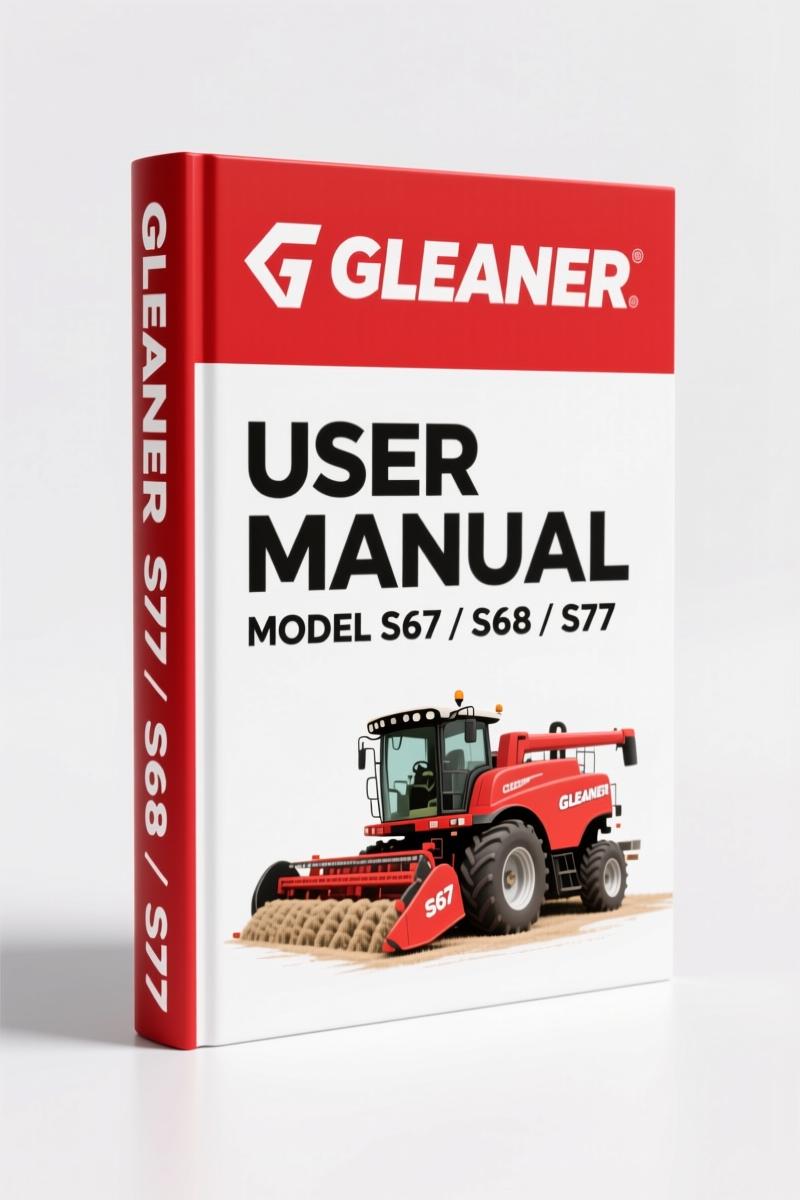
Gleaner S67, S68, S77, S78, S88 2015 User Manual – OEM Specs
Original price was: $17.15.$12.99Current price is: $12.99.
OEM 18-page user manual for Gleaner S67, S68, S77, S78, S88 combines. Factory setup tables, troubleshooting, and grain loss calculation procedure.
Description
Gleaner S67, S68, S77, S78, S88 2015 User Manual
If you are setting up a Gleaner combine for wheat, milo, corn, or beans and guessing at concave gap or rotor speed, you are burning fuel and leaving grain in the field. I have watched too many operators dial in a machine by feel and end up with cracked grain or high loss. That is why this 18-page 2015 User Manual for the S67, S68, S77, S78, and S88 belongs on the seat next to you. It is not a service manual – it is the quick-reference sheet that gives you the factory starting points so you can stop wasting time.
Page 1 opens with a table for Cereal Grain – Wheat, Oats, Barley. Rotor RPM for wheat: 800. Concave setting: 0.1” – 0.2” on the EIP. Fan opening: 3–6. Chaffer: 0.75” (19 mm). Sieve: 0.375” (10 mm). Chopper speed: Fast. Elevator boots: Solid. Those numbers came out of a Gleaner engineer’s notebook, not a reprint house guessing. You get the same for Milo, Dry Corn, High Moisture Corn, Soybeans, Canola, Millet, Edible Beans, Sunflowers, Flax, Grass Seed, Alfalfa, Clover, and Rye. That is 13 crop-specific setups in one table.
Combine Setup for Different Crops
The manual does not stop at wheat. Flip to page 2 and you find Milo (Grain Sorghum) with rotor RPM 450–600, concave 0.2”–0.4”, and a note to “set concave to stem thickness just below head for starting point.” That level of direction is what separates a manual that pays for itself in the first pass from one you toss in the glovebox. Dry Corn under 20% moisture gets rotor 250–300 RPM, concave 0.6”–0.8”, fan 4–6, and slow chopper speed. Each crop includes header drive setup – cutterbar locked up on flex headers, variable speed drive in slowest position. No ambiguity.
For High Moisture Corn above 24% moisture the concave gap opens wider and rotor speed drops. The table on page 3 spells it out. You also get a tip: “Feed chains at slow spe” – that excerpt cuts off, but the actual manual has the full spec. I have seen operators destroy sample grade by running dry-corn settings on wet corn. This manual prevents that.
Rotor RPM and Concave Settings – What the Manual Gives You
You get a chart for every crop that lists Rotor RPM, Concave Setting, Fan Opening, Chaffer Opening, Sieve Opening, Chopper Speed, and Elevator Boots. For example, Soybeans call for rotor 300–450 RPM, concave 0.5”–0.6”, fan 9–12, chaffer 0.625” (16 mm), sieve 0.5” (13 mm), chopper slow, boots solid. That is the kind of data you cannot find in a YouTube comment. The manual also tells you which gearbox range to use – S8 Series has greater range to run on the low side of the gearbox for milo. That is not fluff; that is drive-train life.
3 Reasons to Choose OEM Documentation Over Aftermarket
First, aftermarket summaries leave out the fine print. This manual includes a note that for hard-threshing cereals you may need Concave Filler Kit #700958588. It gives the actual part number. Second, the grain loss calculation procedure on page 25 uses a “Quick check” method and an “Advanced” method for rotor and shoe loss. The chart for Standard Payable Moisture & Density on page 28 tells you what moisture percentage the elevator will accept. Third, the troubleshooting section (starting on page 11) covers header, feed conveyor, processor, grain quality, and separate loss categories. Aftermarket PDFs chop that into generic advice. This is factory original.
Does the Manual Cover Headers and Feed Conveyors?
Yes. Troubleshooting begins with Header – common binding, drive issues, and cutterbar problems. Feed conveyor diagnostics run from page 16. Processor problems on page 17. Grain quality complaints on page 19 – a section that saves you from thinking you have a threshing issue when it is really a fan speed problem. Rotor loss and shoe loss each have dedicated sections with calculation worksheets. If you have ever tried to measure loss by counting kernels in a square foot and guessing at the formula, the manual gives the real “Advanced” procedure on page 27.
Grain Loss Calculation – Page 25 Focus
Loss Calculation starts with a “Quick check” method – you do not need a calculator for that. Then it walks through Spreading discharge assessment. The “Advanced grain loss calculation procedure” splits into Advanced rotor loss and Advanced shoe loss. The manual tells you exactly where to measure and how to calculate loss as a percentage. For a shop owner or farmer doing their own field testing, that section alone saves hours of guesswork and reduces crop loss.
Standard Payable Moisture & Density Chart – Why It Matters
Page 28. This chart shows moisture thresholds for standard payable grain – what the elevator will accept without discount. If you dump a load of wheat at 15% moisture and the chart says the standard is 13.5%, you take a hit. The chart lists commodity, standard moisture, test weight density, and other factors. Having it in the cab means you can check before you haul. That is the kind of detail aftermarket reprints skip because they assume you know it already. Assumptions cost money.
Working on a combine is not like rebuilding a Manual Transmission – you are dealing with hydraulics, belts, and crop flow. But the same rule applies: use the factory spec or waste time. The rotor drive on these Gleaners uses a gearbox that should be set according to the table, not by ear. For deeper repair work, pair this user manual with the Gleaner S7 S8 Series 2015 Technical Manual. If you need operator specs for other equipment, check the Hitachi ZAXIS225US-3 2007 Operators Manual | OEM Factory Specs or the Schneider Electric Masterpact NW08-63 User Manual – Factory Specs. For those still learning drivetrain basics, a Manual Transmission overview helps understand how gear ratios affect torque – same principle applies to the rotor gearbox low/high range.
Frequently Asked Questions
- Does the manual include the S88 model settings?
- Yes. The manual covers S67, S68, S77, S78, and S88 models in all crop tables. Each model shares the same initial settings unless noted.
- Can I use this to set up for sunflowers?
- Yes, sunflowers have a dedicated row in the combine setup table. Rotor RPM 350-450, concave 0.8”–1.0”, chaffer 0.625” (16 mm), sieve 0.5” (13 mm).
- What is the difference between the quick check and advanced loss calculation?
- The quick check on page 25 gives a fast pass-or-fail based on a single collection point. The advanced procedure (page 27) requires measuring rotor and shoe loss separately using multiple samples and a formula. Use the advanced method when you are fine-tuning or troubleshooting a persistent loss issue.
- How many pages is the troubleshooting section?
- Thirteen pages covering header, feed conveyor, processor, grain quality, and loss. That is over half the manual.
Access the Factory Manual. Do not trust your harvest to a photocopy from five combines ago. This 18-page PDF gives you the same data Gleaner shipped with the machine in 2015. Get it, print it, and keep it in the cab. Your combine will thank you.
Additional information
| Brand | Gleaner |
|---|---|
| Language | English |
3 reviews for Gleaner S67, S68, S77, S78, S88 2015 User Manual – OEM Specs
You may also like…
-
Sale!
Acura NSX 1991 Service Manual – 1420 Pages OEM
Original price was: $102.05.$65.00Current price is: $65.00. -
Sale!
Gleaner S7, S8 Technical Manual – 26-Page OEM Spec Document
Original price was: $54.80.$40.00Current price is: $40.00. -
Sale!

Acura Integra 1998 Service Manual – 1891 Pages Factory OEM Documentation
Original price was: $31.75.$25.00Current price is: $25.00. -
Sale!

CDS 705C, 706C, 708C 1981 Parts Catalog – OEM Forklift Specs
Original price was: $61.60.$40.00Current price is: $40.00.
Related products
-
Sale!

1992 Electrical Schematic – OEM Wiring Diagrams for International 1000-3800
Original price was: $24.48.$18.00Current price is: $18.00. -
Sale!

Service Manual – International HS 2.8L Engine – 130 Pages of Factory Specs
Original price was: $56.40.$40.00Current price is: $40.00. -
Sale!

2005 Parts Catalog – International NGD 3.0 L Engine (77 pages)
Original price was: $44.70.$30.00Current price is: $30.00. -
Sale!

2006 Service Manual – International DT 466E, 530E Diesel Engine
Original price was: $67.50.$50.00Current price is: $50.00.
Richard G. –
Great buy! The text is searchable and easy to navigate. A must-have for any Gleaner S67, owner doing maintenance. Saves me so much time.
David K. –
Excellent quality! The pages are clean and easy to navigate. Every spec sheet is provided for Gleaner S67,. I will definitely buy again.
Thomas B. –
Great OEM spec sheet. The document quality is excellent. Contains clear bolt torque specs for Gleaner. I will recommend this shop to others.