
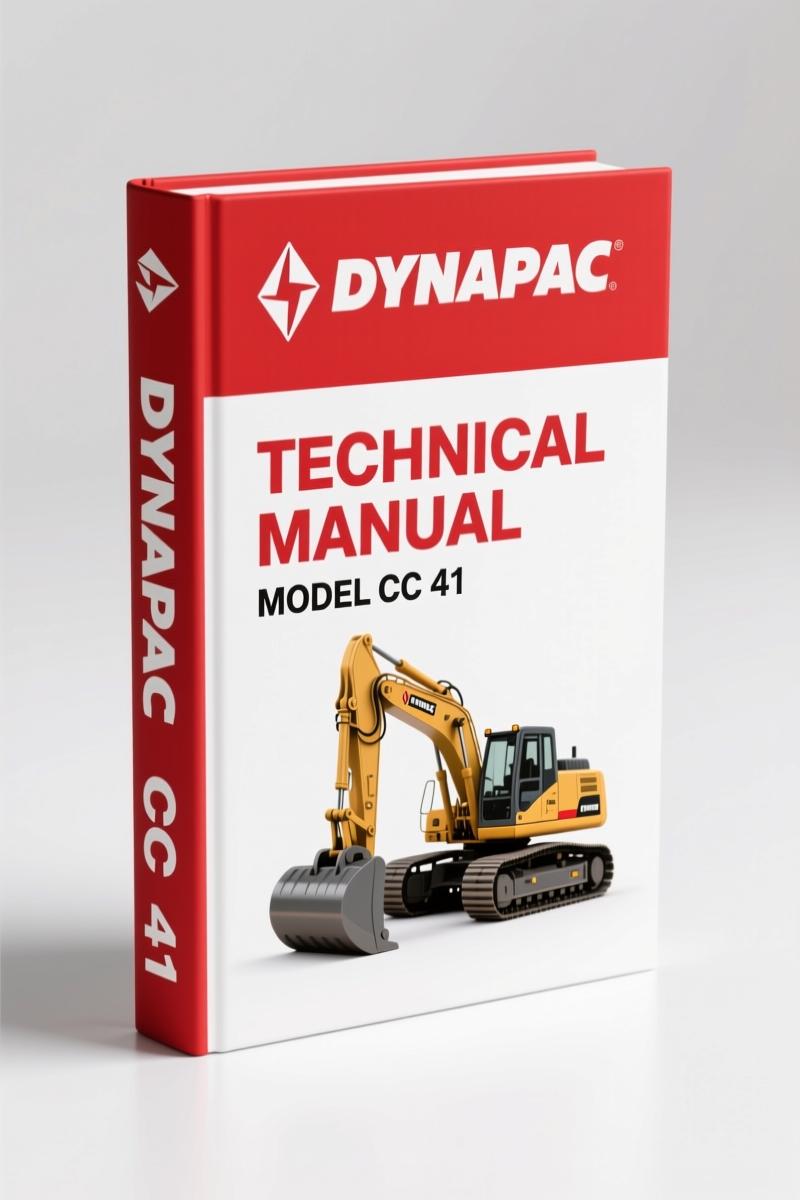
Dynapac CC 41 1982 Technical Manual – Factory Wiring & Hydraulic Specs
Original price was: $44.45.$35.00Current price is: $35.00.
Dynapac CC 41 1982 Technical Manual – 44 pages of factory wiring diagrams, hydraulic diagrams, and brake system specs.
Description
Dynapac CC 41 1982 Technical Manual
If you are working on a Dynapac CC 41 vibratory roller and you are relying on aftermarket guesswork or a faded photocopy, you are wasting time and risking component damage. This Dynapac CC 41 1982 Technical Manual is the original OEM publication from the manufacturer, not a reprint or a third-party rewrite. It gives you the exact factory specs that the engineers at Dynapac used when they built the machine. You get 44 pages of information that came straight out of Sweden in 1982. No short cuts, no missing steps, just the data you need to get the job done right the first time.
General and Design Overview
The manual opens with a General section on page 1 and a Design section on page 2. Page 3 covers the Technical particulars—this is where you find the weight distribution, drum diameter, and engine specs for the Caterpillar D 320B diesel. The design section explains that the CC 41 has articulated steering, hydraulic drive on both drums, and a separate vibration system with an eccentric shaft. Knowing how the frame sections and drums are laid out keeps you from making assumptions that lead to binding or load imbalance.
Does the Manual Cover the Electrical System?
Yes, and it does it properly. The Electrical system starts on page 7 of the manual. This is not a generic schematic—it is the actual factory wiring for the CC 41, including the connections for the parking brake cut-out that links to the diesel engine. The manual also includes a full Wiring diagram on page 8. If you are chasing a dead solenoid or a no-start condition, you need this diagram. Without it, you are guessing which wire goes where, and that is how you blow fuses and burn up harnesses.
3 Systems Covered by the Wiring Diagram
The wiring diagram on page 8 breaks down the electrical system into three main loops: the engine start and charge circuit, the vibration control circuit, and the brake actuation circuit. Each circuit is drawn with component identifiers that match the physical parts on the machine. The manual also lists wire colors and connector pinouts. Combining this diagram with the Hydraulic diagram on page 6 gives you the complete control flow—hydraulic pressure moves the drums, electrical signals control the solenoids. One without the other will leave you halfway through a repair with no idea why the roller won’t move or vibrate.
Get the Right Torque Data from Technical Particulars
Page 3 holds the Technical particulars table. In this table you find the engine oil capacity, hydraulic system pressure, and—critical for any rebuild—the torque values for the drum mounting bolts and the eccentric shaft retaining screws. The manual states the figures in metric (bar, Nm), but you can convert to Imperial: 140 bar is roughly 2030 psi, and 240 Nm comes out to about 177 ft-lb. Do not use a generic torque spec from a comparable roller; the CC 41’s rubber elements and drum geometry require the specific values listed here. Over-torquing will crack the drum housing; under-torquing will let the rubber elements slip and cause uneven compaction.
Hydraulic Diagram: Following the Pressure Path
Page 6 contains the Hydraulic diagram. This is a schematic of the entire hydraulic circuit: the variable displacement swashplate pump driven by the diesel, the two drive motors, the steering cylinders, and the vibration motor. The diagram shows which lines are pressure, return, and case drain. If you are troubleshooting a weak vibration or a steering drift, trace the flow on this diagram. The manual also describes the three braking systems (regular, parking, emergency) and how they interact with the hydraulic circuit. For example, the parking brake is a multi-disc brake on the rear drum; it engages automatically when the engine is stopped. If your roller rolls away on a slope, you need to check the brake actuation sequence using this diagram.
Source Authenticity: OEM vs. Aftermarket
This is the original factory manual printed by Dynapac in 1982. It is not a scanned copy of a third-party rewrite or a collection of photocopies from different years. Every page matches the official OEM publication number OM-10016-2 Eng. Aftermarket manuals often omit the hydraulic diagram details or simplify the wiring colors. Here, you get the exact figure numbers and part callouts that Dynapac used. If you need to order a replacement component, the manual references the OEM part numbers in the text, so you can cross-reference with a parts catalog such as the Dynapac CC 41 Spare Parts Catalogue – Section: Group 6 Electrical Equipment”>Dynapac CC 41 Spare Parts Catalogue – Section: Group 6 Electrical Equipment or the Dynapac CC 41 Parts Catalog – Section: Group 7 Drivers Platform Förar”>Dynapac CC 41 Parts Catalog – Section: Group 7 Drivers Platform Förar.
Who Needs This Manual?
You need this manual if you own or maintain a Dynapac CC 41 vibratory roller. It covers compaction work on asphalt, base courses, and fill material. The manual is written for the operator and the shop technician—it gives you step-by-step operating procedures and maintenance schedules. For the home garage enthusiast or the small construction outfit, this manual saves you from calling a Dynapac dealer every time a wire shorts or a seal leaks. If you are a professional mechanic, you will also want the companion Dynapac CA 15 Technical Manual – OEM Factory Specs”>Dynapac CA 15 Technical Manual – OEM Factory Specs if you work on both models, but keep in mind that the CC 41’s drum setup and hydraulic flow are unique. Do not assume parts interchange.
FAQ
- Does this manual include wiring diagrams?
- Yes, on page 8.
- Can I use this manual to repair a different Dynapac roller model?
- No. The Dynapac CC 41 has a specific frame design, drum rubber elements, and a combined parking/emergency brake system that ties into the engine cut-out. Other models like the CA 15 use different pumps and steer-by-wire configurations. Using the CC 41 manual on a different roller can lead to incorrect torque values or misrouted hydraulic lines. Always get the manual that matches your exact model and year. For understanding general hydraulic principles, you might reference a Manual Transmission”>Manual Transmission analogy, but the CC 41 uses hydrostatic drive, not a gearbox. The vibration system is separate. To understand how a mechanical gearbox differs from a hydraulic drive, read about Manual Transmission”>Manual Transmission principles—but do not apply those torque specs to the CC 41.
Access the Factory Manual from AutoRepairManuals and get the only document that matches the original Dynapac print. You will save time on diagnostics and avoid the headache of ordering wrong parts. Every spec, every diagram, every page is verified OEM data. Your roller deserves the same information the factory technicians used.
Additional information
| Brand | Dynapac |
|---|---|
| Language | English |
4 reviews for Dynapac CC 41 1982 Technical Manual – Factory Wiring & Hydraulic Specs
You may also like…
-
Sale!
Dynapac CA-15A 1987 Parts Catalog – OEM Exploded Views
Original price was: $89.70.$65.00Current price is: $65.00. -
Sale!
Dynapac CA 25, CA 25D, CA 25PD, CA 25R Parts Catalog – OEM Spare Parts (322 Pages)
Original price was: $83.85.$65.00Current price is: $65.00. -
Sale!
Dynapac CC 41 Parts Catalog – 242 Pages OEM Exploded Views
Original price was: $80.60.$65.00Current price is: $65.00. -
Sale!
Dynapac CA250 CA280 CA300 CA260 Workshop Manual – 42 Pages
Original price was: $88.40.$65.00Current price is: $65.00.
Related products
-
Sale!

1992 Electrical Schematic – OEM Wiring Diagrams for International 1000-3800
Original price was: $24.48.$18.00Current price is: $18.00. -
Sale!

Technical Manual – International 6.0L Power Stroke FICM Diagnostics
Original price was: $29.80.$20.00Current price is: $20.00. -
Sale!
1996 Operators Manual – International 1000-4000 Series (246 pages)
Original price was: $15.28.$9.99Current price is: $9.99. -
Sale!
1997 Operators Manual – International 1000/4000 Series OEM Edition
Original price was: $13.49.$9.99Current price is: $9.99.
Michael T. –
I am extremely satisfied with this transaction. The pages are clean and easy to navigate. It guided me to rebuild my Dynapac CC electrical system. Saves me so much time.
James L. –
This is just what I was looking for. Immediate link after checkout. It assisted me to fix my Dynapac CC engine. Saves me hundreds of time.
David K. –
Great OEM spec sheet. It is easily zoomable on my tablet without blur. It guided me to repair my Dynapac CC electrical system. Saves me a lot of time.
gearhead88 –
I am so happy with this purchase. The PDF quality is excellent. Every torque spec is included for Dynapac CC. Worth every penny.