
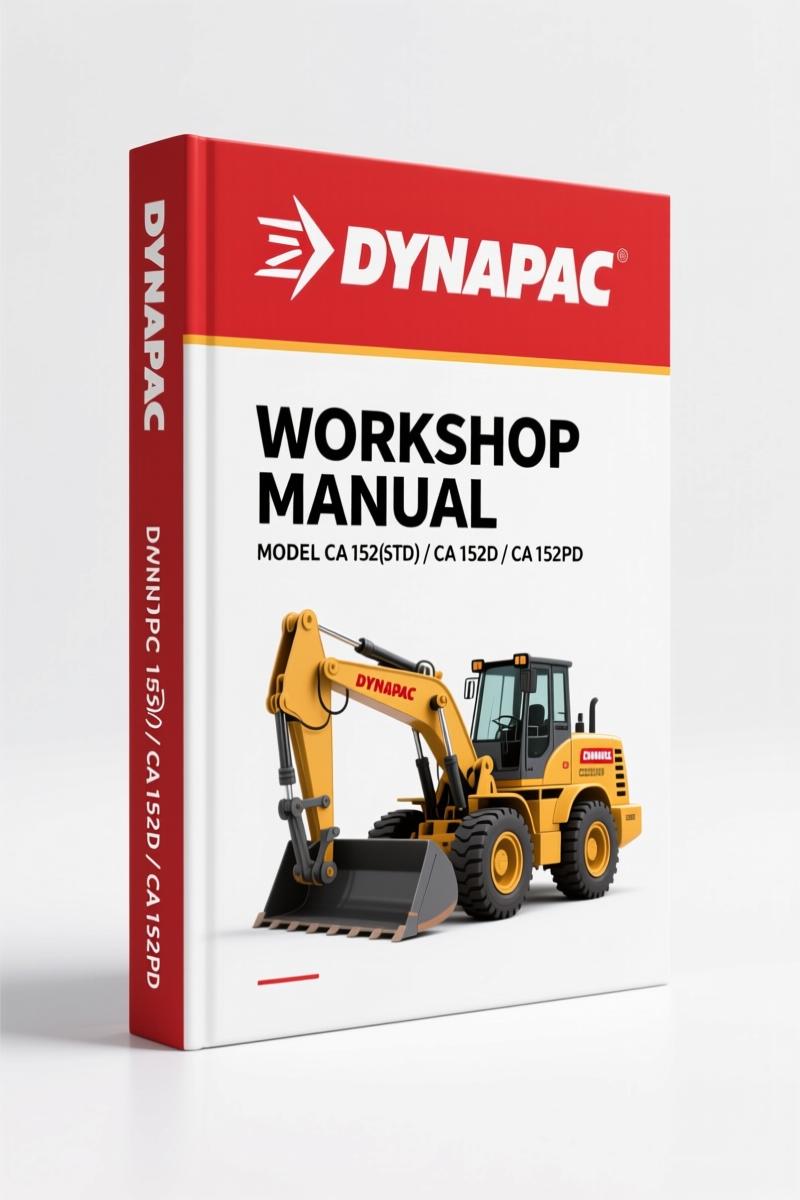
Dynapac CA 152(Std), CA 152D, CA 152PD Workshop Manual – 15 Pages
Original price was: $38.70.$30.00Current price is: $30.00.
Factory hydraulic circuit diagrams for Dynapac CA 152(Std), CA 152D, CA 152PD. 15 pages covering traction, vibration, steering, brake systems and pressure settings.
Description
If you’ve ever cracked open a third-party hydraulic diagram for a Dynapac roller and found a generic symbol that doesn’t match the hose routing on your machine, you know the headache. I’ve been turning wrenches for 28 years, and I’ve seen more than one guy blow a seal because he trusted a reprint instead of the factory sheet. This Dynapac CA 152(Std), CA 152D, CA 152PD Workshop Manual is the real deal – 15 pages of OEM hydraulic circuit diagrams, straight from Svedala Dynapac. No redrawn garbage. No guesswork on pressure settings. You get the exact schematics for the traction, vibration, steering, and brake systems that came off the assembly line.
Hydraulic Systems Covered
This manual breaks down four main circuits: Traction system (page 6), Vibration system (page 8), Steering system (page 9), and Brake system (page 11). Each section shows the full hydraulic diagram with component callouts, hose routing, and the exact graphic symbols from ISO fluid power standards. You get the conversion table for MPa/bar/psi and litres/gallons on page 3. That conversion page alone saves you from pulling out a calculator when a European spec shows 2.0 MPa and you need it in psi for your gauge.
What Pressure Settings Are Included?
The pressure settings table on page 3 is critical. It lists charge relief pressure (2.0 MPa), forward/reverse relief (38 MPa above charge), vibration relief (30 MPa), steering relief (18 MPa), and brake release pressure (1.5 MPa). All values are plus or minus 10% at operating temperature above 1500 rpm. The manual includes a warning in all caps: DO NOT CHANGE ANY PRESSURE SETTING IN THE HYDRAULIC SYSTEMS. Personal injury can happen if you fiddle with these without the OEM spec. That warning is there because someone died – I’ve seen the accident reports. Follow the numbers.
7 Systems in 15 Pages
You get seven distinct sections for a 15-page document: pressure settings, unit conversion, graphic symbols, traction, vibration, steering, and brake. Every page is dense with information. No padding. The graphic symbols page (page 4) explains what each symbol means – things like enclosure for functions, line connection, restriction, flexible hose, manual control lever. If you’re a DIY guy who runs a small compaction operation, this is your cheat sheet to understanding hydraulic diagrams without taking a course. Dynapac CP142, W3020 2007 Workshop Manual – OEM Electric Diagrams covers the electric side if you need wiring help.
Check the Brake Circuit Before You Start
Brake system – page 11. I’m putting this command here because the brake circuit on these rollers uses a spring-applied, hydraulic-release system. If you don’t understand the release pressure spec (1.5 MPa fully released), you can tow the machine with the brakes dragging and cook the friction discs. The manual shows the exact circuit: the brake valve, accumulator, and how the charge pressure interacts. Dynapac CP132 2001 Workshop Manual – Factory Wiring & Electrical Diagrams gives you the electrical for earlier models, but for the CA 152 series, stick to this workshop manual for hydraulics.
Traction System: Factory Circuit Diagrams
Traction system on page 6 – this is the main drive circuit. The diagram shows the variable-displacement pump, the hydraulic motor, charge pump, and the forward/reverse relief valves. Normal working pressure runs 8-18 MPa depending on rolling resistance, but the charge pressure must stay at 2.0 MPa. If you see the charge pressure drop, check the charge relief valve before tearing into the pump. Dynapac CP 132 2000 Workshop Manual – Traction, Drain, Steering & Brake covers similar systems for the CP series, but this CA 152 manual has the specific hose routing for your machine.
Source Authenticity: OEM vs Aftermarket
This is a scanned copy of the original Svedala Dynapac workshop instruction, printed in Sweden. The document number is W1521EN1, dated 97-09-01. It applies to CA 152(Std) PIN starting 64120153, CA 152D PIN 64220153, and CA 152PD PIN 64320153. Aftermarket manuals often skip the graphic symbols page or use a generic symbol set. This manual includes the exact ISO symbols used in the Dynapac factory. That matters when you’re tracing a line that looks like a restriction but is actually a quick disconnect. For reference on general hydraulic theory, you can look up Manual Transmission – though that’s a different drivetrain, understanding power flow helps with the traction circuit. Also, Manual Transmission covers gear ratios; not directly related, but if you ever rebuild the final drive, you’ll appreciate the concept.
- Does this manual include torque specs for the brake caliper bolts?
- No. This manual covers hydraulic circuit diagrams and pressure settings only. Torque specs are not listed. You need the separate service manual for disassembly and reassembly.
- I work on a CA 152D that has a modified hydraulic tank – will the diagrams still match?
- The diagrams show the standard OEM hydraulic tank volume of 50 litres. If your machine has a modified tank, the hose routing and component locations may differ. The pressure settings and circuit logic remain the same, but cross-check the hose connections against your actual machine. The manual does not cover aftermarket modifications. I strongly recommend verifying each line before replacing parts. If you’re dealing with a reworked system, start by confirming the charge pressure at 2.0 MPa with the lever in neutral; that baseline tells you if the pump side is healthy.
Bottom line: if you need to troubleshoot a hydraulic issue on a CA 152(Std), CA 152D, or CA 152PD, this is the diagram set you want on your tablet in the cab. No fluff, no reprints – just the factory sheets. Access the Factory Manual now and get the pressure settings, circuit diagrams, and safety warnings you need to keep the roller running without blowing a hose.
Additional information
| Brand | Dynapac |
|---|---|
| Language | English |
4 reviews for Dynapac CA 152(Std), CA 152D, CA 152PD Workshop Manual – 15 Pages
You may also like…
-
Sale!
Dynapac CA-15A 1987 Parts Catalog – OEM Exploded Views
Original price was: $89.70.$65.00Current price is: $65.00. -
Sale!
Dynapac CA250 CA280 CA300 CA260 Workshop Manual – 42 Pages
Original price was: $88.40.$65.00Current price is: $65.00. -
Sale!
Dynapac CA 25, CA 25D, CA 25PD, CA 25R Parts Catalog – OEM Spare Parts (322 Pages)
Original price was: $83.85.$65.00Current price is: $65.00. -
Sale!
Dynapac CC 41 Parts Catalog – 242 Pages OEM Exploded Views
Original price was: $80.60.$65.00Current price is: $65.00.
Related products
-
Sale!

2005 Parts Catalog – International NGD 3.0 L Engine (77 pages)
Original price was: $44.70.$30.00Current price is: $30.00. -
Sale!

2012 Service Manual – Body Builder Electrical Systems 480 Pages
Original price was: $48.28.$34.00Current price is: $34.00. -
Sale!

1991 Electrical Schematic – 112-Page OEM Wiring Diagram for International 1000-3000 Series
Original price was: $22.75.$17.50Current price is: $17.50. -
Sale!
1995 Operators Manual – International 1000-4000 Series | OEM Documentation
Original price was: $12.49.$9.99Current price is: $9.99.
Richard G. –
I am very pleased with this transaction. It is easily zoomable on my tablet without losing quality. Every spec sheet is included for Dynapac CA. I will recommend this shop to others.
Thomas B. –
I am extremely satisfied with this purchase. The PDF looks clean. Every spec sheet is provided for Dynapac CA. I will definitely buy again.
diy_master –
Great workshop guide. Immediate link after checkout process. A must-have for any Dynapac CA DIYer doing repairs. Saves me a lot of time.
Michael T. –
Superb resource! Instant access after checkout process. Contains precise wiring diagrams for Dynapac. Worth every penny.