
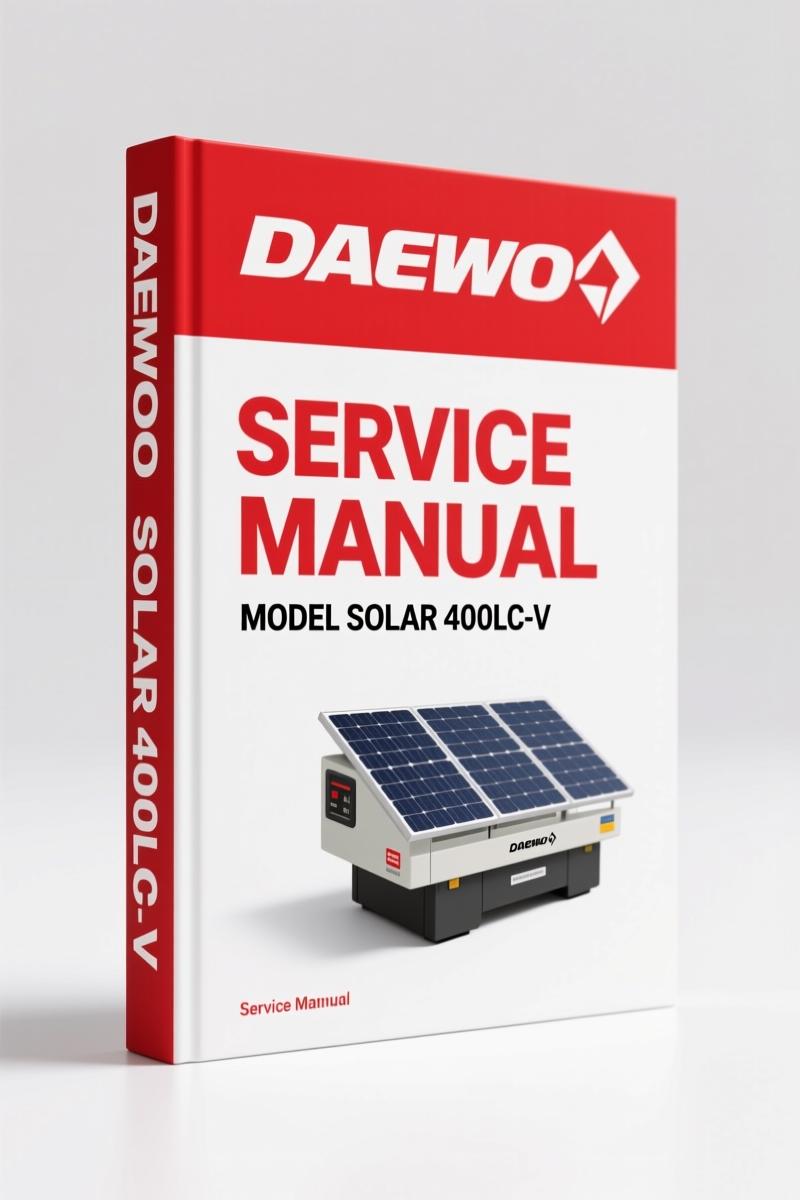
Daewoo Solar 400LC-V 1998 Operators Manual – OEM Factory Doc
Original price was: $15.61.$10.99Current price is: $10.99.
1998 Daewoo Solar 400LC-V Operators Manual. 175 pages. OEM safety, controls, maintenance intervals, troubleshooting. Factory documentation.
Description
Daewoo Solar 400LC-V 1998 Operators Manual
You bought a used Daewoo Solar 400LC-V from some auction, and now you’re staring at a control panel you don’t recognize. No manuals came with it. You’ve got 48,000 pounds of Korean iron sitting in your yard, and you need to know what each switch does before you fire it up and launch a track pin into the next county. I’ve been turning wrenches since before some of you were born, and I’ve seen what happens when operators skip the book. This Daewoo Solar 400LC-V 1998 Operators Manual is the one Daewoo printed for the factory. 175 pages, OEM, not some third-party reprint that guesses on hydraulic pressures. It’s what your machine shipped with when it left Ulsan in 1998. If you value your fingers and your hydraulic pump, you’ll park the machine and read through it before you touch a lever.
Safety Section: Where Most People Skip
Open page 1-1. Daewoo spells out exactly what they expect from the operator. General Safety Essentials on page 1-3, location of safety labels on page 1-4, and a full summary of precautions for lifting in digging mode on page 1-10. If you’re planning to lift pipe or concrete with that bucket, you need those rated lift capacity tables on page 1-26. That’s not optional – I’ve seen a machine tip because the operator thought “it felt fine.” The factory numbers are right there. Use them. The manual also covers work-site precautions and shipping/transportation. You want to load this thing onto a lowboy? Read section 1-25 first.
7 Maintenance Interval Tables
The Inspection, Maintenance and Adjustment section starts with the Table of Recommended Lubricants. Then it breaks down service by hours: 10-hour daily, 50-hour weekly, 150-hour, 250-hour monthly, 500-hour, 1000-hour, 2000-hour yearly, and 4000-hour biennial. Each interval tells you what to check and what to replace. Need to know track tension? There’s a procedure for that. Bucket shimming? Page reference in the TOC. Venting and priming the hydraulic system – if you don’t do it right after a filter change, you’ll cavitate the pumps and that’s a five-figure repair. The manual walks you through it.
Bolt and nut inspection is its own subsection. On a machine this size, a loose swing gear bolt can take out the whole rotating assembly. The manual gives you the sequence and the torque – but I’ll tell you right now, you need a torque wrench that reads in ft-lbs, not a cheater bar. Don’t guess.
Operating Controls: Are You Sure You Know That Switch?
Chapter 2 covers every lever, button, and panel in the cab. Component locations, operator’s area, instrument panel with all the warning lights, mode selection switches, heater and A/C control panel, stereo, seat adjustment, seat belt, ceiling cover, front windows, door side latch, and even the emergency glass breaking tool. If your machine has a cab, this section tells you where the breaker tool is stored so you can get out when the hydraulics pin you. The stereo wiring is in there too, but don’t mess with it until you’ve studied the electrical system schematic – that’s in the Troubleshooting section.
3 Common Failure Points Addressed
The troubleshooting chapter covers five systems: engine, hydraulic, swing, electrical, and travel. Each has a symptom table. For example, if the swing brake won’t release, the manual tells you to check the pilot pressure and the solenoid valve. It does not say “call a dealer.” It gives you a test procedure. Pair this manual with the Daewoo Solar 400LC-V 2000 Workshop Manual for deeper repair info – but for daily operation and preventive maintenance, this operators manual is what you need on the machine.
The specification section gives you the standard spec, working range, and probably the engine model (likely a Daewoo or Cummins – the manual will say). You need those numbers to order parts. Don’t rely on a serial number plate that’s been painted over four times.
Source Validity: Factory OEM, Not Aftermarket
Aftermarket manuals cut corners. They copy torque specs from a similar model, or they leave out the safety labels location. This one is printed by Daewoo in 1998, part number 2022-7168E. It covers serial number 0001 and up. If your machine falls in that range, this is the document. No generic diagrams, no “typical” values – these are the actual Daewoo measurements. I’ve used factory manuals for thirty years, and I can spot a knockoff from the font. This is the real thing. For transportation safety, see Daewoo Solar 400LC-V Operation and Maintenance Manual – Section: Transportation. For lifting with slings, reference the Daewoo Solar Track Excavator Safety Manual 2001 – Section: Lifting With Sling.
FAQ
- Does this manual include torque specs for the engine head bolts?
- No. This is an operators manual, not a service manual. It covers daily inspections, controls, and maintenance intervals. Head bolt torque specs belong in the workshop manual.
- Can I use this manual to rebuild the hydraulic pump?
- No. You need the service repair manual for that. What it does give you is the procedure for venting and priming the hydraulic system after a filter change, plus troubleshooting tables for common hydraulic faults like slow travel or weak swing. The pump rebuild itself requires disassembly specs, clearances, and shim measurements that aren’t in this operators manual. If you’re trying to rebuild a pump without that data, you’re wasting money on seals that will blow out in ten hours. Get the Daewoo Solar 400LC-V 2000 Workshop Manual for that job. The internal combustion engine basics are covered in general texts like Internal Combustion Engine on Wikipedia, but for Daewoo-specific clearances, stick with OEM. The manual transmission section in the troubleshooting chapter is minimal – this machine uses hydrostatic drive, not a manual gearbox, so references like Manual Transmission don’t apply. Focus on the hydraulic and travel system diagnostics instead.
If you operate or maintain a Daewoo Solar 400LC-V, you need this manual in the cab. Not on a tablet in the office – in the cab, so you can reference it when a warning light comes on at 6 AM. Access the Factory Manual now.
Additional information
| Brand | Daewoo |
|---|---|
| Language | English |
4 reviews for Daewoo Solar 400LC-V 1998 Operators Manual – OEM Factory Doc
You may also like…
-
Sale!
Daewoo Solar 130LC-V Workshop Manual – 558 Pages | OEM Factory Specs
Original price was: $102.70.$65.00Current price is: $65.00. -
Sale!
Daewoo Solar 250LC-V 2000 Workshop Manual – 567 Pages, OEM Specs
Original price was: $84.50.$65.00Current price is: $65.00. -
Sale!
Daewoo Solar 175LC-V 2003 Workshop Manual – 686 Pages OEM Spec
Original price was: $83.85.$65.00Current price is: $65.00. -
Sale!
Daewoo Solar 220LC-III Workshop Manual – 329 Pages Factory Specs
Original price was: $91.00.$65.00Current price is: $65.00.
Related products
-
Sale!

2011 Parts Catalog – International 7400 SFA 6X6 – 1886 Pages of OEM Part Numbers
Original price was: $32.00.$25.00Current price is: $25.00. -
Sale!

1995 Operators Manual – International 1000-4000 Series | OEM Documentation
Original price was: $12.49.$9.99Current price is: $9.99. -
Sale!

Technical Manual – International 6.0L Power Stroke FICM Diagnostics
Original price was: $29.80.$20.00Current price is: $20.00. -
Sale!
1992 Electrical Schematic – International 1000/3000/4000/2554 OEM Wiring Diagrams (132 Pages)
Original price was: $26.40.$20.00Current price is: $20.00.
Richard G. –
This is just what I was looking for. Quick access after payment. Every wiring layout is provided for Daewoo Solar. Great value for money.
David K. –
Excellent quality! The pages are clean and easy to navigate. A must-have for any Daewoo Solar owner doing maintenance. Saved my weekend project! Thanks.
Robert M. –
This is exactly what I was looking for. Immediate link after checkout. Every torque spec is included for Daewoo Solar. I will recommend this shop to others.
Michael T. –
This is exactly what I required. The PDF is high resolution. It guided me to rebuild my Daewoo Solar transmission. I will recommend this shop to others.