
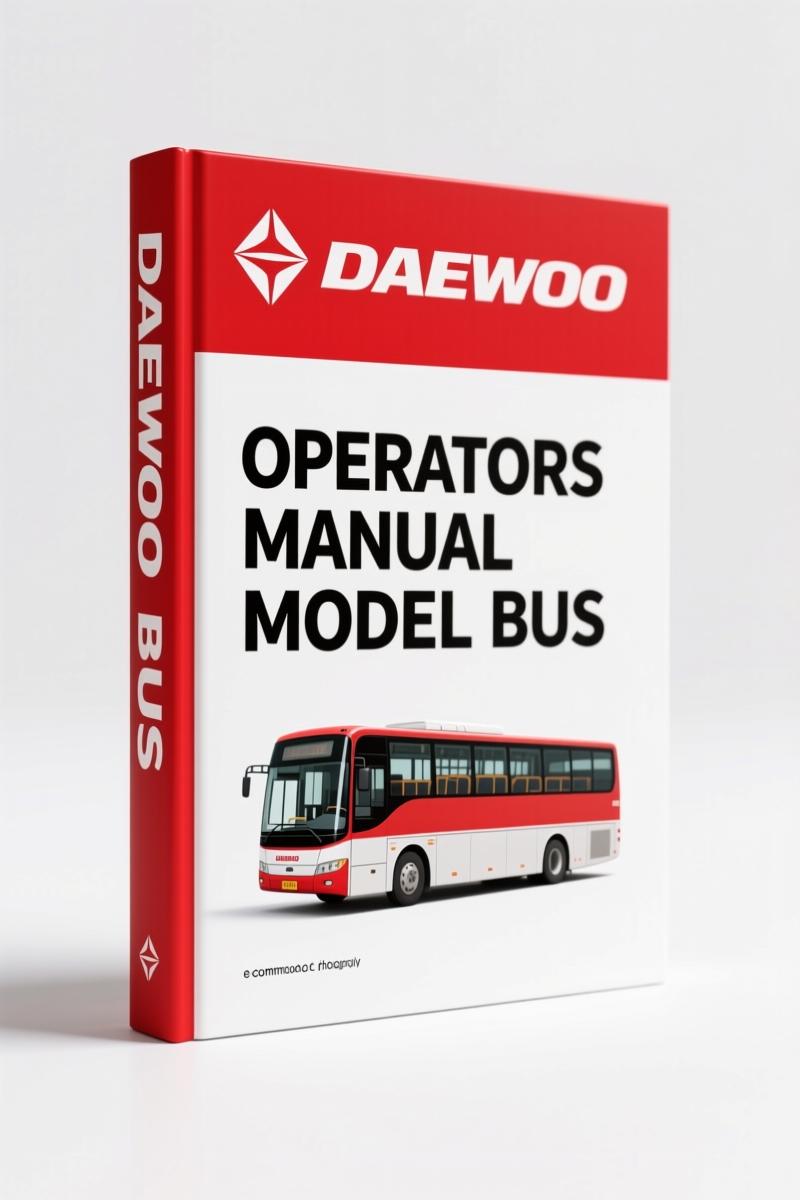
Daewoo BUS Operators Manual – Factory Maintenance and Fluid Specs
Original price was: $11.27.$7.99Current price is: $7.99.
191-page OEM Daewoo BUS Operators Manual: interval charts, fluid specs, troubleshooting – factory data for fleet maintenance.
Description
Daewoo BUS Operators Manual – Factory Specs for Real Work
You bought a Daewoo BUS because it’s built to run. But running it without the factory Daewoo BUS Operators Manual is like guessing the torque on a head bolt — you might get lucky, but you’ll pay for it later. I’ve seen too many fleet guys skip the break-in oil change because they figured “it’s fine.” Then they wonder why the D1146 spins a bearing at 50,000 km. This is 191 pages of OEM procedure, not some reprint from a third-party that misprints the valve clearance spec. You need the real thing.
What the Daewoo BUS Operators Manual Covers
Open the table of contents and you see eleven chapters that mirror exactly what a service manager would ask for. Chapter 1 is important information — read it. Chapter 2 covers operation and care of a new vehicle, including that critical first 1,000 km break-in. Chapter 3 is getting on and off, driver’s seat and belt — sounds simple until a driver gets hurt because the belt retractor wasn’t inspected. Chapter 4 is instruments, switches and controls. Chapter 5 is driving. Then chapter 6 jumps into inspection and maintenance, page 101 onward. That’s where the real meat lives: engine oil, fuel filters, valve clearance, air cleaner, transmission oil, rear axle oil, power steering oil and filter. Each one lists the factory interval in kilometers, not “every few months” like an aftermarket pamphlet. Page 2 of the manual states clearly that any failure from skipping these intervals voids warranty. You want to argue with that? I don’t.
Engine Oil and Filter: Factory Intervals You Cannot Ignore
For the D1146 and DE12 engines, change the oil at the end of the first 1,000 km, then every 15,000 km for high-speed/long-distance, or every 10,000 km for city/short-distance. The DE08TIS gets 30,000 km long-distance, 20,000 km short-distance. The oil filter goes with every oil change. That’s straight from page 102. The manual also specifies the fuel filter schedule: primary filter clean every 5,000 km, change every 15,000 km; secondary filter change every 5,000 km. DE08TIS and DE12 get a change every 20,000 km. If you’re running a fleet of Daewoo buses, this schedule keeps your injectors clean and your pumps alive. Ignore it and your fuel system becomes a parts-swapping exercise.
Does This Manual Cover the Fuel System?
It covers inspection and maintenance of the fuel system — filter replacement, water separator draining, and air bleeding procedures. But it’s not a full injection pump overhaul guide. For that you need the service manual. However, the troubleshooting chapter (Chapter 9, starting page 163) will walk you through symptoms like hard starting, low power, or excessive smoke. You get the factory diagnostic flow, not “check the fuel filter” generic advice. And it references the main data and specification chapter (page 172) for injection timing and pressure values. If you need charge pressure or injector opening pressure, that’s where you find it.
3 Critical Safety Points from Page 2
First, the manual is a permanent part of your vehicle — it must stay with the bus at resale. Second, any failure from not following the maintenance chart is not covered by warranty. Third, the manual includes “important safety information” in the foreword. That means things like proper jacking points, safe battery removal, and handling hot engine oil. Page 2 spells out that Daewoo Motor Co., Ltd. reserves the right to make changes without notice. That’s fine — your manual is the baseline for your specific build year. You don’t guess on safety when you have the factory document in hand.
Get the Right Torque Data – Not Aftermarket Guesswork
You see a fastener on a Daewoo BUS, you need the tightening torque. The main data and specification chapter on page 172 lists torque values for cylinder head bolts, main bearing cap bolts, connecting rod nuts, flywheel bolts, and more. The manual uses metric units, but you can convert to imperial if you’re working with inch-pound torque wrenches. I still recommend using a metric torque wrench on these Korean-built engines. The internal combustion engine and manual transmission are built to metric specs, and the factory manual is the only reliable source. Trusting a third-party website that says “tighten to 80 ft-lbs” when the spec is 98 N·m will cost you a gasket failure. Get it from the source.
Scheduled Maintenance Service: Why 191 Pages Matter
Chapter 8 covers scheduled maintenance service starting page 159. That’s the checklist your shop should post on the wall. Valve clearance adjustment at first 1,000 km and every 20,000 km thereafter. Transmission oil and rear axle oil change at first 5,000 km and every 20,000 km. Power steering filter change at first 1,000 km and every 24,000 km. These intervals are based on the OEM’s testing, not some general guideline. If you run a shop that works on Daewoo buses, you need this manual for every job that comes in. The 191 pages include body dimensions (Chapter 11) so you can verify panel gaps after body repairs. That’s OEM-level detail.
If you’re working on other Daewoo equipment, check the related operator manuals: Daewoo Solar 400LC-V 1998 Operators Manual – Factory Specs & Safety, Daewoo Solar S220LC-V 1998 Operators Manual – Factory Specs & Safety, and Daewoo Solar 420LC-V 2001 Operators Manual – 238 Pages. These follow the same factory format. For background on how internal combustion engines work, see Internal Combustion Engine. If you need to understand manual transmission operation, read Manual Transmission. But for this bus, stick to the Daewoo factory documentation.
- Can I use this manual for an engine overhaul?
- It covers inspection and maintenance, not full disassembly. You need the service manual for rebuild specs.
- Are the torque specs in imperial or metric units?
- The manual uses metric units (N·m) as factory spec. Chapter 10 on page 172 lists tightening torques for major components like cylinder head and main bearing. Always use the factory values – converting incorrectly leads to stripped threads or leaks. If your torque wrench reads ft-lbs, multiply N·m by 0.73756. But I tell my guys to get a good metric torque wrench and avoid the math.
Don’t let a missed oil change or wrong torque spec cost you an engine. Get the factory information. Access the Factory Manual.
Additional information
| Brand | Daewoo |
|---|---|
| Language | English |
2 reviews for Daewoo BUS Operators Manual – Factory Maintenance and Fluid Specs
You may also like…
-
Sale!
Daewoo Solar 250LC-V 2000 Workshop Manual – 567 Pages, OEM Specs
Original price was: $84.50.$65.00Current price is: $65.00. -
Sale!
Daewoo Solar 175LC-V 2003 Workshop Manual – 686 Pages OEM Spec
Original price was: $83.85.$65.00Current price is: $65.00. -
Sale!
Daewoo Solar 130LC-V Workshop Manual – 558 Pages | OEM Factory Specs
Original price was: $102.70.$65.00Current price is: $65.00. -
Sale!
Daewoo Solar 220LC-III Workshop Manual – 329 Pages Factory Specs
Original price was: $91.00.$65.00Current price is: $65.00.
Related products
-
Sale!

2011 Parts Catalog – International Truck OE Parts Documentation (1786 Pages)
Original price was: $34.50.$25.00Current price is: $25.00. -
Sale!

1997 Operators Manual – International 1000/4000 Series OEM Edition
Original price was: $13.49.$9.99Current price is: $9.99. -
Sale!
2004 Acura TSX Wiring Diagram – 73-Page Factory Electrical Schematics
Original price was: $15.88.$9.99Current price is: $9.99. -
Sale!
1993 Electrical Schematic – International 1000/3000/4000 Bus Chassis OEM Wiring Diagrams
Original price was: $29.26.$22.00Current price is: $22.00.
workshop_guy –
This is exactly what I required. The scan is high-quality and well indexed. Contains detailed bolt torque specs for Daewoo. I will definitely buy again.
pro_mechanic –
Perfect workshop guide. It is very easy to read on my phone without losing quality. Contains clear bolt torque specs for Daewoo. Saved my weekend project! Thanks.