
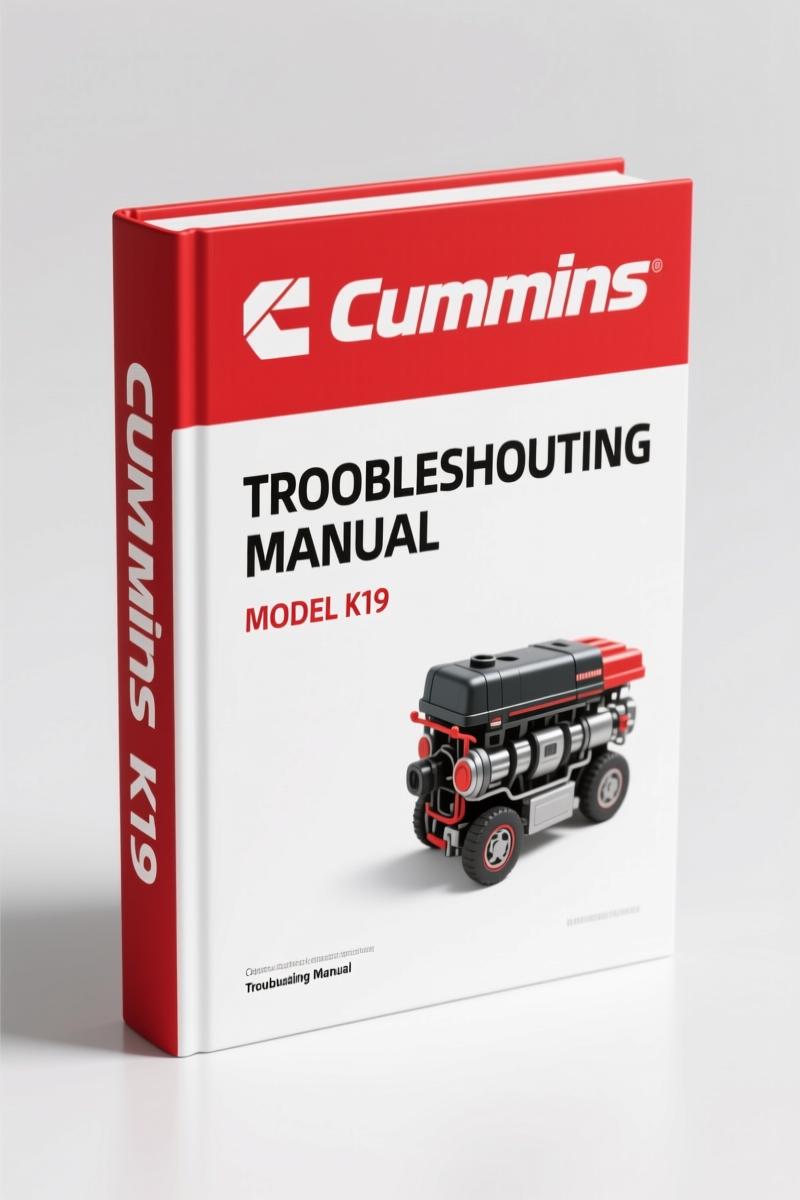
Cummins K19 1986 Troubleshooting Manual – Factory Diagnostics for K19 Engine
Original price was: $62.55.$45.00Current price is: $45.00.
Factory 1986 Cummins K19 troubleshooting manual: 713 pages of system-specific diagnostics, torque specs, and symptom charts for certified mechanics.
Description
Cummins K19 1986 Troubleshooting Manual
If you’ve ever wasted a Saturday chasing a low oil pressure fault on a K19 because some aftermarket PDF gave you the wrong spec, you know the difference between a factory manual and a reprint. I’ve torqued more head bolts than most people have had hot meals, and I can tell you that having the correct 1986 specifications for a Cummins K19 engine isn’t optional—it’s the only way to avoid pulling a head twice. This is the real thing: Cummins K19 1986 Troubleshooting Manual, 713 pages of OEM factory documentation.
That’s not a photocopy or a compiled-from-three-sources mess. Cummins printed this in 1986, Bulletin No. 3810307-00. The manual was designed for field technicians who needed to diagnose an engine in the chassis without pulling it. Section T alone is 30+ symptoms from “Coolant Temperature Above Normal” to “Turbocharger Noise,” each with cause-and-correction charts. You get the actual troubleshooting flow, not a guess.
3 Reasons to Choose the Factory Manual Over Aftermarket
First, accuracy of torque specs. Aftermarket manuals often round values or use metric approximations that don’t match the original SAE fasteners. This manual gives you the exact numbers. Second, the wiring diagrams in Section 06 are taken from the actual production harness drawings—not redrawn by an intern. Third, the cleaning procedures in Section I specify solvents, steam temps, and bead media that work with the K19’s materials. One wrong solvent on a copper gasket and you’re buying a new one.
I’ve seen too many engines come back with blown head gaskets because someone used a generic torque sequence. Factory manual eliminates that risk.
You’ll find the general engine specifications on page E-3. That includes bore, stroke, displacement, firing order, and the all-important air induction system data. Need the turbocharger boost pressure spec for a 1986 K19? It’s in the General Specifications table. No extrapolation required.
Section T – Troubleshooting: What the Charts Actually Cover
The troubleshooting section (page T-1) starts with procedures and techniques—how to isolate a problem without swapping parts. Then the alphabetical symptom list guides you to the right chart. Want to diagnose “Engine Cranks But Will Not Start (No Smoke From Exhaust)”? That’s right there. The manual treats each symptom with a logic tree: check fuel supply, then injection timing, then compression. No jumping to conclusions. For a genset application, there’s a specific sub-section under “Engine Power Output Low” that addresses alternator load interaction. Marine and construction variants get their own callouts too.
That level of application-specific detail is what separates a factory manual from a generic one. You can’t get that from a third-party book.
Cooling System Diagnostics: More Than Just Hoses
Section 01 (Cooling System) runs from 01-1 through 01-something. It covers everything from coolant filter replacement (01-08) to fan clutch operation check (01-24). The flow charts in 01-03 show the actual coolant path through the engine block, head, and radiator—critical when you’re chasing a hot spot. There’s a specific test for air or combustion gases in the coolant (01-11). If you skip that step, you might miss a cracked cylinder liner. The manual includes the recommended Diesel Coolant Additives DCA4 concentration, not a generic “add until the bottle is empty.”
Does This Manual Cover the PT Fuel System?
Yes. Section 05 covers the fuel system, including the PT (pressure-time) injection pump. The troubleshooting charts in Section T list “Fuel Consumption Excessive” and “Throttle Response Slow” with step-by-step checks on the PT pump timing and pressure regulator. You also get the fuel pump datapate identification and the correct fuel system electrical wiring for the 1986 model year. If you’re working on a K19 with a manual transmission, the manual references how to handle the driveline interaction during engine diagnostics. Check the related manual Manual Transmission if you need deeper coverage on the gearbox side. For the engine itself, everything you need is here.
Cummins designed the K19 as an industrial workhorse. The troubleshooting manual reflects that—no fluff, no filler. Every page has a purpose.
What You Won’t Find in Aftermarket Reprints
The OEM manual includes the “Definition of Terms” section (I-1), which standardizes phrases like “hand tight,” “finger tight,” and “lightly oiled.” Aftermarket manuals often skip that, leaving you to guess what the author meant. Also, the general repair instructions in Section I specify tool requirements: which pullers, which torches, which thread-lock compounds. The manual even tells you how to clean parts properly—solvent and acid cleaning versus steam versus glass bead (page I-something). That matters when you’re dealing with K19 aluminum components that can be damaged by caustic cleaners.
Another thing: the “Alternative Repair” and “Specifications” manuals are listed in the Additional Service Literature (Section 12). This manual is the troubleshooting companion. If you need the full shop rebuild procedures, look for the Cummins K19 1995 Troubleshooting and Repair Manual which covers later updates. For marine applications, the Cummins Marine Engine Handbook is a good supplement. And if you’re working on the smaller 8.3 or 9 liter engines, the Cummins 8.3 Liter, 9 Liter Troubleshooting Manual – OEM Factory Specs has that platform covered.
FAQ
- Is this manual the same as the one used by Cummins dealers?
- It’s the exact same digital file that Cummins distributed to its dealer network in 1986. No modifications, no omitted pages. 713 pages.
- Does it include wiring diagrams for the electrical system?
- Yes. Section 06 covers the electrical system with schematic diagrams for the alternator, starter, and engine control circuits. The troubleshooting charts also reference electrical tests for no-crank conditions.
- Can I use this for a K19 built after 1986?
- Some specs changed after 1986—for example, injection pump timing and some cooling system updates. If you have a 1995 K19, get the 1995 manual. For 1986-1989 engines, this manual matches.
- How do I get the torque values for cylinder head bolts?
- They are listed in the Engine Component Specifications table in Section 10, along with the tightening sequence diagram. Use the correct angle or torque-to-yield method specified.
If you’re serious about keeping a K19 running without guesswork, this is the manual you need. Access the Factory Manual now, and have the actual specs on your device before you touch a wrench. Your engine—and your wallet—will thank you.
Additional information
| Brand | Cummins |
|---|---|
| Language | English |
2 reviews for Cummins K19 1986 Troubleshooting Manual – Factory Diagnostics for K19 Engine
You may also like…
-
Sale!
Cummins ISB, ISBe2, ISBe3, ISBe4, QSB4.5 Troubleshooting Manual
Original price was: $92.30.$65.00Current price is: $65.00. -
Sale!
Cummins NT 855 Service Manual – 693 Pages of OEM Repair Data for Big Cam III & IV
Original price was: $104.00.$65.00Current price is: $65.00. -
Sale!
Cummins 495, 743, 855, V-1710, KT-1150 Service Manual – 143 Pages
Original price was: $89.70.$65.00Current price is: $65.00. -
Sale!
Cummins QSB6.7, ISL, ISC, ISB, QSB4.5 2014 Repair Manual – 810 Pages
Original price was: $109.20.$70.00Current price is: $70.00.
Related products
-
Sale!

2006 Service Manual – International DT 466E, 530E Diesel Engine
Original price was: $67.50.$50.00Current price is: $50.00. -
Sale!

1992 Electrical Schematic – International 1000/3000/4000/2554 OEM Wiring Diagrams (132 Pages)
Original price was: $26.40.$20.00Current price is: $20.00. -
Sale!
1991 Electrical Schematic – 112-Page OEM Wiring Diagram for International 1000-3000 Series
Original price was: $22.75.$17.50Current price is: $17.50. -
Sale!
Acura NSX 1991 Service Manual – 1420 Pages OEM
Original price was: $102.05.$65.00Current price is: $65.00.
David K. –
This is just what I needed. The scan is high-quality and easy to navigate. Every spec sheet is included for Cummins K19. Highly recommended for mechanics.
pro_mechanic –
Five stars! The document looks clean. Every spec sheet is provided for Cummins K19. Saves me a lot of time.