
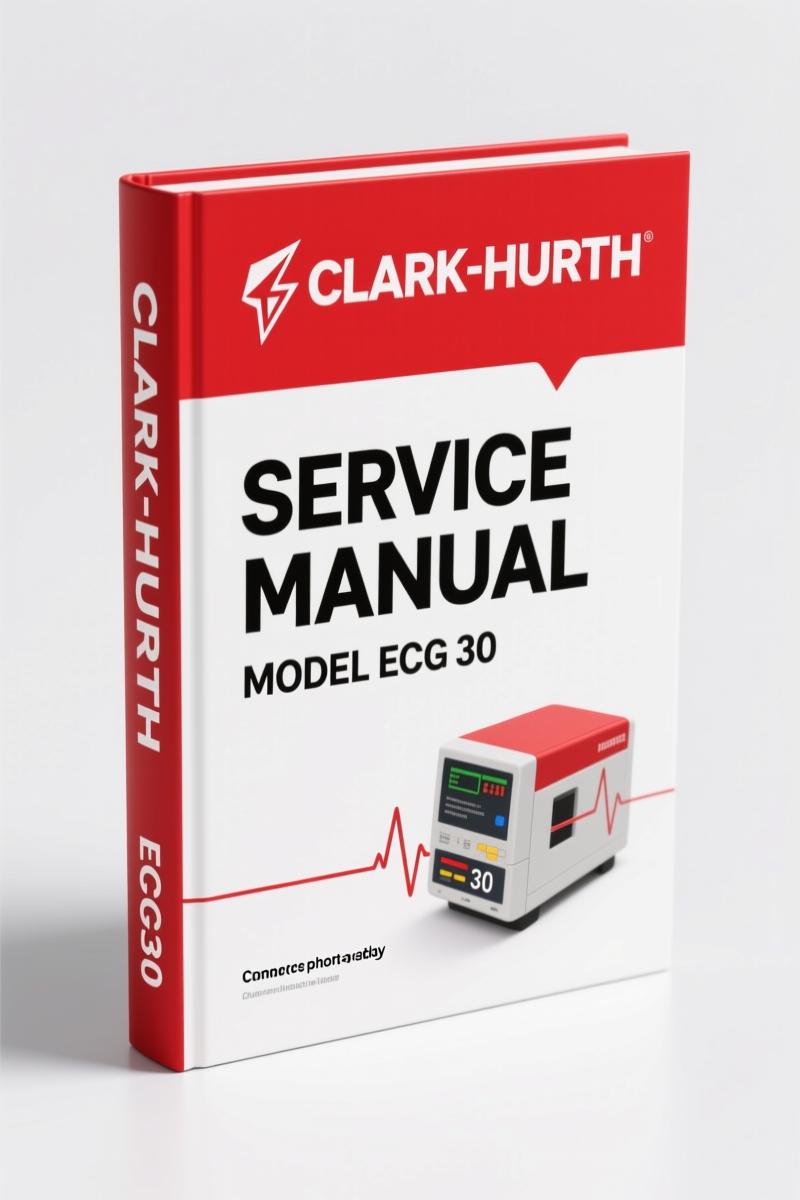
Clark-hurth ECG 20, ECG 30 1996 Service Manual – 443 Pages OEM Factory Data
Original price was: $59.20.$40.00Current price is: $40.00.
443-page OEM service manual for Clark-hurth ECG 20 and ECG 30 (1996). Covers safe maintenance, electrical motors, battery tests, and periodic service.
Description
Clark-hurth ECG 20, ECG 30 1996 Service Manual
You’ve got a Clark-Hurth ECG 20 or ECG 30 on your shop floor, and the customer is watching the clock. The last thing you need is a generic aftermarket procedure that skips critical torque specs or leaves out the lock-out steps. I’ve seen guys chain an upright wrong because the reprint manual they bought off some forum said “support as necessary.” That gets a forklift off the stands and into a tech. This 1996 original factory service manual – 443 pages of what Clark-Hurth wrote for its own dealers – is the only document that tells you exactly how to lift, block, and service that Genesis series truck without bending something or breaking yourself.
Safe Maintenance – 3 Chapters That Keep You Alive
The manual opens with SA Safe Maintenance, and they mean it. Section SA-01 covers safety signs, general shop precautions, and the exact procedure for chaining the upright in a raised position (SA-02). Page 2 shows you the group numbering system – each page ID tells you Group-Section-Page, so when I tell you “see SA-02-3,” you flip right to it. No flipping through a PDF that has no bookmarks. The factory included a full towing procedure (SA-03) with weight limits and hitch points. If you’re working on these trucks, you need those numbers.
Periodic Service – The PM Inspection Form You Actually Use
Section PS-02 gives you a step-by-step Planned Maintenance procedure that starts with a visual inspection, operational checks, and a test drive with a load. They list the exact intervals for hydraulic fluid and filter change, drive axle fluid change, and critical fastener torque checks. The manual includes a blank PM Inspection Form in PS-03 that you can photocopy. That form is worth the price of the whole book – it forces you to check the battery compartment, motor transistor controls, and hydraulic compartment in a specific order. Miss one step and you’re chasing an intermittent fault that came from a loose fastener.
Battery – Get More Than 3 Years Out of Yours
Section 12 covers battery handling, removal, and maintenance. They tell you how to clean battery vents, what electrolyte level to maintain, and how to charge without cooking the plates. There’s a whole sub-section on battery tests (12-02) that includes the equipment you need – a 500-volt Megger, not a cheap multimeter. If you’ve ever replaced a battery prematurely because someone told you it was “bad,” you’ll appreciate the test procedures here. They also include records keeping forms to track charge cycles.
Electrical Switches – Foot Brake, Lift, Forward/Reverse Adjustments
Sections 13-01 through 13-04 give you the exact adjustment procedures for the foot brake switch, parking brake switch, lift and tilt pump switches, forward/reverse switches, and accelerator control. Each one starts with a safety warning. The accelerator control description includes adjustments and maintenance – not just “adjust to spec.” They tell you what the spec is and how to measure it with a feeler gauge or a dial indicator. No guesswork.
Drive Motor Overhaul – What the Group ID System Tells You
Section 16 covers the drive motor, hydraulic pump motor, and steering pump motor. The drive motor removal and installation procedure includes disassembly, component inspection, troubleshooting, and assembly. They give you a brush inspection chart so you can eyeball commutator wear and know when to replace versus turn the armature. The steering pump motor section (16-04) includes troubleshooting prior to disassembly – that’s the step that saves you from pulling a perfectly good motor. Clark-Hurth provided pump motor specifications with winding resistance and brush length limits. You won’t find those in a aftermarket CD-ROM that was scanned from a faded photocopy.
Why Factory OEM Specs Beat Aftermarket Copies
This is an original Clark-Hurth dealer-only manual, copyright 1996. The PDF came from a dealer’s file, not a third-party reprint. The CLARK logo and “Intended for CLARK dealers only” notice on page 1 tell you this is the real thing. Aftermarket manuals often omit the Critical Fastener Torque Checks section or merge it with generic values. Here, every torque is specific to the ECG 20 and ECG 30 – wheel lug nuts, upright mounting bolts, drive motor fasteners. If you’ve ever had a leak because the aftermarket manual said “50 ft-lb” and the real spec was “85 ft-lb,” you know why this matters.
For other models, check out Spicer Clark-hurth HR Service Manual – Factory Specs for Heavy-Duty Transmission and Clark-hurth 55A SERIES II Service Manual – 136 Pages of Factory Specs and Clark-hurth SM-715, TMX12-25, EPX16-20s 2007 Service Manual – 502 Page OEM Facto. For a deep dive into Manual Transmission theory or Manual Transmission design, Wikipedia has the basics – but for field service specs, stick with the factory binder.
- Does this manual cover the ECG 32?
- The base module covers ECG 20-30 models. The manual says it includes a base module for ECG 20-30 and other modules for specific models. If you have an ECG 32, you need the module for that specific model. This PDF contains the base module only.
- What torque values are listed?
- Torque values appear throughout – wheel lug nuts, upright mounting bolts, drive motor fasteners, hydraulic fitting torque. They are scattered per procedure, not in a single table. The PM section (PS-02) includes critical fastener torque checks.
- Can I use a Simpson 260 instead of a Megger?
- Yes. Section 16-01 explains using a Simpson 260-6p volt-ohmmeter calibrated on the R x 10,000 scale for insulation resistance tests. The manual gives both methods – Megger and Simpson – so you can use what you have.
- How do I lift the ECG 30 without damaging the upright?
- Section SA-02 covers lifting, jacking, and blocking. It includes chaining the upright in raised position, raising drive wheels, and raising the entire truck. Follow the exact blocking sequence in SA-02-2 to avoid bending the upright channels.
If you need to get this ECG 20 or ECG 30 back in service without burning billable hours on guesswork, access the factory manual. It’s 443 pages of Clark-Hurth engineering, not a third-party rehash. Get the PDF, print the PM form, and torque every fastener to the number the factory put on the page.
Additional information
| Brand | Clark-hurth |
|---|---|
| Language | English |
2 reviews for Clark-hurth ECG 20, ECG 30 1996 Service Manual – 443 Pages OEM Factory Data
You may also like…
-
Sale!
Clark-hurth C15-33, C15-32C 2005 Service Manual – 1006 Pages of OEM Specs
Original price was: $89.05.$65.00Current price is: $65.00. -
Sale!
Clark-hurth 292, 292B 1990 Parts Catalog – OEM Parts Data
Original price was: $92.25.$75.00Current price is: $75.00. -
Sale!
Clark-hurth 280IIIA 1978 Parts Catalog – Factory Parts Manual
Original price was: $108.00.$75.00Current price is: $75.00. -
Sale!
Clark-hurth 55R, 55AWS 1965 Parts Catalog – Factory Parts Manual for Tractor Shovels
Original price was: $103.50.$75.00Current price is: $75.00.
Related products
-
Sale!

1996 Operators Manual – International 1000-4000 Series (246 pages)
Original price was: $15.28.$9.99Current price is: $9.99. -
Sale!

Service Manual – International HS 2.8L Engine – 130 Pages of Factory Specs
Original price was: $56.40.$40.00Current price is: $40.00. -
Sale!
2004 Acura TSX Wiring Diagram – 73-Page Factory Electrical Schematics
Original price was: $15.88.$9.99Current price is: $9.99. -
Sale!

Acura Integra 1998 Service Manual – 1891 Pages Factory OEM Documentation
Original price was: $31.75.$25.00Current price is: $25.00.
Michael T. –
Great buy! Quick access after checkout. It guided me to repair my Clark-hurth ECG transmission. Saves me hundreds of dollars.
Charles W. –
I am very pleased with this manual. The document is very clear. Every torque spec is provided for Clark-hurth ECG. I will recommend this shop to others.