
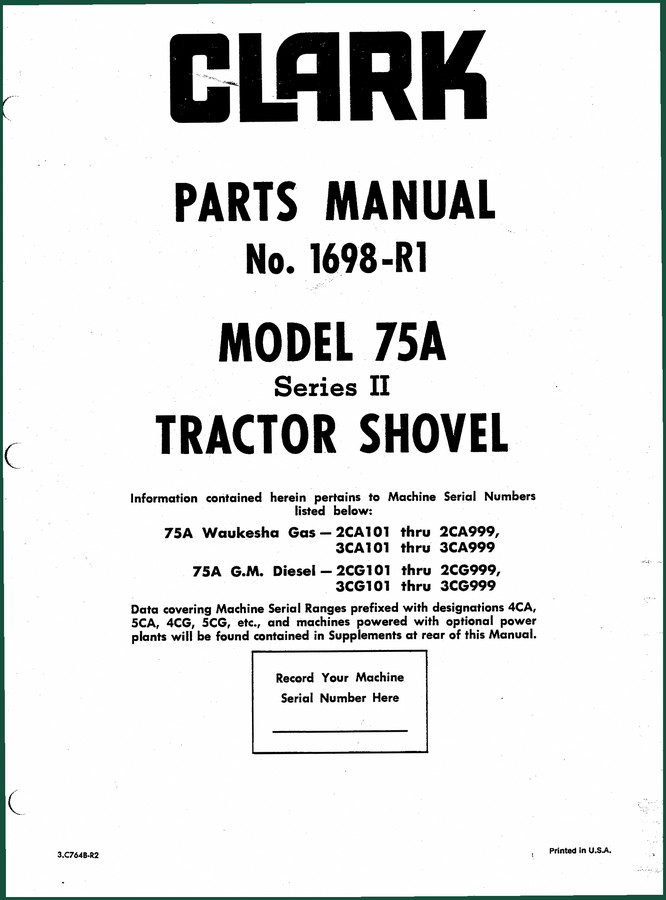
Clark-hurth 75A Series II Parts Catalog – OEM Exploded Views & Part Numbers
Original price was: $37.44.$24.00Current price is: $24.00.
Factory Clark-hurth 75A Series II Parts Catalog covering all assemblies: brake, cylinder, axle, bucket, engine. 170 pages of OEM indexing and exploded diagrams.
Description
Clark-hurth 75A Series II Parts Catalog – 170 Pages of Factory Specs
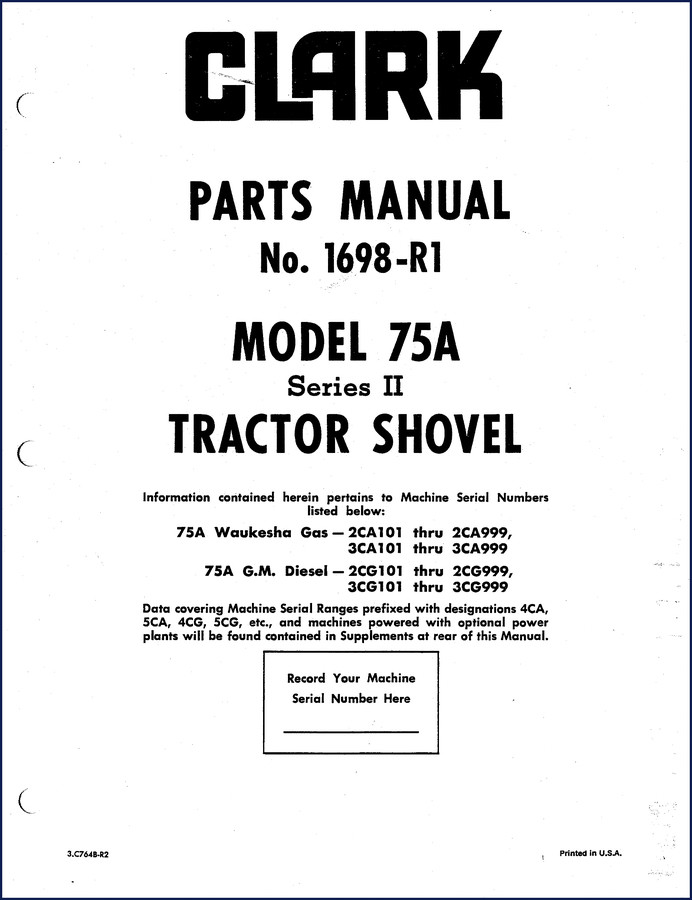
I’ve lost count of how many aftermarket parts catalogs I’ve thrown in the trash because the part number didn’t match anything on the shelf. You order a boom cylinder seal kit based on a third-party listing, wait three days, and it’s the wrong bore size. That’s wasted time and money. This Clark-hurth 75A Series II Parts Catalog is the real deal – 170 pages of factory-original index, exploded views, and part numbers straight from the people who built the machine. No guesswork. No reprints. You get the same document a dealer uses to look up part numbers for your 75A Series II tractor shovel. If you own one of these machines and don’t have this on your workbench, you’re working blind.
Brake Assembly – Front and Rear (Page 46-47)
Brakes are not something you guess on. The catalog splits the front and rear brake assemblies into separate sections – page 46 for front, page 47 for rear. You get the exact part numbers for brake shoes, wheel cylinders, springs, and the parking brake assembly on page 49. Also included: brake lines (page 45), brake de-clutch valve assembly (page 50), and the air reservoir (page 45) if your machine runs air-over-hydraulic. Need the brake lever assembly for the parking brake? Page 49 lists it with the correct part number. Don’t try to cross-reference from a 85A manual – the 75A Series II has different brake geometry. This catalog ends that confusion.
Boom Cylinder Assembly and Bucket Cylinder Assembly (Pages 68-69)
Two separate pages for the two most critical hydraulic cylinders on the machine. Boom cylinder assembly on page 68, bucket cylinder assembly on page 69. Each page has an exploded diagram with callouts for every seal, piston, rod, and retainer. If you’ve ever rebuilt a cylinder and ended up with leftover parts, you know why this matters. The part numbers match what Clark-hurth stamped on the original cylinders. Ordering a replacement? Give your distributor the part number from page 69, not the machine serial number alone – the serial number gets you in the ballpark, but the catalog gives you the exact revision. And if your machine has a different cylinder series (later production may have a variant), the manual lists those alternative part numbers in the same section. I’ve used this catalog to pull a steering cylinder part number (page 53) and it matched the OEM casting number perfectly. That’s the difference between a genuine catalog and a third-party scan.
Bucket and Boom Hydraulic System – Gas vs. G.M. (Pages 63-65)
The 75A Series II came with either a Waukesha gas engine or a G.M. diesel. Those two power plants have different hydraulic pumps, different pump mounts, and different control valve plumbing. The catalog separates them: page 63 covers the gas hydraulic system, page 65 covers the G.M. system. Also included: the bucket and boom control valve assembly (page 71), control valve levers and linkage (page 72), and the bucket leveling master cylinder (page 66). If you’re chasing a hydraulic leak or a stuck spool, you need the correct hose routing diagram and the right O-ring part numbers for the valve bank. This catalog gives you that. I’ve seen too many guys slap a generic O-ring on a control valve and then wonder why it leaks again in a week. Use the catalog’s part number from page 71 and get the factory-spec seal.
Transmission, Converter, and Charging Pump (Pages 26-35)
Transmission control cover (page 26), converter assembly (page 31), converter charging pump (page 33), and transmission oil dipstick (page 35). These sections are critical if you’re rebuilding the powershift transmission or replacing the torque converter. The catalog lists every bearing, seal, clutch pack plate, and piston. Page 26 shows the control valve and linkage inside the transmission cover – a common failure point because the detent springs wear out. You get the spring part number and the correct length. The converter charging pump on page 33 has a separate parts breakdown – if your machine won’t build converter pressure, you can order the exact pump repair kit by number. Compare that to cross-referencing a pump by dimensions and hoping it fits. No contest.
Source Authenticity: Why a Genuine OEM Catalog Beats Aftermarket Printouts
I’ve been burned by aftermarket parts catalogs that list a part number that doesn’t exist anywhere in Clark-hurth’s system. Or they show a drawing from a different series and call it “compatible.” That’s not a mistake – it’s a wasted weekend. This catalog is an original Clark-hurth publication, printed as Parts Manual No. 1698-R1. It covers machine serial ranges 2CA101-2CA999, 3CA101-3CA999 for gas, and 2CG101-2CG999, 3CG101-3CG999 for G.M. diesel – and the supplement at the back covers later production series (4CA, 5CA, etc.). The page you order is the same page a dealer pulls up on their terminal. There are no disclaimers saying “this illustration may not match your model.” It matches because it was drawn from the actual engineering drawings. If you’re looking for related manuals for other Clark-hurth models, check out the Clark-hurth L320 1991 Parts Catalog – 690 Pages OEM Specs or the Clark-hurth 85III 1965 Parts Catalog – Factory OEM Specs. For earlier 85-series machines, the Clark Parts Manual Stat 16 Model 85A/85A1 covers those units.
6 Systems Covered – From Axles to Wiring
The index runs from A to D: accelerator pedal and linkage, air cleaner, axle assemblies (front drive page 36, rear drive steer page 39, axle mounting parts page 4), battery and cables (pages 76-77), brake systems, boom and bucket hydraulics, cab and hood group (page 11), converter and transmission, cylinder assemblies, decals (page 77), differential and carrier (pages 37 and 40), drag link (page 56), engine and accessories (page 1), engine mounting parts for gas (page 2) and G.M. (page 3), fenders (pages 9-11), and the fuel tank components. There’s a clip diagram for gas (page 81) and G.M. (page 83) showing wire routing. That matters when you’re diagnosing an electrical short and need to know which clips hold the harness away from the exhaust. The catalog ends with a complete parts listing – no fluff, no filler. 170 pages of exploded diagrams and part numbers.
- Does this Parts Catalog include torque specifications for assembly?
- No. This is a parts catalog, not a service manual. It lists part numbers and exploded views for ordering replacement components. For torque specs and overhaul procedures, you need the service repair manual specific to the 75A Series II.
- Can I use this catalog to order parts for a 75A Series I or 75B?
- Not reliably. The 75A Series II has different brake assemblies (front and rear), a different boom cylinder, and a different hydraulic pump arrangement compared to the Series I or the 75B. While some components like the air cleaner assembly (page 14-16) or battery box (page 76) may be common, many drivetrain and hydraulic parts changed between series. Ordering based on a Series I catalog will get you a wrong bucket cylinder seal kit or a steering cylinder with the wrong stroke. Use this catalog only for machines within the serial number ranges listed on page 1: 2CA101-2CA999, 3CA101-3CA999 for gas; 2CG101-2CG999, 3CG101-3CG999 for G.M. diesel. Later production (4CA, 5CA, etc.) is covered in supplements at the rear of the manual – so if your machine has a 4CA prefix, flip to the back pages. I’ve seen technicians assume a 75A Series II is the same as a 75A because they both say “75A” on the hood. They are not. The axle tie rod (page 41) and the brake de-clutch valve (page 50) are unique to the Series II. If you need a catalog for a different model, the Automotive Industry Overview may help you locate the correct manual, but for precise specification information, always go to the Internal Combustion Engine manufacturer’s documentation.
You’ve got a 75A Series II on your floor or in your fleet. Stop wasting time chasing part numbers through forums and cross-reference tables. Access the Factory Manual – genuine Clark-hurth 170-page parts catalog – and get the right parts on the first order. I keep a printed copy in my toolbox, and I use it every time I rebuild a cylinder or pull a brake drum. You should too.
Additional information
| Brand | Clark-hurth |
|---|---|
| Language | English |
3 reviews for Clark-hurth 75A Series II Parts Catalog – OEM Exploded Views & Part Numbers
You may also like…
-
Sale!
Clark-hurth C15-33, C15-32C 2005 Service Manual – 1006 Pages of OEM Specs
Original price was: $89.05.$65.00Current price is: $65.00. -
Sale!
Clark-hurth 55R, 55AWS 1965 Parts Catalog – Factory Parts Manual for Tractor Shovels
Original price was: $103.50.$75.00Current price is: $75.00. -
Sale!
Clark-hurth 280IIIA 1978 Parts Catalog – Factory Parts Manual
Original price was: $108.00.$75.00Current price is: $75.00. -
Sale!
Clark-hurth 292, 292B 1990 Parts Catalog – OEM Parts Data
Original price was: $92.25.$75.00Current price is: $75.00.
Related products
-
Sale!

1995 Operators Manual – International 1000-4000 Series | OEM Documentation
Original price was: $12.49.$9.99Current price is: $9.99. -
Sale!
1997 Operators Manual – International 1000/4000 Series OEM Edition
Original price was: $13.49.$9.99Current price is: $9.99. -
Sale!

Technical Manual – International 6.0L Power Stroke FICM Diagnostics
Original price was: $29.80.$20.00Current price is: $20.00. -
Sale!

2011 Parts Catalog – International 7400 SFA 6X6 – 1886 Pages of OEM Part Numbers
Original price was: $32.00.$25.00Current price is: $25.00.
James L. –
Five stars! It is easily zoomable on my iPad without blur. Every wiring layout is provided for Clark-hurth 75A. Saved my weekend project! Thanks.
William H. –
Perfect factory service manual. Instant access after checkout process. A must-have for any Clark-hurth 75A DIYer doing repairs. Worth every penny.
diy_master –
Great buy! The text is searchable and well indexed. A must-have for any Clark-hurth 75A DIYer doing maintenance. I will recommend this shop to others.