
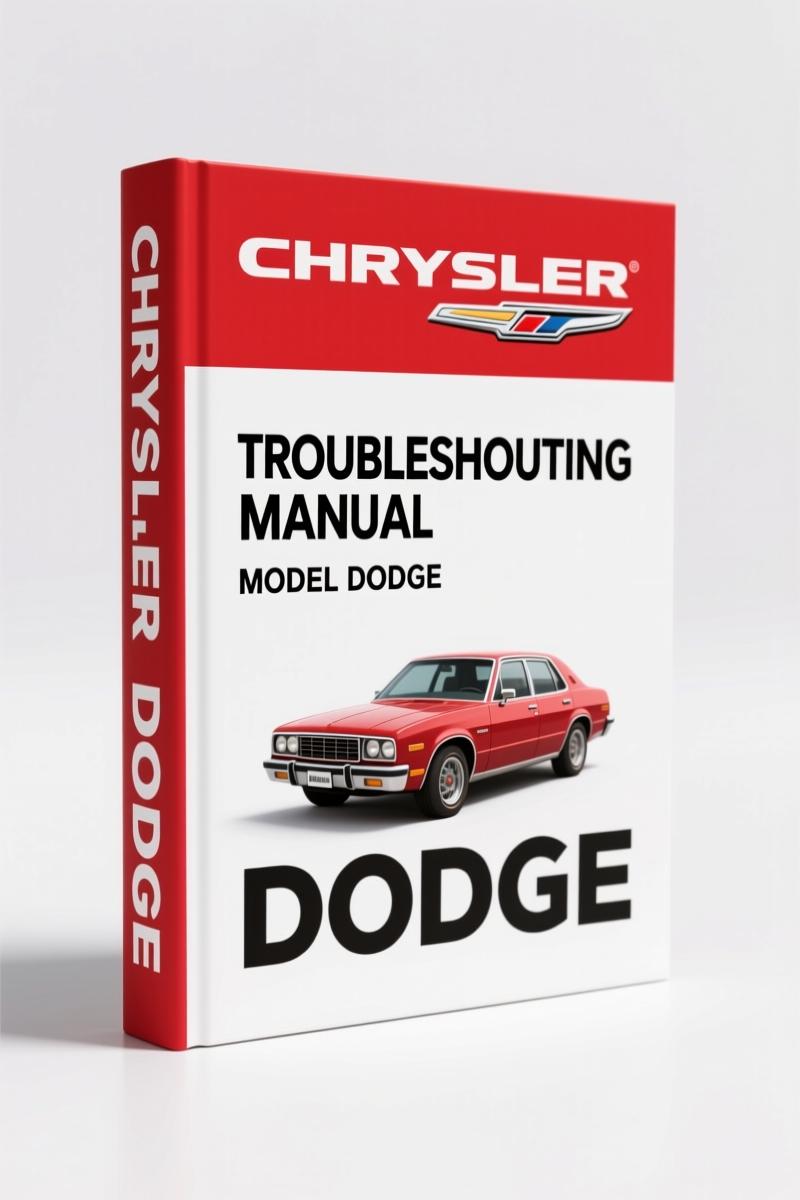
Chrysler Plymouth Dodge Imperial Troubleshooting Manual – Factory Electrical Diagnostics
Original price was: $17.75.$11.99Current price is: $11.99.
16-page factory troubleshooting manual covering electrical diagnostics for Chrysler, Plymouth, Dodge, Imperial. Test light, jumper, meter usage.
Description
Chrysler Plymouth, Dodge, Imperial Troubleshooting Manual – 16 Pages of Factory Electrical Diagnostics
You’ve got a dead short somewhere, the dome light stays on and the battery drains overnight. You grab a test light and start poking. That’s how electrical work gets done wrong, and why you end up chasing ground faults for two hours. I’ve seen shop kids burn through a dozen fuses because they didn’t understand how a simple jumper works. This Chrysler Plymouth, Dodge, Imperial Troubleshooting Manual is the same 16-page booklet Chrysler handed out to dealer techs in the 1970s. It teaches the right way to use test lights, jumpers, and meters so you stop guessing and start fixing.
These are not generic wiring diagrams pulled from a third-party database. This is OEM material from Chrysler Motors Corporation—the exact same reference used by Master Technicians Service Conference. That matters when you’re diagnosing electrical gremlins on a Plymouth Fury or a Dodge Coronet. Aftermarket manuals skip the theory and just give you a schematic. This one explains why your test light glows dim when you probe a high-resistance circuit, and what that tells you about the ground path. Page 2 has more usable troubleshooting tactics than most modern textbooks.
Test Light and Jumper Tactics
Chapter two is called “Test Light Troubleshooting Tactics”. Chrysler didn’t call it a chapter, they called it a tactic, because this is battlefield-level diagnostics for dealership mechanics. You’ll learn how to differentiate between an open circuit, a wire-to-wire short, and a wire-to-ground short using nothing but a 12-volt test light. Page 2 covers the method for isolating a short without blowing fuses. Then section three, “A Jumper Is a Test Tool, Too”, shows you how to bypass switches and relays safely—without backfeeding voltage into the control module. I’ve seen guys fry a brand-new ECU because they jumped the wrong terminal. Those mistakes don’t happen when you follow factory procedure.
Don’t treat a jumper wire like a get-out-of-jail-free card. Chrysler dedicates an entire section to jumper discipline: how to fuse the jumper, where to connect the ground side, and when to walk away and grab a meter instead. That level of detail keeps you from becoming a statistic.
Battery Testing Basics: Don’t Skip the Foundation
Section five, “Battery Testing Basics”, is the part most backyard mechanics ignore. You cannot troubleshoot an electrical system on a weak battery. The manual explains how to perform a proper load test using a hydrometer and a voltmeter. It tells you the difference between a sulfated cell and a shorted cell, and what those readings look like on your meter. If you’ve ever replaced an alternator only to find the real problem was a dying battery, you know what I mean. Page 11 covers battery capacity checks and surface charge removal—stuff that’ll save you from throwing parts at a problem.
Understand Your Electrical Measuring Instruments
Section four covers voltmeters, ammeters, and ohmmeters. Chrysler’s approach is practical: they show you how to measure voltage drop across a corroded connector without guessing. They teach you to use an ohmmeter to find a short in a harness that’s buried behind the dash. Most aftermarket manuals give you a formula and a diagram. This one gives you the scenario: “The headlights dim when you hit the brake. Which meter do you grab?” Then it walks you through the diagnosis step by step. That hands-on thinking is why experienced techs still go back to these old factory booklets.
3 Tools You Need Before You Touch a Wire
Before you open the manual, make sure you own these three: a 12-volt test light with a sharp probe, a fused jumper wire (at least 18-gauge with a 10-amp inline fuse), and a digital multimeter capable of reading DC volts, ohms, and millivolts. The manual assumes you have access to a hydrometer too—old-school tools still beat scan tools for battery health. If you’re working on a 1970s Chrysler product, that’s your reality. No CAN bus, no OBD codes. You need test lights and a solid understanding of circuit theory. This manual gives you both.
What Makes This Chrysler Manual Different?
It’s the source. This is not a re-keyed PDF from some online aggregator. It’s a direct scan of the original Master Technicians Service Conference reference book used in Chrysler, Plymouth, Dodge, and Imperial dealerships. The content was written by Chrysler engineers and taught to factory-trained mechanics. You get the same instruction they got: Electrical Circuit Troubleshooting (Reference Book 10). The table of contents matches exactly what you see here—Introduction to Electrical Troubleshooting page 1, Test Light Tactics page 2, Jumper Use page 4, Electrical Measuring Instruments page 6, Battery Testing page 11. That authenticity means the wiring color codes, test procedures, and safety warnings are correct for the era. Third-party manuals often miscall a ground circuit and send you down the wrong path.
For example, if you own a 1969 Dodge Charger and you’re chasing a parasitic draw, you will not find a better 16-page guide anywhere. The manual references the earlier Chrysler Plymouth Dodge Radio Sound System Troubleshooting for radio-specific issues, but this booklet covers the core electrical diagnostics that apply across all models. Pair it with the Chrysler Torqueflite Transmission 1973 Diagnostics Manual if you’re also dealing with driveline problems, or grab the Chrysler Dodge Service Manual – 2338 Page OEM Shop Manual for complete vehicle coverage. For background on how older manual transmissions work, check Manual Transmission and Manual Transmission.
- How many pages does this Chrysler troubleshooting manual have?
- 16 pages.
- Which specific test tools does the manual cover and why should I trust them over modern scan tools?
- It covers test lights, fused jumpers, voltmeters, ammeters, ohmmeters, and hydrometers. You should trust these methods because they teach circuit fundamentals—voltage drop, continuity, and load testing—that apply to any car, not just vintage Chrysler products. A scan tool cannot tell you that a ground wire is corroded behind the firewall. Your test light, used correctly, can. The manual’s author was Chrysler’s own engineering staff, not an aftermarket publisher. That makes the procedures safer and more accurate. Beginners often damage wiring by guessing; this manual eliminates the guesswork with factory-proven steps.
This manual is 16 pages of dense, actionable information. It’s not a novel. It’s a field guide. You can read it in an hour and apply it the same afternoon. If you do electrical work on any Chrysler product from the 1970s—Plymouth, Dodge, Imperial, even Dodge Truck—you need this on your bench. Access the Factory Manual now and put real OEM procedures behind your next repair.
Additional information
| Brand | Chrysler |
|---|---|
| Language | English |
4 reviews for Chrysler Plymouth Dodge Imperial Troubleshooting Manual – Factory Electrical Diagnostics
You may also like…
-
Sale!

Chrysler Laser, Talon Parts Catalog – 528 Pages OEM Reference
Original price was: $50.40.$40.00Current price is: $40.00. -
Sale!

Chrysler Concorde Intrepid LHS New Yorker Vision Parts Catalog 1993-1996
Original price was: $50.80.$40.00Current price is: $40.00. -
Sale!

Chrysler 150, 350, Ramcharger 1993 Service Manual – 1502 Pages of Factory Data
Original price was: $62.80.$40.00Current price is: $40.00. -
Sale!

Chrysler 5, 5A, 6, 6A, 7 Technical Manual – Factory Specs for Industrial Engines
Original price was: $50.00.$40.00Current price is: $40.00.
Related products
-
Sale!

1994 Troubleshooting Manual – International 1000-4000 FBC
Original price was: $60.00.$50.00Current price is: $50.00. -
Sale!
1995 Operators Manual – International 1000-4000 Series | OEM Documentation
Original price was: $12.49.$9.99Current price is: $9.99. -
Sale!

Service Manual – International HS 2.8L Engine – 130 Pages of Factory Specs
Original price was: $56.40.$40.00Current price is: $40.00. -
Sale!

Technical Manual – International 6.0L Power Stroke FICM Diagnostics
Original price was: $29.80.$20.00Current price is: $20.00.
Charles W. –
This is just what I needed. The file quality is excellent. Every torque spec is provided for Chrysler Plymouth. I will definitely buy again.
workshop_guy –
Excellent OEM spec sheet. The file is very clear. Contains precise bolt torque specs for Chrysler. I will recommend this shop to others.
Robert M. –
Highly recommended! It is very easy to read on my laptop without blur. Every wiring layout is provided for Chrysler Plymouth. Highly recommended for mechanics.
David K. –
This is just what I was looking for. The pages are clean and well indexed. Every torque spec is provided for Chrysler Plymouth. I will definitely buy again.