
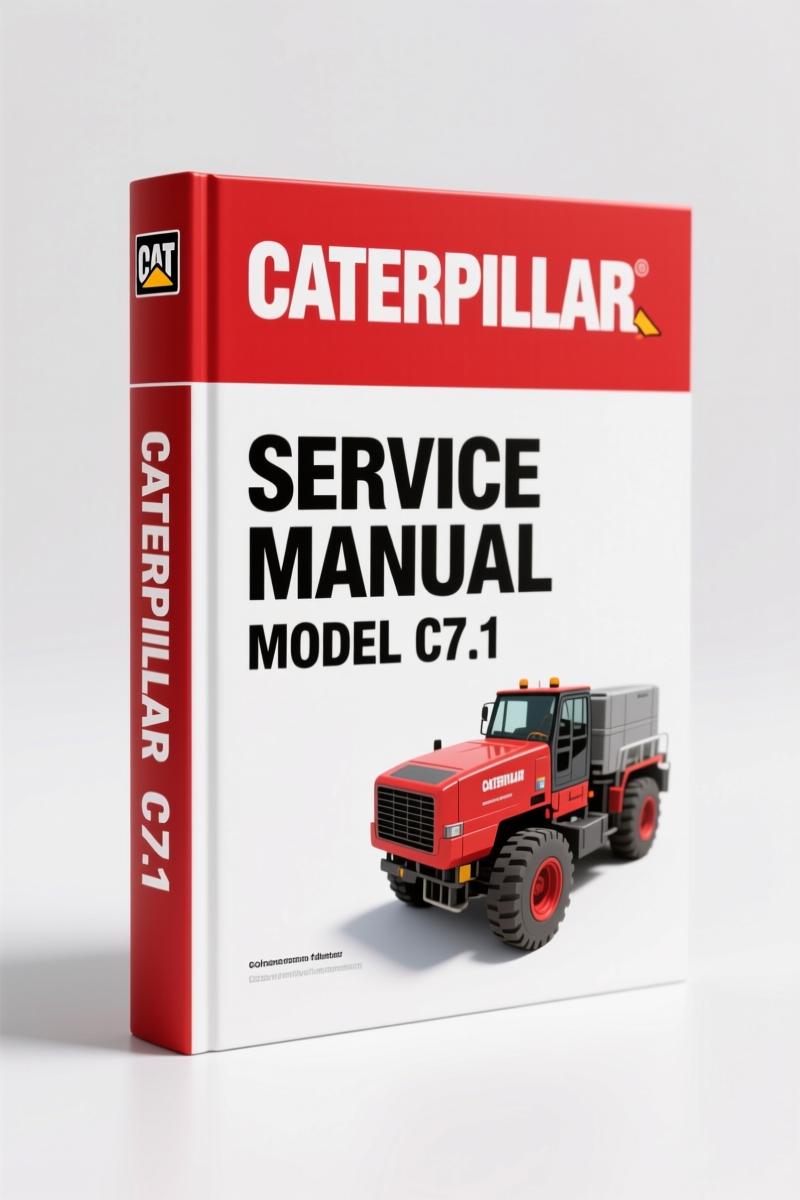
Caterpillar C7.1 Service Manual – 17 Pages of Factory Specs
Original price was: $45.60.$30.00Current price is: $30.00.
Factory-original 17-page service manual for C7.1 industrial engine. Covers ECM, sensors, aftertreatment – direct from Caterpillar SIS.
Description
Caterpillar C7.1 Service Manual – Electronic Control System
I’ve lost count of how many times a guy brings in a C7.1 that won’t start and starts throwing parts at it – new ECM, fuel pump, injectors – and still gets nowhere. The problem is they don’t understand how the electronic control system actually talks to the sensors. That’s where this OEM manual comes in. It’s 17 pages of pure factory documentation, not some aftermarket rewrite that leaves out half the steps. If you’re working on a C7.1 Industrial Engine (serial 77000001-UP), you need the original spec sheet from Caterpillar, not a copy.
Systems Operation: Electronic Control System
Page 1 lays out exactly what you’re dealing with. The engine has an Electronic Control Module (ECM), a fuel injection pump, and electronic unit injectors – all controlled electronically. There’s also an electronically controlled wastegate for the turbo. The ECM runs the show through software parameters and inputs from every sensor listed. I’ve seen guys bypass sensors because they didn’t understand the logic, and then wonder why the ECM goes into derate. This manual explains the control system layout – illustration 1 on page 1 shows the whole system: air cleaner, turbochargers, sensors, aftertreatment devices like the DOC and DPF. If you don’t know what each component does, you’re guessing. And guessing on a $30,000 engine gets expensive fast.
The introduction on page 1 also tells you the engine is designed for electronic control – that means you can’t just unplug stuff and expect it to run. The software contains operating maps and customer-selected parameters. To change those, you need Cat ET software, but to understand what’s happening, you need this manual.
Component Layout and Sensor Identification
Page 2 is a goldmine. It lists 46 numbered components from the control system layout: air inlet temperature sensor (#2), low-pressure turbocharger (#3), spark plug (#4), ignition coil (#6), flame detection temperature sensor (#7), ARD combustion air valve (#8), the DOC and DPF (#10), high-pressure turbocharger (#11), soot sensor (#17), and ECM (#39). The list goes right through fuel system sensors, timing sensors, and aftertreatment sensors. I’ve had techs ask me what a particular sensor does – I point them to this page. If you’re diagnosing a fault code like “Inlet pressure sensor for the DPF – voltage out of range”, you need to know exactly which component that is and where it sits in the system. Page 2 gives you the whole picture. Without it, you’re reading a wiring diagram blind.
Why You Need OEM Factory Specs
I don’t trust aftermarket documentation. Period. I’ve seen third-party manuals that tell you to torque a bolt to 45 lb-ft when the factory spec is 55 lb-ft. On a cylinder head, that’s a leak waiting to happen. On a C7.1, the ECM relies on precise sensor inputs – if you use a generic resistance value from a cheap manual, you’ll misdiagnose a sensor and replace parts you didn’t need. This manual comes straight from Caterpillar’s SIS site. Media number KENR9104-01, publication date 01/01/2011. That’s the real deal. For torque specs and overhaul procedures, you’d want the full service manual, but for understanding the electronic control system – the brain of the engine – this 17-page document is your diagnostic cheat-sheet. No guesswork, no reprints, no copy-paste from a forum.
The 17 Pages: What You Get
Seventeen pages might not sound like a lot, but these pages are dense. You get the systems operation chapter, the complete component layout with callouts, and the basic theory of how the ECM controls fuel, timing, aftertreatment regeneration, and the wastegate. I’ve worked on enough electronic engines to know that 90% of diagnostics is understanding the control logic. This manual gives you that foundation. There’s no fluff – no history of the diesel engine, no marketing text. Just factory diagrams and descriptions. That’s what I want on the workbench, not a novel.
Compare that to the Caterpillar C175, 3600, C8.7, C12.9 2016 Service Manual – Factory Tool Catalog for big generator sets, or the Caterpillar 3500B 2002 Service Manual – Factory Specs for high-horsepower engines. Each manual serves a specific engine family. For the C7.1, this is the electronic control system manual. If you need driveline theory, the principles in a Manual Transmission apply to any vehicle – but for engine electronics, stick to the factory book. Even the Manual Transmission section in your shop library won’t help you with an ECM code. Get the right tool for the job.
Another related manual to consider: Caterpillar C27 C32 DWB1 SXC1 WDR1 2008 Service Manual | OEM Factory Specs for large mining engines. Different application, same principle – OEM only.
Real-World Use: Diagnosing a No-Start C7.1
Let’s say a C7.1 cranks but won’t fire. You pull fault codes – no luck. The manual’s systems operation tells you the ECM needs inputs from the crankshaft speed/timing sensor (#31) and camshaft speed/timing sensor (#34) to fire the injectors. Without these signals, no injection. Page 2 shows both sensors. Page 1 explains that the software contains operating maps. You check the sensor resistance with a multimeter against factory spec? The manual doesn’t list the spec here – that’s in the full service manual – but it tells you the ECM uses those signals. That’s the diagnostic direction. Without this manual, you might chase an aftertreatment regeneration issue that’s secondary. The manual saves you hours of wasted diagnostics because you understand the control system hierarchy.
- Does this manual include torque specifications?
- No. It covers systems operation only. Torque values are in the full service manual.
- How is this different from aftermarket manuals?
- Aftermarket manuals often copy diagrams from the factory literature but miss the fine print – like the exact sensor locations or the ECM operating logic. I’ve seen aftermarket books that list the wrong fuel pressure sensor location for the C7.1, leading a mechanic to replace the right part on the wrong engine. This manual comes directly from Caterpillar’s SIS database. The component numbers, the control system description, the publication date – all verified. You’re getting the same information a dealer tech uses. That’s the difference between a fix that lasts and a comeback that costs you a Saturday.
If you work on C7.1 engines – either in a shop or in the field – this manual belongs in your library. It’s 17 pages of focused, factory-accurate information that will keep you from chasing ghosts in the ECM logic. I’ve been turning wrenches since before electronic injection was common, and I still pull out the OEM manual every time I hit a weird fault. Don’t trust a forum. Access the Factory Manual and get the specs that Caterpillar engineers approved.
Additional information
| Brand | Caterpillar |
|---|---|
| Language | English |
3 reviews for Caterpillar C7.1 Service Manual – 17 Pages of Factory Specs
You may also like…
-
Sale!

Caterpillar 3500B 2000 Service Manual – MEUI Fuel System
Original price was: $93.00.$75.00Current price is: $75.00. -
Sale!

Caterpillar 3116, 3126, 3114 2010 Troubleshooting Manual – 89 Pages
Original price was: $107.10.$70.00Current price is: $70.00. -
Sale!

Caterpillar 14M, 16M 2007 Training Manual – OEM Service Training Guide
Original price was: $108.50.$70.00Current price is: $70.00. -
Sale!

Caterpillar CP-563E CS-563E CS-573E CS-583E 2002 Service Manual
Original price was: $102.70.$65.00Current price is: $65.00.
Related products
-
Sale!

Technical Manual – International DT 530 & HT 530 (118 Pages)
Original price was: $37.00.$25.00Current price is: $25.00. -
Sale!

Acura Integra 1998 Service Manual – 1891 Pages Factory OEM Documentation
Original price was: $31.75.$25.00Current price is: $25.00. -
Sale!

1989 Service Manual – International 1000-4000, 7000, 8000 Instruments
Original price was: $58.80.$40.00Current price is: $40.00. -
Sale!

2005 Parts Catalog – International NGD 3.0 L Engine (77 pages)
Original price was: $44.70.$30.00Current price is: $30.00.
workshop_guy –
This is exactly what I needed. The PDF looks clean. Contains precise bolt torque specs for Caterpillar. I will recommend this shop to others.
Robert M. –
Five stars! The scan is high-quality and well indexed. Every torque spec is provided for Caterpillar C7.1. Worth every penny.
David K. –
Five stars! Quick access after payment. It guided me to repair my Caterpillar C7.1 engine. Highly recommended for mechanics.