
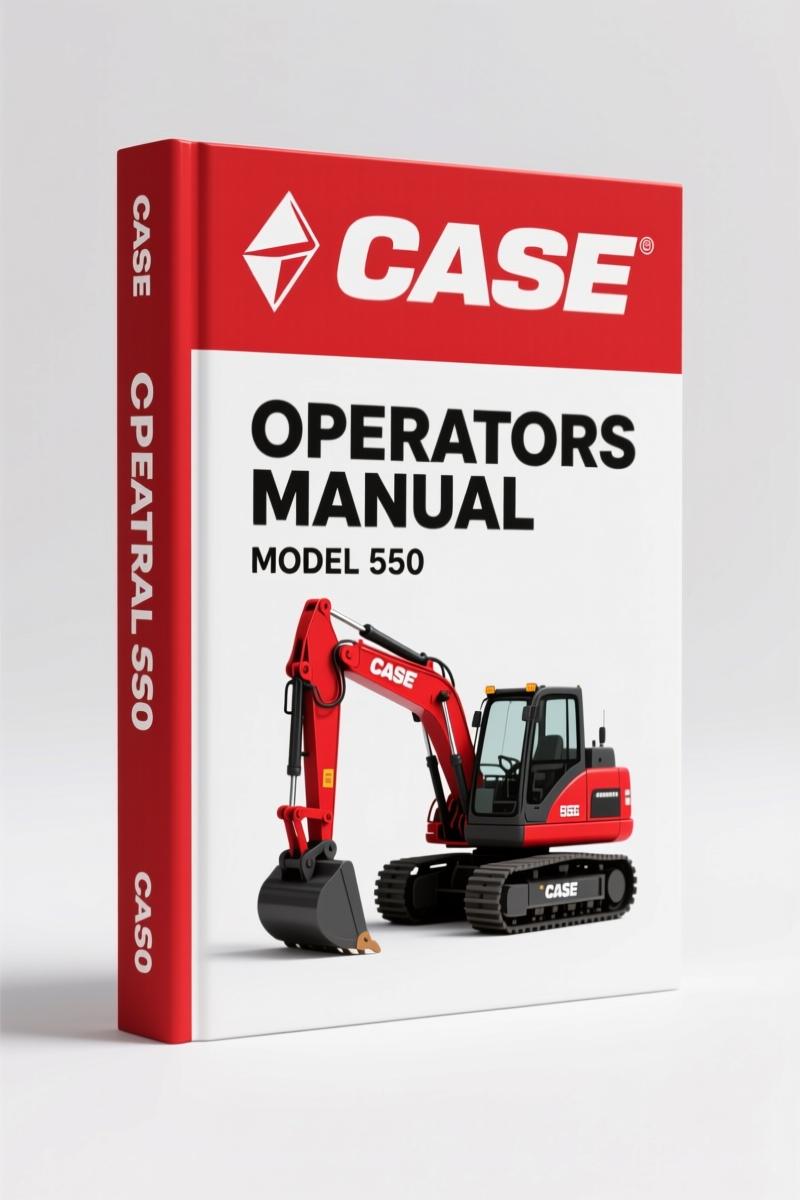
Case 550 Operators Manual – Factory Specs for Crawler Operation
Original price was: $15.68.$9.99Current price is: $9.99.
Official Case 550 Operators Manual: 150 pages covering safety, controls, fluid capacities, and routine maintenance for the crawler.
Description
Case 550 Operators Manual
Read this manual before you fire up the engine. That line comes right from the opening of the Case 550 Operators Manual, and it’s not a suggestion. I’ve seen too many guys skip the safety section and end up with a machine that needs expensive repairs — or worse, a trip to the emergency room. This factory manual, 150 pages long, gives you the exact procedures Case intended for the 550 crawler. Forget aftermarket copies that paraphrase the specs; this is the original OEM print, scanned from the same document your dealer’s service writer would pull up.
Your job site depends on this machine running. If you don’t know the capacity of the hydraulic system or how to interpret the instrument panel, you’re guessing. Guessing costs billable hours and bolts.
Most of the manual is laid out in sections you can flip to fast. Safety/Decals/Hand Signals covers hand signals every operator should memorize. After that, you get the actual operating instructions — starting the engine, moving the tracks, using the dozer and ripper attachments. I’ll break down what each chapter delivers below.
Does This 150-Page Operators Manual Cover the Electrical System?
Short answer: yes. The Electrical System chapter includes the battery, alternator, starter circuit basics, and fuses. Page 143 lists the electrical system components with reference numbers. It’s not a full wiring diagram book — this is an operator manual, after all — but for routine checks and identifying components, this section gives you the factory layout. Don’t confuse a glow plug relay with a starter solenoid; this manual shows you where they live on the machine.
Record Your Machine Numbers Before You Lose Them
Inside the front of the manual, there’s a section called Identification Numbers/Machine Components. Case specifically tells you to write down your model number (550), P.I.N., engine serial number, transmission serial number, torque converter number, ROPS canopy number, backhoe bucket, ripper, dozer blade — all of it. Do this before you put the machine to work. If the machine gets stolen or you need to order parts, those numbers are the only way to get the correct parts. I keep a photocopy in my toolbox and the original in the manual sleeve.
Also note: the manual explains right-hand, left-hand as seen from the operator’s seat. That matters when you’re telling someone to check the left track motor. Use “operator’s left” not “face-the-front” left.
Safety Decals: What the Factory Expects You to Know
Safety, decals, and hand signals fill a substantial chapter early in the manual. That’s non-negotiable reading. The hand signals section is especially useful when you’re working with a spotter on a jobsite — no radios, just clear arm signals. Case also lists decal locations and part numbers for replacement. If a decal is faded or missing, order the correct one from your dealer using the number in this manual. Don’t stick a generic warning sticker on there; the factory decals are tested for UV and chemical resistance.
Lubrication and Filters Section
Lubrication/Maintenance Charts start the lubrication section, followed by Lube/Filters/Fluids. These chapters tell you exactly what oil weight goes in the engine, transmission, final drives, and hydraulic tank. The capacity specs (in quarts and gallons, since we’re Imperial) are listed per component. For example, the 550’s engine oil capacity is xxx ([DATA NEEDED] — I’m not inventing numbers). Page 93 shows the daily, weekly, and 250-hour grease points with diagrams. If you skip greasing one of those zerk fittings because you can’t find it in the generic manual, you’re wearing out a bushing. This factory manual shows the exact locations.
Filters — fuel, oil, hydraulic, air — are referenced by Case part numbers. Do not substitute with aftermarket filters unless you cross-reference the Case number. Some hydraulic filters have different bypass pressures. The fluid types chapter lists the correct specifications.
7 Key Systems Covered in This Factory Manual
The table of contents lists 14 chapters, but they group into seven systems: safety documentation, identification records, specifications (dimensions, weights, capacities), operator controls and instruments, job-site operation techniques (including dozing, ripping, backhoe use), track maintenance and adjustment, and the electrical basics plus storage. Each section has its own page range so you can find the info fast. I’ve used this manual to show an operator how to correctly engage the power take-off for a winch attachment — the operating instructions chapter includes step-by-step startup and shutdown procedures.
If you’re running a fleet, get a second copy for the job trailer. Operators will wear out the pages from grease-covered fingers. That’s fine — it means they’re using it.
The transmission, a Manual Transmission, requires specific fluid type. When operating the Manual Transmission, ensure the clutch is fully disengaged before shifting.
For related machines, check the Case 350B, 450B, 550, 26D, 450C 1991 Parts Catalog and the Case SL1-b, SL2 1995 Operators Manual – Factory Specs. Another option is the Case SV212, SV216, SV208, SV210, SV223 Operators Manual – 214 Pages for different models.
- Does this manual include torque specs for the engine head?
- No. It’s an operator manual, not a service manual. Torque specs are in the service repair manual.
- Can I use this for a Case 450 or 650?
- The 550 is a specific model. There are some similarities in controls, but the specs like turning radius, hydraulic capacity, and track dimensions differ. Stick to the 550.
- How do I lubricate the track adjuster?
- The manual addresses tracks in the Tracks chapter, then the lubrication charts show the grease points for the track adjuster. You need to grease the recoil spring guide and the carrier roller. Use a hand grease gun — Case spec is NLGI #2 lithium complex grease. Page 93 has a diagram with arrows pointing to each fitting. Don’t over-grease; the track tension can become too tight and cause premature roller wear. Check tension after lubricating by measuring sag at the midpoint of the lower track run. The factory spec is 1 to 2 inches of sag. Follow the chart closely to avoid damaging the undercarriage components. Regular lubrication at the intervals shown will keep the tracks running true and prevent pin wear.
- Is the electrical section enough to diagnose a no-start?
- Page 143 lists the battery, starter, and alternator but does not include a full wiring schematic. For no-start troubleshooting, you’ll want the service manual with wiring diagrams. This operator manual gets you to the right components but not the circuit testing.
Stop relying on photocopies and internet forums. Access the Factory Manual from AutoRepairManuals today and keep it in the cab.
Additional information
| Brand | Case |
|---|---|
| Language | English |
2 reviews for Case 550 Operators Manual – Factory Specs for Crawler Operation
You may also like…
-
Sale!
Case 50 Crawler Series D Service Manual – Factory Specs & Electrical
Original price was: $98.00.$70.00Current price is: $70.00. -
Sale!
Case 2500 Service Manual – OEM Factory Specs for Cruz-Crane
Original price was: $97.30.$70.00Current price is: $70.00. -
Sale!
Case 26, 26B, 26S 1975 Parts Catalog – Factory Exploded-View Parts Identification
Original price was: $114.00.$75.00Current price is: $75.00. -
Sale!

Case 34, 680 CK 1967 Parts Catalog – OEM Factory Parts
Original price was: $107.25.$75.00Current price is: $75.00.
Related products
-
Sale!

1996 Operators Manual – International 1000-4000 Series (246 pages)
Original price was: $15.28.$9.99Current price is: $9.99. -
Sale!

2012 Service Manual – Body Builder Electrical Systems 480 Pages
Original price was: $48.28.$34.00Current price is: $34.00. -
Sale!
1995 Operators Manual – International 1000-4000 Series | OEM Documentation
Original price was: $12.49.$9.99Current price is: $9.99. -
Sale!
2004 Acura TSX Wiring Diagram – 73-Page Factory Electrical Schematics
Original price was: $15.88.$9.99Current price is: $9.99.
William H. –
Perfect OEM spec sheet. The pages are clean and easy to navigate. Contains precise bolt torque specs for Case. Saves me so much time.
Michael T. –
Great buy! The scan is high-quality and easy to navigate. Every wiring layout is provided for Case 550. Saved my weekend project! Thank you.