
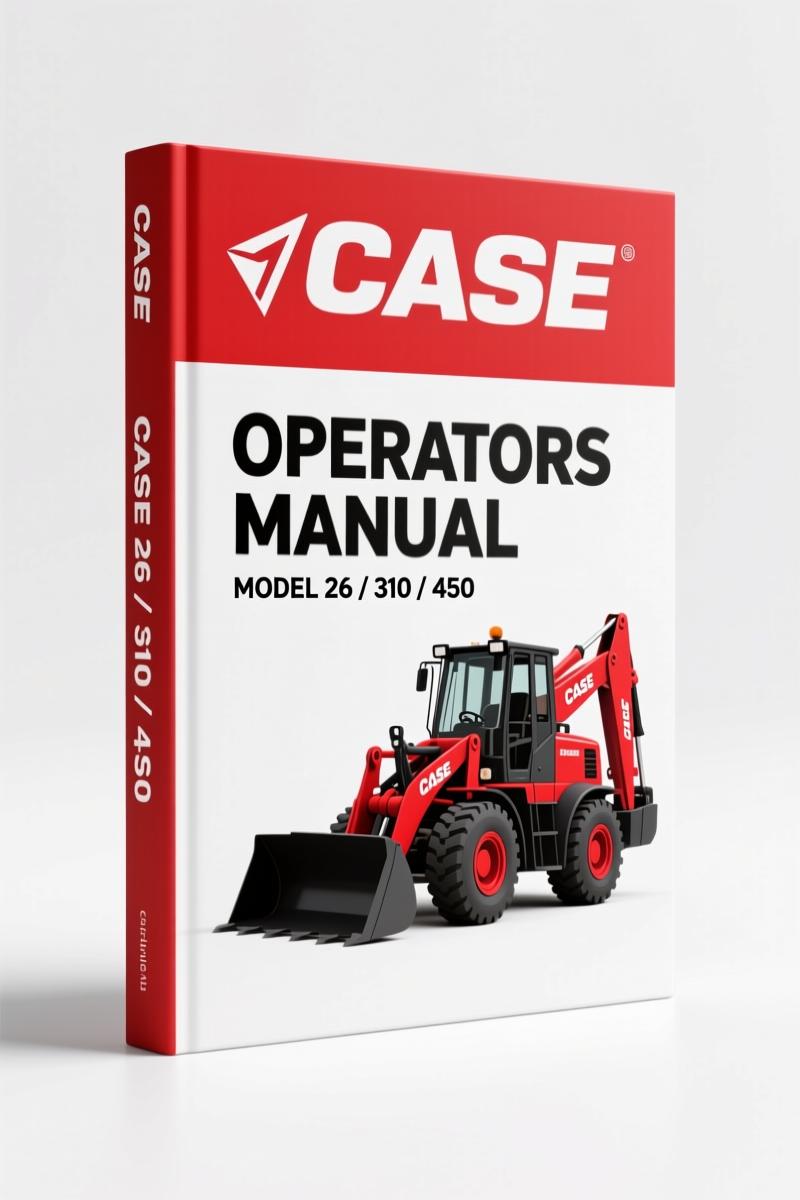
Case 26 1995 Operators Manual – Factory Specs for Loader & Backhoe
Original price was: $14.29.$9.99Current price is: $9.99.
Factory Case 26 Operators Manual (1995) for Model 26 Loader and Backhoe. 104 pages of OEM specs, hydraulic diagrams, and safety instructions.
Description
Case 26 1995 Operators Manual – Factory Documentation for the Model 26 Loader and Backhoe
You’ve got a Case 26 in the shop—maybe a loader-only, maybe a loader-backhoe combination. The hydraulic lines are weeping, the bucket cutting edges are worn, and somebody before you already swapped a control valve without labeling a thing. Without the factory Operators Manual from 1995, you’re guessing on relief pressures, missing lube points, and risking a $2,000 pump because you used aftermarket specs. I’ve seen it a dozen times. That manual sitting on the shelf is your safety net. This one—104 pages of Case’s own instructions—is cut for the 26. Case 26 Backhoe Operators Manual covers the backhoe side in more depth, but this is the base document you run first.
Model 26 Loader and Backhoe: What the TOC Tells You
Table of Contents splits clean: Model 26 Loader (pages 3–29) and Model 26 Backhoe (pages 33 onward). Loader section walks through serial number location, lubrication intervals, hydraulic specs, the pump (both loader-only and loader-backhoe models), control valve, and cylinder removal. Backhoe section adds a trouble‑shooting chart that runs pages 37–41 and a flowmeter procedure. If you’re chasing a hydraulic issue, you start on page 5 for the loader specs and page 35 for the backhoe—those pages list pressures, flows, and oil recommendations. No guesswork. Page 26 details removing the loader from the tractor, including the order to disconnect hydraulic lines and the lift‑arm pivot pins. Follow that sequence or you’ll bend something.
Before You Start the Engine: Read the Manual
The first warning inside is not boilerplate. It says: “BEFORE THE OPERATOR STARTS THE ENGINE: 1. Give instructions … 2. Make sure the operator reads and understands the Operator’s Manual.” Then a second warning spells out reading all safety decals and clearing the area. This isn’t a suggestion—it’s a legal and mechanical requirement. Ignore it and you’re liable for anyone who gets hurt. I keep a copy in the cab and a spare in the toolbox. The manual also reminds you to learn and practice safe use of machine controls in a safe, clear area before operating on a job site. That’s exactly the language you’d expect from a factory document, not some generic translation.
Hydraulic Specs – Page 5 and 35
Page 5 gives hydraulic specifications for the loader—pump flow, relief pressure, cylinder bore and stroke—all in imperial units. Page 35 does the same for the backhoe circuit, including the hydraulic diagram on page 36. These numbers are what Case tested at the factory. If your pressure relief is set 200 PSI low, the bucket won’t curl properly under load. If it’s 200 PSI high, you blow seals. The manual includes a note: “Refer to Hydraulic Diagrams 6–7” for the loader. Don’t use a generic diagram from a third‑party site—they swap ports and hose IDs. Case’s own drawing shows exact port locations and tube routing. Case 26 & 26B Loader Parts Catalog E1124 breaks down the parts, but this manual shows you how the system works.
Page 26: Removing the Loader from the Tractor
That page covers the step‑by‑step procedure to detach the loader frame from the tractor chassis. It lists the tools needed: a set of wrenches (sizes given in inches), a drift pin, and a suitable support stand. The manual warns to park on level ground, lower the bucket to the ground, and shut off the engine before disconnecting hydraulic quick‑couplers. Then it tells you which pin to remove first and why. Skip that order and you’ll have the loader arm drop on your foot. I’ve pulled loaders off a dozen times—this procedure is the difference between a 20‑minute job and an afternoon with a come‑along.
Troubleshooting with a Flowmeter – Factory Procedure
The backhoe section includes a “Trouble Shooting With a Flowmeter” heading right after the trouble‑shooting chart (page 37–41). That’s your diagnostic path for low breakout force, slow swing, or erratic cylinder movement. The manual doesn’t tell you to “take it to a dealer”—it gives you a method: install a flowmeter in the pressure line, run the engine at rated RPM, and compare readings to the specs on page 35. If flow is below spec, check the pump inlet screen. If pressure is low and flow is correct, the relief valve is sticking. That kind of diagnostic logic saves hours. Case 26, 26B & 26S Backhoe Parts Catalog will get you the seals, but you need this manual to know which valve to shim.
Who Needs This 1995 Operators Manual?
Home garage enthusiasts with a 26 sitting in the backyard. Equipment dealers who rent these machines and need to provide safe operating instructions. Shop owners who want to avoid liability when an employee runs a backhoe for the first time. Beginners who need to understand the controls and lubrication points before they touch a lever. The manual assumes you can read a wrench size and turn a grease fitting, but it doesn’t assume you know the factory lube schedule. It lists every grease point by name and tells you the type of grease (NLGI #2). That level of detail matters when you’re rebuilding a loader after twenty years of field abuse.
OEM Factory Print vs Aftermarket
This is a genuine Case Corporation document, published in 1995, printed in the U.S.A. (Form 9‑9985). The OCR excerpt shows the exact warning language and part numbering that Case used on the assembly line. Aftermarket manuals—the ones with scanned, greyscale pages and missing foldouts—almost never include the flowmeter trouble‑shooting procedure or the hydraulic diagram with proper port labels. I tell every tech I train: if the manual doesn’t have the Case logo and part number 9‑9985, don’t trust the torque or pressure specs. You can buy a half‑dozen aftermarket PDFs for the price of this one, and every one of them will have a wrong clearance somewhere. Manual Transmission? That’s a different category—if you’re working on the transmission of a Case 26, you need the service manual, not this operator’s manual. But for daily operation, lubrication, and basic hydraulics, this is the document that keeps the machine running without surprises.
FAQ – Case 26 1995 Operators Manual
- Does this manual cover the complete backhoe overhaul, or just operation and maintenance?
- This is an Operators Manual, not a service or repair manual. It covers operation, lubrication, periodic maintenance (filters, fluids, greasing), hydraulic adjustments (relief valve, flow checks), and removal of the loader from the tractor. For internal overhauls—engine rebuild, transmission, or backhoe cylinder disassembly—you need the corresponding service manual. The manual clearly states in the front: “See your Authorized Case dealer for additional operator’s manuals, parts catalogs, and service manuals.” So if you’re pulling pistons, get the service manual. But 90% of the hydraulic diagnostics you’ll do on a rental or personal 26 are covered here.
- Can I use this manual for a 26B or 26S model?
- No. The 26B and 26S have different hydraulic circuits and control valves. Use the dedicated manual for those models.
Factory manuals don’t come with a guarantee that you’ll never break something—they come with the guarantee that when you follow them, you’re working inside the engineer’s safety margins. The Case 26 Operators Manual from 1995 is that guarantee. Access the Factory Manual and put it on the tablet in the cab before you crank the engine. Manual Transmission content is elsewhere, but for the loader-backhoe hydraulic system, this is the only document you need.
Additional information
| Brand | Case |
|---|---|
| Language | English |
3 reviews for Case 26 1995 Operators Manual – Factory Specs for Loader & Backhoe
You may also like…
-
Sale!
Case 50 Crawler Series D Service Manual – Factory Specs & Electrical
Original price was: $98.00.$70.00Current price is: $70.00. -
Sale!
Case 2500 Service Manual – OEM Factory Specs for Cruz-Crane
Original price was: $97.30.$70.00Current price is: $70.00. -
Sale!
Case 26, 26B, 26S 1975 Parts Catalog – Factory Exploded-View Parts Identification
Original price was: $114.00.$75.00Current price is: $75.00. -
Sale!
Case 34, 680 CK 1967 Parts Catalog – OEM Factory Parts
Original price was: $107.25.$75.00Current price is: $75.00.
Related products
-
Sale!

2012 Service Manual – Body Builder Electrical Systems 480 Pages
Original price was: $48.28.$34.00Current price is: $34.00. -
Sale!

1995 Operators Manual – International 1000-4000 Series | OEM Documentation
Original price was: $12.49.$9.99Current price is: $9.99. -
Sale!
1994 Troubleshooting Manual – International 1000-4000 FBC
Original price was: $60.00.$50.00Current price is: $50.00. -
Sale!

Technical Manual – International 6.0L Power Stroke FICM Diagnostics
Original price was: $29.80.$20.00Current price is: $20.00.
Richard G. –
Superb resource! It is easily zoomable on my iPad without blur. It guided me to repair my Case 26 engine. Saved my weekend project! Thanks.
Charles W. –
I am very pleased with this purchase. Immediate link after checkout. Contains detailed bolt torque specs for Case. Saved my repair job! Thank you.
gearhead88 –
I am extremely satisfied with this transaction. It is very easy to read on my laptop without losing quality. Contains detailed bolt torque specs for Case. Worth every penny.