
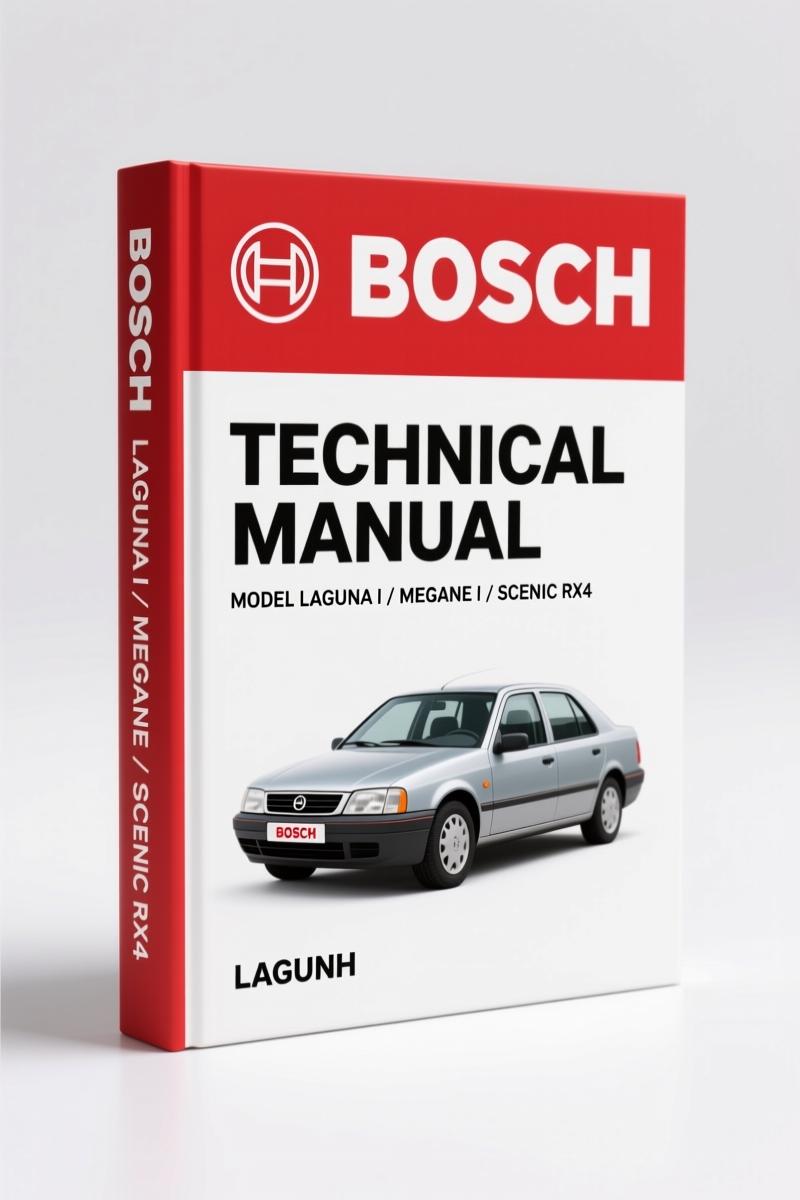
Bosch Laguna I, Megane I, Scenic RX4, Master 2006 Technical Manual – Diesel Injection
Original price was: $35.25.$25.00Current price is: $25.00.
266-page factory fault finding manual for Bosch EDC15C3 diesel injection on Laguna I, Megane I, Scenic RX4, Master. 2006 edition.
Description
Bosch Laguna I, Megane I, Scenic RX4, Master 2006 Technical Manual
You’ve got a Renault with a diesel that won’t start, or it does start but runs like a bag of rocks. You pull out some aftermarket manual you found online, and the pinout for the computer doesn’t match what you’re seeing. Or the torque value for the injector hold-down is listed as “tighten to feel” — which is not a spec. That’s when you lose a Saturday and maybe a set of injectors. I’ve been there. This Bosch Laguna I, Megane I, Scenic RX4, Master 2006 Technical Manual is the real deal: a factory Renault publication (Technical Note 3919A) for the EDC15C3 diesel injection system. 266 pages, printed December 2006, covering four platforms with the F9Q and G9T engines. No reprints, no third-party guesswork.
Fault Finding Introduction – What This Manual Covers
First thing you’ll see on page 1 is a table that tells you exactly which vehicles and engines are covered: Laguna I (B56W, X56W), Megane I (XA1F, XA05), Scenic RX4 (XA1F, XA05) all with the F9Q diesel, plus Master (XDXG) with the G9T. The manual is specific to the Bosch EDC15C3 computer – program number CB, Vdiag 08. If you’ve got a different ECU revision, this isn’t your document. The introduction lays out the scope, prerequisites, and required special tools: a multimeter and universal terminal Elé. 1681. That part alone saves you from buying a scope you don’t need. Waste not, want not.
13B Diesel Injection System Operation – Cleanliness and System Logic
The manual doesn’t throw you into fault codes without context. The “System operation” section explains how the EDC15C3 manages injection timing, rail pressure, and the EGR. But the cleanliness guidelines are the part most weekend guys skip – and it’s why they end up buying new injectors. Diesel injection is sensitive. Dirt in a connector or fuel line causes faults that aren’t real. Page 8-9 in the PDF covers the cleaning protocol. Follow it. I’ve seen a $10 can of contact cleaner solve a no-start that three different scan tools called “ECU failure.” The system operation section also goes through the allocation of computer tracks – the pinout. Page 15 shows the connector arrangement. If you’re chasing a wiring issue, start there.
3 Key Sections for Beginners and Pros
Three sections in this manual will save you the most time: the Interpretation of faults (starting page 25), the Conformity check (page 148), and the Fault finding chart (page 222). The interpretation section takes each fault code – for example, “DF001 – Injector circuit 1” – and gives you the possible causes, the test steps, and the expected readings. It tells you what to measure and where. The conformity check is a list of checks to run after a repair to confirm the system is working within factory parameters. Not “the light went off, send it.” Actual values. The fault finding chart is a decision tree. It says “Engine hard to start – check the fuel pressure sensor signal.” Then points you to the correct page. That structure keeps you from jumping at the first code before you understand the context.
Allocation of Computer Tracks – Why It Matters
One of the biggest time wasters in a shop is chasing a wiring problem with the wrong pinout. This manual gives you the exact allocation of computer tracks for the EDC15C3. It lists each pin, the wire color (from the factory harness), the function, and the voltage or resistance specs. For example, pin 12 – fuel temperature sensor signal – should read between 0.5V and 4.5V depending on temperature. If you measure 0V, you know it’s either a short to ground or a bad sensor. That kind of data isn’t in a generic Bosch book. It’s Renault-specific. And it came from the same engineers who designed the car. You can trust it.
Interpretation of Parameters and Commands – Live Data You Can Trust
The manual includes a parameter summary table (page 180) and a command summary table (page 191). The parameter table lists every live data value the ECU sends out – rail pressure, injection quantity, timing, EGR position. Beside each is the min/max acceptable range and the conditions under which to read it. For example, “Permanent rail pressure at idle: 250 ± 20 bar.” The command table lists what you can actuate with a diagnostic tool – like the fuel pressure regulator or the EGR valve – and the expected result. That’s gold when you’re testing actuators without guessing. The interpretation section explains what each parameter means and what to do if it’s out of range. If you’re a beginner, read that part twice before touching anything.
Does This Manual Cover the Fuel System?
It covers the diesel injection system – injection pump, injectors, rail, pressure sensor, regulator valve, and all the related wiring. It does not cover the low-pressure fuel supply (tank pump, filters) or the transmission. For understanding how a manual transmission works, check Manual Transmission for basics. But if you’re dealing with a no-start or poor running caused by the high-pressure injection side, this is your manual. The fault finding chart also includes customer complaints – things like “engine stalls under load” or “excessive smoke” – and maps them to the probable fault.
Source Authenticity – OEM vs Aftermarket
This is a Renault s.a.s. document. It says “All rights reserved” and “Copying or translating … forbidden without prior written authority.” That means it’s a factory publication, not some reprint from a third party that scanned it and lost half the resolution. The OCR text you read earlier came directly from the original PDF – the same content you get when you access it. No missing pages, no blurry wiring diagrams. If you’ve been burned by aftermarket manuals that list the wrong torque for the high-pressure rail bolts (I have – it’s 25 Nm, not 20, not 30), you know the value of a factory spec. This manual cancels 8 earlier technical notes and consolidates them into one edition. That tells you it’s the final word for the 2006 model year.
Who Should Buy This Manual
DIY home mechanics who own a Laguna I, Megane I, Scenic RX4, or Master with a diesel engine. Also independent shops that see these Renault vans and cars – the Master is common as a work van, and the F9Q engine has known injector issues. The manual expects you to have a basic multimeter and a way to read live data (CLIP or a compatible scan tool). A beginner can follow the fault finding chart and the parameter tables, but you need to be comfortable reading a wiring diagram. If you’re brand new to diesel injection, pair this with a good book on the Bosch basics. For related factory Bosch manuals, see Bosch NG6, NG10 Technical Manual – 204 Pages of Factory Hydraulic Specs if you work on heavy equipment, or Bosch KTS 550 2004 Technical Manual – Factory Specs for scan tool use. For engine work, Bosch 147, 156, 159, 166, 2400 2011 Technical Manual | Shop Specs covers older diesel systems. For more on manual transmission basics, refer to Manual Transmission.
FAQ – 4 Questions About This Manual
- Does this manual include torque specs for injector and rail bolts?
- It lists the factory torque values in the conformity check and in the fault finding procedures. You get Nm values from Renault, not a generic range.
- What diagnostic tools do I need?
- Multimeter and universal terminal Elé. 1681 are the required special tools. A CLIP scan tool is recommended but not mandatory for every step; the manual includes voltage/resistance checks you can do with a meter.
- Can I use this manual on a 2007 Master with the same engine?
- It covers the Master with G9T engine up to 2006. If your Master is a later model year, the ECU or wiring may have changed. Check the program number and Vdiag number on the vehicle’s ECU before assuming compatibility.
- How many pages and what year?
- 266 pages, edition 3 – December 2006.
If you’re tired of chasing diesel injection ghosts with guesswork and aftermarket PDFs that leave out the torque values or pinouts, get the factory source. Access the Factory Manual and keep it on your shop tablet or printed out. One correct torque spec will pay for the price of the whole document.
Additional information
| Brand | Bosch |
|---|---|
| Language | English |
2 reviews for Bosch Laguna I, Megane I, Scenic RX4, Master 2006 Technical Manual – Diesel Injection
You may also like…
-
Sale!
Bosch 33, 75, 90, 147, 156 Technical Manual – 156 Pages of OEM Component Data
Original price was: $39.60.$30.00Current price is: $30.00. -
Sale!
Bosch NG 6 Technical Manual – Proportional Pilot Pressure Valve Specs
Original price was: $70.00.$50.00Current price is: $50.00. -
Sale!
Bosch AS 2.5, AS 0.8 Technical Manual – 84 Pages of OEM Specs
Original price was: $71.00.$50.00Current price is: $50.00. -
Sale!
Bosk K1 Series Service Manual – 28 Pages of Factory Alternator Specs
Original price was: $37.50.$30.00Current price is: $30.00.
Related products
-
Sale!

1992 Electrical Schematic – OEM Wiring Diagrams for International 1000-3800
Original price was: $24.48.$18.00Current price is: $18.00. -
Sale!
1994 Troubleshooting Manual – International 1000-4000 FBC
Original price was: $60.00.$50.00Current price is: $50.00. -
Sale!
1996 Operators Manual – International 1000-4000 Series (246 pages)
Original price was: $15.28.$9.99Current price is: $9.99. -
Sale!
International 1000-3000 Series Operators Manual – 132 Pages of OEM Specs
Original price was: $14.40.$10.99Current price is: $10.99.
William H. –
This is exactly what I required. The pages are clean and easy to navigate. Every torque spec is provided for Bosch Laguna. Saved my weekend project! Thanks.
Richard G. –
This is exactly what I was looking for. The pages are clean and well indexed. It assisted me to fix my Bosch Laguna transmission. Saves me hundreds of dollars.