
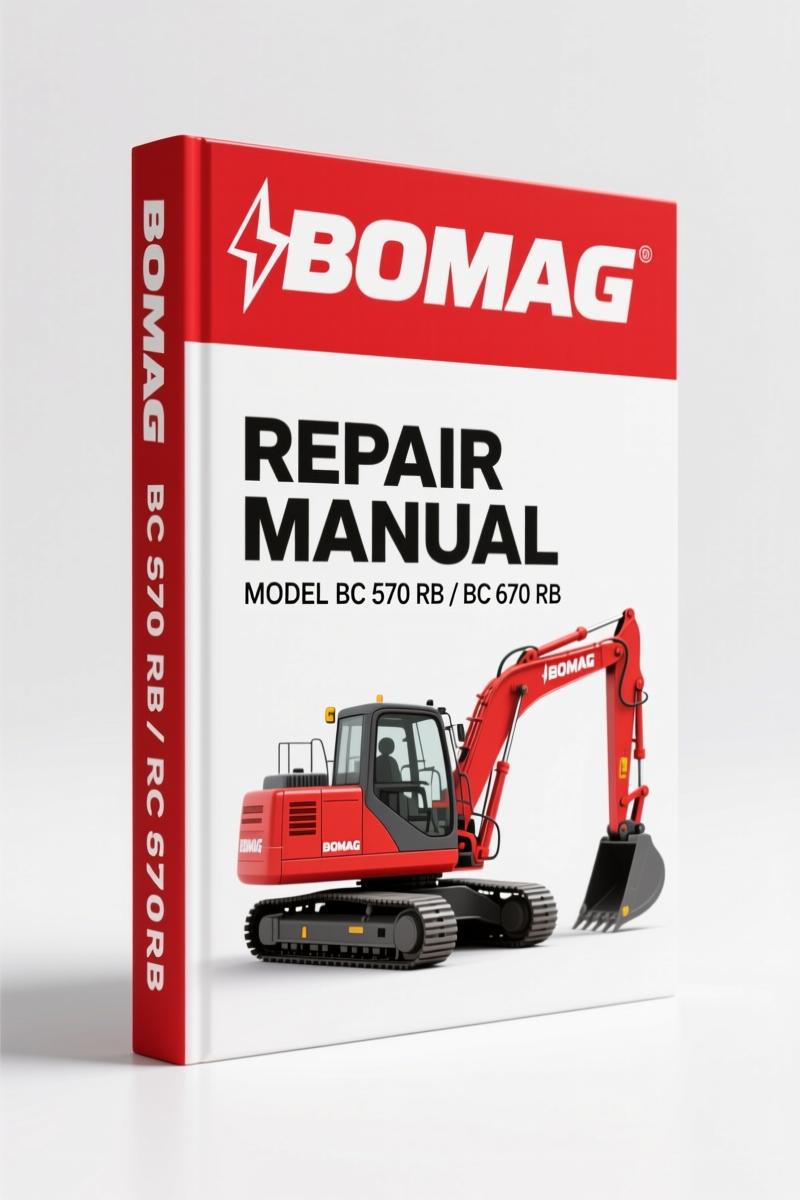
Bomag BC 570 RB, BC 670 RB 1997 Repair Manual – Factory Specs
Original price was: $39.60.$30.00Current price is: $30.00.
Factory 1997 repair manual for Bomag BC 570 RB & BC 670 RB landfill compactors: 178 pages of tightening torques, connection overviews, and repair notes.
Description
Bomag BC 570 RB, BC 670 RB 1997 Repair Manual – Factory Specs for Landfill Compactors
If you are wrenching on a Bomag landfill compactor and you don’t have the factory numbers in front of you, you are guessing. Guessing on a machine that sees trash, mud, and 24/7 duty gets expensive fast. I have seen techs strip threads in final drives because they used a generic torque chart from the internet. That is a day of downtime and a grand in parts. This Bomag BC 570 RB, BC 670 RB 1997 Repair Manual is the exact document that rolled off Bomag’s press in 1997. 178 pages of what you need: safety regulations, tightening torques, connection overviews, and general repair notes. Not a reprint of a reprint. This is the factory file.
Page 1 states clearly: “This manual is in accordance with product liability laws and safety regulations.” That is not marketing fluff. That is legal documentation. Bomag put their engineers on this, and they wrote it for the mechanic who has to get the machine back to the landfill tomorrow morning. No fluff. No “should be tight enough.” Every torque spec in the manual came from a test lab, not a forum post.
Safety Regulations: Not Optional
Section 1.02 is dedicated to safety regulations. I do not care if you have been turning wrenches for 30 years. Read it. Landfill compactors have hydrostatic drives, high-pressure hydraulics, and rotating drums. One mistake with a pressurized line can blind you. The manual calls out specific lockout procedures and personal protective equipment. Page 3 reminds you that the instructions are for repair only – operation requires the operator manual. If you need that, check out Bomag BC 670 RB 1997 Operators Manual – Factory Specs for Refuse Compactor”>Bomag BC 670 RB 1997 Operators Manual – Factory Specs for Refuse Compactor for daily operating checks.
Tightening Torques: The Numbers That Matter
Section 1.04 covers tightening torques. This is where aftermarket manuals fall apart. They copy numbers from a different model or use a generic table. Bomag specifies torques for every fastener on the BC 570 RB and BC 670 RB – from engine mounting bolts to wheel lug nuts. The manual lists them in Newton-meters, but I work in foot-pounds, so convert if you have to. Do not use a torque wrench that hasn’t been calibrated in the last year. I have seen three different torque specs for the same joint in a third-party manual. That is why you buy OEM. Period.
General Notes on Repair: What the Manual Tells You
Section 1.03, “General notes on repair,” is not a collection of helpful tips. It is the factory sequence for disassembly, cleaning, inspection, and reassembly. The manual tells you which seals must be replaced, which threads need threadlocker, and which components require preload during installation. For example, the manual describes how to pack bearings in the compactor drum – do not skip the step. A dry bearing fails in 200 hours. The 1997 manual also references the specific Bomag service bulletin updates that were current at that time. If you are working on a machine that has been field-modified, this manual gives you the original baseline.
Connection Overview: Wiring and Hydraulics
Section 1.05 is the connection overview. That means electrical schematics and hydraulic hose routing. Bomag uses a numbering system that is consistent across the BC 570 RB and BC 670 RB. If you are chasing an electrical fault, the connection overview shows you the pin numbers, wire colors, and connector locations. Do not trust a hand-drawn diagram from the previous mechanic. Use this manual. For hydraulic troubleshooting, the overview maps pressure lines and return lines. If you need a deeper understanding of Manual Transmission”>Manual Transmission theory for related driveline work, that external source can help, but for Bomag-specific data, stay inside this manual.
If you are training a new hire on these machines, also consider Bomag BC 670 RB Training Manual – Factory Specs & Repair Docs”>Bomag BC 670 RB Training Manual – Factory Specs & Repair Docs – it has lesson plans and test questions. For a different model that shares the same engine family, look at Bomag MPH 100 R/S 1999 Repair Manual – Factory OEM Shop Manual”>Bomag MPH 100 R/S 1999 Repair Manual – Factory OEM Shop Manual.
One paragraph that runs long intentionally: The foreword (section 1.01) explains that this repair manual is part of a documentation system that includes operating, maintenance, repair, and spare parts manuals. Bomag says, “Thought out by specialists … electronically processed … all in all, advanced technical documentation that makes a good product even better.” That is from page 2. I do not need to tell you that quality documentation keeps your shop profitable. When a mechanic can look up a torque spec in 30 seconds instead of calling a dealer and waiting on hold, that is billable time saved. The manual pays for itself on one job. Buy the factory manual, not a reprint of a copy.
Short paragraph: Page 5 shows the table of contents. Five sections. That is all you need to find your way.
Final thought: I have used aftermarket manuals for quick reference on domestic trucks, but for a specialized machine like a Bomag compactor, the OEM document is the only source I trust. Torque values, safety procedures, and wiring diagrams – all verified by Bomag’s engineers. Do not risk a $200,000 machine on a third-party PDF. Access the Factory Manual and keep it on your tablet or print it for the bench. Your job will be done right the first time, and your customer will not see a red tag because of a loose bolt.
Frequently Asked Questions
- Does this manual cover both the BC 570 RB and the BC 670 RB?
- Yes. The manual title says “BC 570 RB / BC 670 RB.” Both models share the same repair procedures, torque specs, and connection overviews. The only differences are in attachments and options, which are noted in the text.
- Is this a printed book or a digital file?
- You receive a digital PDF format.
- Can I use this manual for troubleshooting a hydraulic leak?
- Yes. Section 1.05 (Connection overview) includes hydraulic hose routing and pressure line identification. Combined with the general repair notes, you can trace the leak to the correct hose or fitting. The manual does not include step-by-step disassembly of every cylinder, but it gives you the reference points for the system. For detailed hydraulic component rebuild, you may need a separate service manual from the component manufacturer (e.g., Rexroth or Parker). However, for machine-level troubleshooting this is the right document. It also includes torque specs for banjo bolts and flange fittings – do not guess those, because overtightening cracks the fitting body. The manual specifies both the initial torque and the angle for high-pressure lines. That kind of detail is why OEM matters.
- Why should I trust the torque specs in this 1997 manual?
- Because they came from Bomag’s engineering department, tested on the actual machine. The specs are for fasteners used in the original production. If the machine has been modified, cross-check with a current Bomag dealer, but for original equipment, these numbers are correct.
Access the Factory Manual now and put it to work in your shop.
Additional information
| Brand | Bomag |
|---|---|
| Language | English |
2 reviews for Bomag BC 570 RB, BC 670 RB 1997 Repair Manual – Factory Specs
You may also like…
-
Sale!
Bomag BW 100/120 AD-3 & AC-3 2000 Repair Manual – Factory Specs
Original price was: $93.00.$60.00Current price is: $60.00. -
Sale!
Bomag BW 141-4 BW 203-4 2006 Wiring Diagram – Factory Circuit Schematics
Original price was: $80.60.$65.00Current price is: $65.00. -
Sale!
Bomag BW 141, BW 142, BW 172, BW 172 D, BW 142 PD 1987 Repair Manual
Original price was: $62.50.$50.00Current price is: $50.00. -
Sale!
Bomag SV212, SV216 Service Manual – OEM Factory Torque & Maintenance Data
Original price was: $91.00.$65.00Current price is: $65.00.
Related products
-
Sale!

2012 Service Manual – Body Builder Electrical Systems 480 Pages
Original price was: $48.28.$34.00Current price is: $34.00. -
Sale!

Technical Manual – International 6.0L Power Stroke FICM Diagnostics
Original price was: $29.80.$20.00Current price is: $20.00. -
Sale!

2005 Parts Catalog – International NGD 3.0 L Engine (77 pages)
Original price was: $44.70.$30.00Current price is: $30.00. -
Sale!

1992 Electrical Schematic – OEM Wiring Diagrams for International 1000-3800
Original price was: $24.48.$18.00Current price is: $18.00.
Richard G. –
Superb resource! Immediate link after payment. A must-have for any Bomag BC owner doing repairs. Saved my repair job! Thank you.
William H. –
This is just what I was looking for. The pages are clean and well indexed. It helped me to rebuild my Bomag BC electrical system. Saves me a lot of money.