
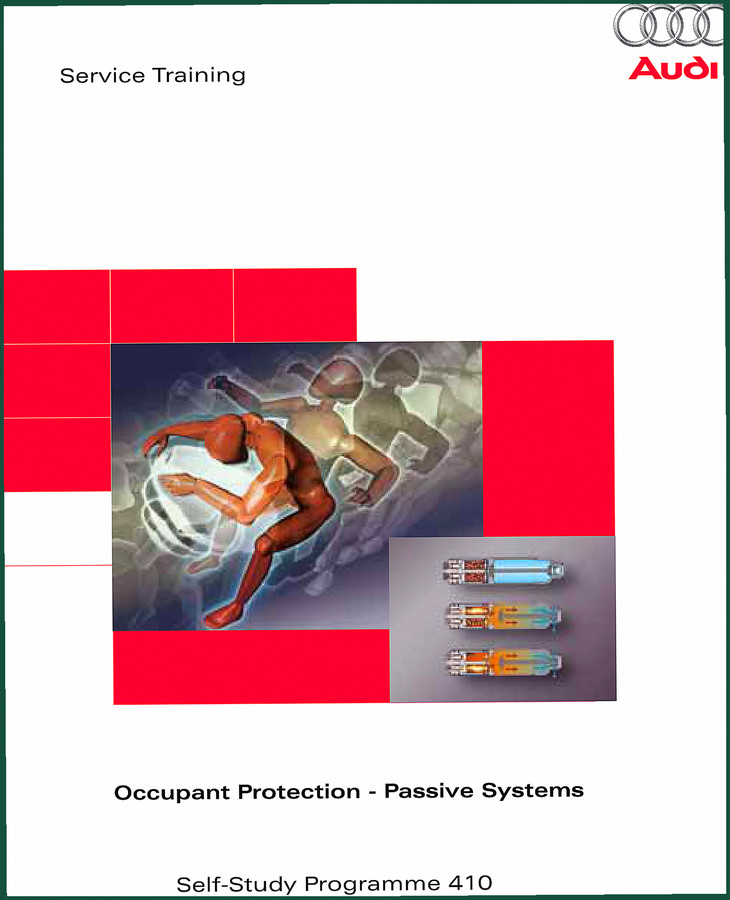
Audi Self-Study Programme 410 Training Manual – Occupant Protection
Original price was: $40.50.$30.00Current price is: $30.00.
Factory Audi training manual (SSP 410) on passive occupant protection systems. 76 pages of design, function, and diagnostic fundamentals.
Description
Audi Self-Study Programme 410 Training Manual – Occupant Protection Passive Systems
Every time I see a tech cracking open an aftermarket wiring diagram for an airbag system, I get that same sinking feeling. You’re trusting a third-party screenshot with your liability. This Audi Self-Study Programme 410 Training Manual is the actual OEM material Audi puts in front of its dealer techs – not a rewritten, condensed version, not a generic safety supplement. It’s 76 pages of factory-level explanation on how the passive occupant protection network operates, from the airbag control unit down to the battery disconnector. If you work on modern Audi vehicles and don’t have this document within arm’s reach, you’re flying blind.
General Principles – What the Manual Actually Teaches
The document kicks off with fundamental physics you can’t skip: types of collisions, impact situations, and the exact time sequence of a head-on crash versus a side impact. Most technicians glaze over this stuff, but without understanding deployment timing, you won’t diagnose why a bag didn’t fire or why a pretensioner locked prematurely. Pages 8 through 17 cover the general principles and networking of system components. This isn’t a repair manual – it’s a design and function primer. Note that the manual itself states: “The Self-Study Programme is not a Repair Manual!” So don’t expect torque values for seat belt anchors here. You’ll need the actual workshop manual for that. But for understanding how the system thinks, this training manual is irreplaceable.
Passive Occupant Protection Systems – 7 Subsystems Detailed
Here’s where the meat lives. Starting on page 18, the manual breaks down each component in its own section:
- Airbags – deployment logic, staged inflation, and sensor inputs
- Belt tensioners – pyrotechnic vs. electric, activation thresholds
- Belt force limiters – how they reduce peak shoulder load
- Head restraints – active crash-responsive designs (page 46)
- Child seats – Audi-specific ISOFIX and top tether routing
- Roll-over protection – convertible pop-up bars and sensor fusion
- Battery disconnectors – the high-voltage cutoff strategy in a crash
Each subsystem comes with factory diagrams that show signal paths, component locations, and interaction with the central airbag control module. Need to understand why the side curtain didn’t deploy on a particular impact angle? This manual walks through the collision classification logic that decides which bags fire.
Who Should Buy This Manual – Real-World Use Case
If you’re a DIY homeowner garage enthusiast who likes to do your own interior work on an Audi A4 or Q7, this manual is your safety net. Most owners yank out seats, remove headliners, or swap steering wheels without disconnecting the battery and waiting the full capacitor discharge time. The manual explains exactly why you must wait – and what happens if you don’t. For the professional shop owner, handing this document to a less-experienced tech before they crack into a restraint system cuts down on callback risk. I’ve seen techs misroute belt pretensioner wiring because they assumed the connector was interchangeable with another model year. This training manual gives you the correct system architecture so you don’t learn the hard way. Pair it with the Audi multitronic 01J Training Manual – CVT Design & Function (100 Pages) for a complete drivetrain understanding, and the Audi 09L, 0AT, 0B6, 0BQ, 09E 2006 Training Manual – Factory Specs for transmission-specific nuances.
Source Validity – Why OEM Beats Aftermarket Every Time
Aftermarket manuals for passive safety systems are notoriously vague. They’ll tell you “disable the airbag system before working” but won’t show you the specific connector pinouts for the R32 connector or the resistor bypass requirements for the driver knee bag. This Audi Self-Study Programme 410 was written by Audi’s own Service Training department. The diagrams are taken directly from production vehicle CAD data. You get the same level of detail that dealer technicians receive in their classroom training. The document includes a “Test yourself” section on page 74 – 12 questions that force you to apply what you just read. That’s not something you’ll find in a Chilton or Hayes manual. And for context on why training materials like this exist, check the Automotive Industry Overview to see how modern safety systems evolved from the 1950s seat belt to today’s networked restraint controllers.
FAQ – Questions from Real Techs
- Does this manual cover actual repair steps like removing an airbag module?
- No. The manual repeatedly states it is a training document, not a repair manual. Use it to understand the system design before you grab your tools. For repair procedures you need the official Audi workshop manual or a subscription-based service.
- How many pages are in the Self-Study Programme 410?
- 76 pages total, including the test yourself section and overview of related self-study programmes.
- Will this manual help me diagnose an airbag light that won’t clear after a seat swap?
- Yes, indirectly. It explains the occupant classification system and the seat position sensor logic. If you understand which sensors talk to the control unit, you’ll have a better chance of tracing a resistance fault than blindly clearing codes. But again, pinout and diagnostic procedures are in the workshop manual.
- Can I get torque specs for belt tensioner bolts from this manual?
- No. Torque values are intentionally omitted because the document focuses on function, not installation. Use the factory repair information for fastener specs.
Look, I’ve been turning wrenches since before airbags were standard equipment. The difference between a safe repair and a liability lawsuit is understanding why the system behaves the way it does. This training manual gives you that understanding in the same format Audi uses to certify its own techs. If you’re serious about working on passive restraint systems – either as a shop owner training your crew or as a DIYer who wants to avoid a hospital trip – Access the Factory Manual now and add it to your digital library. Pair it with the Audi Q7 Training Manual – 76-Page Factory Self-Study Programme 361 if you’re working on the Q7 platform.
Additional information
| Brand | Audi |
|---|---|
| Language | English |
4 reviews for Audi Self-Study Programme 410 Training Manual – Occupant Protection
You may also like…
-
Sale!
Audi 5000 S 1985 Wiring Diagram – OEM Cooling Fan Circuit Data
Original price was: $86.90.$55.00Current price is: $55.00. -
Sale!
Audi 100, 200 1989 Workshop Manual – Factory Service for 5-Cylinder Engine
Original price was: $63.45.$45.00Current price is: $45.00. -
Sale!
Audi A8, Q7 Training Manual – Ceramic Brake Systems
Original price was: $54.00.$45.00Current price is: $45.00. -
Sale!
Audi A3 2003 Repair Manual – Fuel System Service Documentation
Original price was: $63.45.$45.00Current price is: $45.00.
Related products
-
Sale!

Service Manual – International HS 2.8L Engine – 130 Pages of Factory Specs
Original price was: $56.40.$40.00Current price is: $40.00. -
Sale!

1992 Electrical Schematic – International 1000/3000/4000/2554 OEM Wiring Diagrams (132 Pages)
Original price was: $26.40.$20.00Current price is: $20.00. -
Sale!

1991 Operators Manual – International Truck OEM Specs (108 Pages)
Original price was: $13.63.$10.99Current price is: $10.99. -
Sale!
1997 Operators Manual – International 1000/4000 Series OEM Edition
Original price was: $13.49.$9.99Current price is: $9.99.
David K. –
Five stars! Quick access after checkout. A must-have for any Audi SelfStudy owner doing maintenance. Saves me so much money.
John S. –
Five stars! Instant access after payment. Every spec sheet is provided for Audi SelfStudy. Saved my weekend project! Thanks.
William H. –
Great workshop guide. It is very easy to read on my phone without blur. It assisted me to rebuild my Audi SelfStudy electrical system. Saves me hundreds of dollars.
pro_mechanic –
Great workshop guide. Instant access after checkout process. A must-have for any Audi SelfStudy DIYer doing repairs. Saves me a lot of time.