
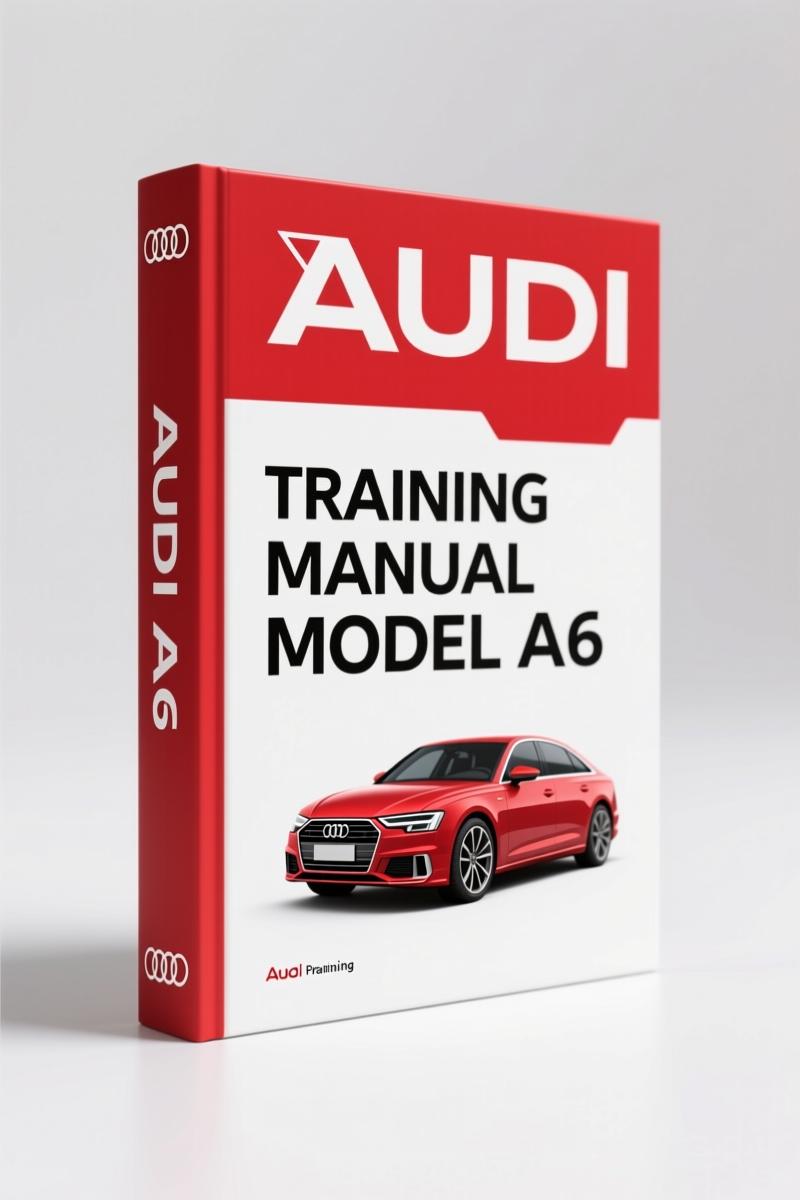
Audi A6 Training Manual – 76 Pages of Factory System Documentation
Original price was: $27.93.$21.99Current price is: $21.99.
Factory-authored 76-page training manual for Audi A6 covering body, passenger protection, diagnosis, and chassis systems.
Description
Audi A6 Training Manual – 76 Pages of Factory Self-Study
If you are working on an Audi A6 Training Manual and you expect a step-by-step repair procedure with torque specs for every bolt, stop right here. That is not what this is. This is the Self-Study Programme 323 – a 76-page document Audi put together to teach its technicians the how and why behind the new A6 ’05. It covers body construction, passenger protection, airbag systems, chassis, and air conditioning. It does not give you the values to replace a head gasket. But if you want to understand where the airbag control unit J234 sits, how the seat occupied recognition works for US market cars, or what signals the Climatronic control unit J255 expects – this is the file you need on your tablet next to the lift.
I have seen techs waste an hour chasing a CAN bus fault because they did not understand the bus topology. This manual lays out the in/outputs on control units J393, J519, and J520 in Chapter 7. That alone can save you a diagnostic loop. The manual is 76 pages – printed by Audi, written for service training. It is not a reprint or a third-party compilation. You get the original PDF, exactly as Audi distributed it to its training centers.
Body Construction and Connection Technology
Chapter 2 runs through the body shell, materials, blanks, assemblies, bumpers, and trailer coupling. If you are repairing collision damage on an A6, you need to know where the high-strength steels are and how the connection technology works – spot welds, bonding, or rivets. This manual shows the material distribution, so you do not end up pulling on a panel that was meant to be replaced only by Audi procedure. The chapter on assemblies explains how the front end structure ties into the crash rails. Good reference for anyone doing structural work.
Airbag System: Control Unit, Sensors, and Disabling Key Switch
The passenger protection section (Chapter 3) is extensive. It covers the airbag control unit J234, data exchange between sensors, belt warning, the front passenger airbag disabling key switch E224, seat belts with tensioners N153/N154, active head restraints, and the battery cut-off relay J655. There is also a separate sub-section for seat occupied recognition – both for non-USA and USA markets. The US version uses a specific control unit J706. If you are diagnosing an SRS light, you need to understand how the system decides to fire or not. This training manual diagrams the sensor locations and the logic. I have seen guys replace a perfectly good airbag module because they did not know the seat occupied sensor had a calibration procedure. Read this chapter first.
Diagnosis: VAS 5051, 5053, and Recording Work Time
Chapter 4 is short but critical for shop workflow. It explains the diagnostic tools Audi intended: VAS 5051, VAS 5052, and the newer 5053/20. More importantly, it shows how to record working time using those tools. That is useful if you are billing warranty or trying to streamline your diagnostic process. Not a lot of pages here, but the tool list tells you what you need to communicate with the A6 CAN bus. If you are using a generic scan tool, you might miss some of the OEM-specific data blocks this manual describes.
Engine/Gearbox Combinations and Highlights
Chapter 5 lists the engine/gearbox combos available for the A6 ’05. It is not a repair guide, but if you are swapping a transmission or verifying a vehicle build, the table of dimensions and product highlights gives you the factory data. You can see at a glance which gearbox mates to which engine – useful when you have a salvage powertrain and need to confirm compatibility. For actual transmission overhaul, you will want the dedicated workshop manual, but this training document explains the philosophy behind the 6-stage tiptronic and the Multitronic 01J.
Chassis: Front Axle, Rear Axle, ESP, and Electromechanical Parking Brake
Chapter 6 covers the front and rear axle technology, wheel brakes, ESP, the electromechanical parking brake (EPB), steering system, wheels/tires, and tire pressure control. The EPB section is particularly useful if you are dealing with a brake caliper that will not release – the training manual explains the control logic and the self-diagnosis functions. The ESP chapter walks through the sensor set and how the system intervenes. If you are troubleshooting a stability control complaint, this is your starting point. The manual also references SSP 324 and SSP 326 for deeper dives into chassis and electrics.
Electrics: Bus Topology and Control Unit Inputs/Outputs
Chapter 7 is worth the price of admission alone. It diagrams the bus topology – which control units talk on which bus (Powertrain CAN, Convenience CAN, Infotainment CAN, etc.). Then it lists the exact inputs and outputs on the three main convenience control units: J393 (convenience system), J519 (central electrics), and J520 (driver door?). If you are installing aftermarket accessories or chasing a parasitic drain, knowing what each pin does is gold. For wiring diagrams, you should pair this with the Audi A6 1998 Wiring Diagram or the Audi A6 2000 Wiring Diagram for older cars, but for the ’05 model, this training manual gives you the signal descriptions. The Audi A6 2001 System Wiring Diagram might help for mid-cycle vehicles, but the 2005 bus layout is different – this manual covers it.
Air Conditioning: Convenience Automatic AC and Component Replacement
Chapter 8 goes through the air conditioning system – the convenience automatic AC and the plus version. It explains CAN networking of the AC system, component locations in the A6 ’05, control motor versions, input/output signals at the Climatronic control unit J255, additional electric air heater, auxiliary heating, and special tools. The section on replacing components lists the steps you need to follow to avoid breaking the refrigerant circuit or damaging the blend doors. There is also a diagnosis section specific to the Audi A6 ’05 AC system. If your customer’s A/C blows hot on one side and cold on the other, the training manual shows you which control motor is responsible and how to test it using the VAS 5051.
Why This Manual Matters for Your Shop
Look, I have been turning wrenches for 28 years. I can rebuild an engine blindfolded. But when a new model comes out, I read the training manual before I touch the car. This Audi A6 training manual is the difference between guessing and knowing. It is 76 pages of factory-authored explanations – not a third-party rewrite. You get the same information Audi paid its own techs to learn. The Automotive Industry Overview might give you general trends, but this manual gives you the specific systems. If you need to understand how a manual transmission works, the Manual Transmission links are fine for background, but for the A6, this training manual tells you which gearbox goes with which engine and how the diagnostic chain works.
Do not confuse this with a workshop manual. It does not contain step-by-step repair procedures with torque values. It does contain the system descriptions and data exchange diagrams that make those repair procedures make sense. If you are a beginner, start here. If you are a pro, use it as a reference when you hit a system you have not seen before.
- Does this manual include factory torque specifications?
- No. This is a training manual, not a workshop manual. It explains system functions, not specific repair values.
- Can I use this manual to diagnose the airbag system on a 2005 Audi A6?
- Yes. Chapter 3 covers the airbag control unit J234, sensors, belt tensioners, and seat occupied recognition. It explains how the system communicates with the rest of the car. However, for actual diagnostic trouble code charts and pin voltage tests, you will need the factory workshop manual. This training manual gives you the background so you know why the airbag light is on before you start probing wires. The section on data exchange (page references available within the PDF) shows the CAN messages between the airbag module and the central electrics. Pair it with a proper scan tool and you will save time.
The only way to get the real factory training material is to access it from a source that does not doctor the content. Access the Factory Manual now – get the 76-page Audi A6 Self-Study Programme 323 PDF in your hands. No reprints, no condensed versions. Audi wrote it. You read it. Then you go fix the car.
Additional information
| Brand | Audi |
|---|---|
| Language | English |
3 reviews for Audi A6 Training Manual – 76 Pages of Factory System Documentation
You may also like…
-
Sale!
Audi A8, Q7 Training Manual – Ceramic Brake Systems
Original price was: $54.00.$45.00Current price is: $45.00. -
Sale!
Audi A3 2003 Repair Manual – Fuel System Service Documentation
Original price was: $63.45.$45.00Current price is: $45.00. -
Sale!
Audi 5000 S 1985 Wiring Diagram – OEM Cooling Fan Circuit Data
Original price was: $86.90.$55.00Current price is: $55.00. -
Sale!
Audi 100, 200 1989 Workshop Manual – Factory Service for 5-Cylinder Engine
Original price was: $63.45.$45.00Current price is: $45.00.
Related products
-
Sale!

2011 Parts Catalog – International 7400 SFA 6X6 – 1886 Pages of OEM Part Numbers
Original price was: $32.00.$25.00Current price is: $25.00. -
Sale!
2004 Acura TSX Wiring Diagram – 73-Page Factory Electrical Schematics
Original price was: $15.88.$9.99Current price is: $9.99. -
Sale!

Technical Manual – International 6.0L Power Stroke FICM Diagnostics
Original price was: $29.80.$20.00Current price is: $20.00. -
Sale!

1989 Service Manual – International 2000-8000 Electrical Systems
Original price was: $72.00.$50.00Current price is: $50.00.
diy_master –
Excellent factory service manual. The text is searchable and easy to navigate. Contains precise schematics for Audi. Great value for money.
gearhead88 –
This is exactly what I was looking for. It is easily zoomable on my tablet without blur. A must-have for any Audi A6 DIYer doing maintenance. Great value for money.
pro_mechanic –
Excellent factory service manual. Immediate link after checkout. A must-have for any Audi A6 DIYer doing repairs. I will recommend this shop to others.