
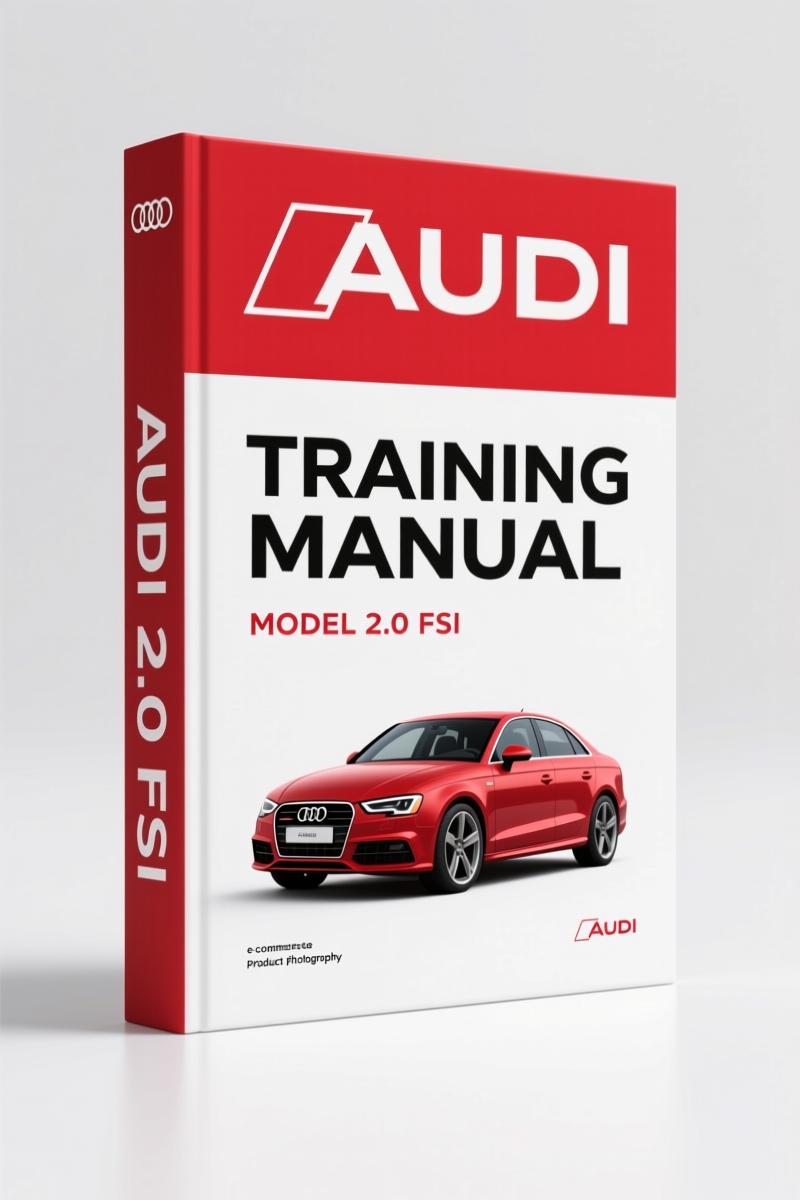
Audi 2.0 FSI Training Manual – Factory Self-Study Programme 279
Original price was: $40.50.$30.00Current price is: $30.00.
OEM Audi 2.0 FSI training manual (44 pages). Covers direct injection, stratified charge, NOx catalyst, and CAN-Bus interfaces. Essential for professional diagnostics.
Description
Audi 2.0 FSI Training Manual
I’ve watched a shop waste a Saturday chasing a misfire on a Audi 2.0 FSI Training Manual because the aftermarket wiring diagram had the injector pins swapped. That’s what happens when you trust a scan of a scan instead of the factory paperwork. This 44-page self-study programme (SSP 279) is the real thing – the same document Audi techs used to learn the 2.0 FSI engine with 110 kW and direct injection. It’s not a repair manual, but if you don’t understand how the stratified charge mode works or where the camshaft position sensor lives, you’ll waste time guessing.
Modos Operativos: Stratified Charge and Homogeneous Mode
The 2.0 FSI doesn’t run the same way at every rpm. Pages 17–23 lay out the two operating modes – stratified charge for low-load efficiency and homogeneous for full power. You need to know when the engine switches because the fuel pressure, injection timing, and even the exhaust gas temperature change. Miss that detail and you’ll misdiagnose a lean condition. The manual explains the transition logic, including the CAN-Bus signals that trigger the shift. For the injector timing, see page 31 for the high-pressure injectors N30–N33.
What the 44 Pages Cover – Engine, Fuel, and Exhaust
Here’s the breakdown straight from the Índice: introduction (page 4), main engine features (page 4), 2.0 ltr. FSI engine (page 5), pistons and oil circuit (pages 6–7), cylinder head and camshaft phasing (pages 8–11), intake manifold and air intake (pages 12–13), system architecture and CAN-Bus interfaces (pages 14–16), engine control unit and operating modes (pages 17–23), fuel system including the single-plunger high-pressure pump and fuel rail (pages 24–30), injectors (page 31), exhaust system including NOx storage catalyst and regeneration phases (pages 32–36), EGR (page 37), function diagram (page 38), and special tools (page 40). Every page has factory illustrations with component callouts.
Torque Specs and Special Tools
Page 40 lists the special tools required for timing chain service, fuel injector removal, and intake flap adjustment. If you’re pulling the cylinder head on this engine, you need the camshaft locking tool and the tensioner pin. The manual doesn’t give torque values for every bolt – it’s a training manual, not a repair manual – but it tells you which tool to use and why. That alone saves you from hammering a seal driver into a bore that needs a press-fit adapter. For actual torque specs, you’ll pair this with the workshop manual. But without the training manual, you won’t understand the sequence.
Why the Factory Training Manual Beats Aftermarket Data
Aftermarket documents often skip the “why” and just give you a procedure. This Audi training manual shows the cross-section of the high-pressure fuel pump on page 26, the flow of recirculated exhaust gas on page 37, and the regeneration phases of the NOx catalyst on pages 34–35. You can trace the air path from the throttle valve through the intake manifold runner flaps. When a technician understands the system, they diagnose faster and break fewer parts. The Automotive Industry Overview confirms that manufacturer training materials reduce comeback rates. This is the same material Audi used internally – not a reprint, not a paraphrase.
CAN-Bus Interfaces and Engine Control Unit Details
Pages 16–17 detail how the engine control module communicates with the transmission, ABS, and instrument cluster via CAN-Bus. If you’re swapping an engine or chasing a no-start with a communication fault, these pages show the signal paths. The manual also covers the MSV (metering solenoid valve) and its role in regulating fuel pressure. For context on how the transmission interacts, see the Audi multitronic 01J Training Manual – CVT Design & Function (100 Pages) and the Audi 09L, 0AT, 0B6, 0BQ, 09E 2006 Training Manual – Factory Specs. Those manuals pair well with this FSI material if you’re working on the whole powertrain.
3 Systems You Should Understand Before Tearing Down
First, the fuel system: single-plunger high-pressure pump, fuel rail pressure sensor G247, and injectors N30–N33. Second, the variable intake manifold with the lower section and tumble flaps. Third, the exhaust aftertreatment with NOx sensor G295 and temperature sensor G235. If you skip studying these three, you’ll likely flood a cylinder or burn out a catalyst during a test drive. The training manual devotes pages 24–36 to these systems. For the exhaust specifically, the Audi Q7 Training Manual – 76-Page Factory Self-Study Programme 361 covers similar NOx trap technology on a different platform, but this FSI manual focuses on the 2.0 L.
Frequently Asked Questions
- Is this a repair manual with torque specs for head bolts?
- No. This is a self-study programme (SSP) that explains system design and function. It does not list bolt torque values. Use it to understand the engine before you touch a wrench, then refer to the official repair manual for fastener specs.
- Will this cover the 2006 Audi A3 2.0 FSI?
- Yes, the engine variant described is the 2.0 FSI with 110 kW, used in A3, A4, and other Audi models from the mid-2000s. The manual covers mechanical and electronic concepts that apply across those installations.
- Does it include wiring diagrams?
- Yes, but only a function diagram on page 38. For full wiring diagrams, you need the factory wiring diagram manual. This training manual gives you the logic behind the CAN-Bus and sensor signals.
- Can I use this for other FSI engines like the 1.6 FSI?
- Some principles overlap, but the 2.0 FSI has unique components like the single-plunger high-pressure pump and specific piston geometry. The manual is model-specific. For other FSI engines, look for their own SSPs.
After you’ve read through the 44 pages, you’ll know the difference between stratified and homogeneous mode, how the NOx storage catalyst regenerates, and which special tool you need for the camshaft timing. That knowledge keeps your diagnostic time under an hour instead of a full day. Access the Factory Manual now – it’s the difference between guessing and knowing.
Additional information
| Brand | Audi |
|---|---|
| Language | English |
2 reviews for Audi 2.0 FSI Training Manual – Factory Self-Study Programme 279
You may also like…
-
Sale!
Audi 5000 S 1985 Wiring Diagram – OEM Cooling Fan Circuit Data
Original price was: $86.90.$55.00Current price is: $55.00. -
Sale!
Audi 100, 200 1989 Workshop Manual – Factory Service for 5-Cylinder Engine
Original price was: $63.45.$45.00Current price is: $45.00. -
Sale!
Audi A3 2003 Repair Manual – Fuel System Service Documentation
Original price was: $63.45.$45.00Current price is: $45.00. -
Sale!
Audi A8, Q7 Training Manual – Ceramic Brake Systems
Original price was: $54.00.$45.00Current price is: $45.00.
Related products
-
Sale!

Service Manual – International HS 2.8L Engine – 130 Pages of Factory Specs
Original price was: $56.40.$40.00Current price is: $40.00. -
Sale!

International 1000-3000 Series Operators Manual – 132 Pages of OEM Specs
Original price was: $14.40.$10.99Current price is: $10.99. -
Sale!

2011 Parts Catalog – International Truck OE Parts Documentation (1786 Pages)
Original price was: $34.50.$25.00Current price is: $25.00. -
Sale!
1991 Electrical Schematic – 112-Page OEM Wiring Diagram for International 1000-3000 Series
Original price was: $22.75.$17.50Current price is: $17.50.
David K. –
I am extremely satisfied with this transaction. The pages are clean and well indexed. Contains detailed bolt torque specs for Audi. Saved my weekend project! Thank you.
Michael T. –
I am so happy with this transaction. The file is very clear. Contains detailed schematics for Audi. Saves me so much time.