
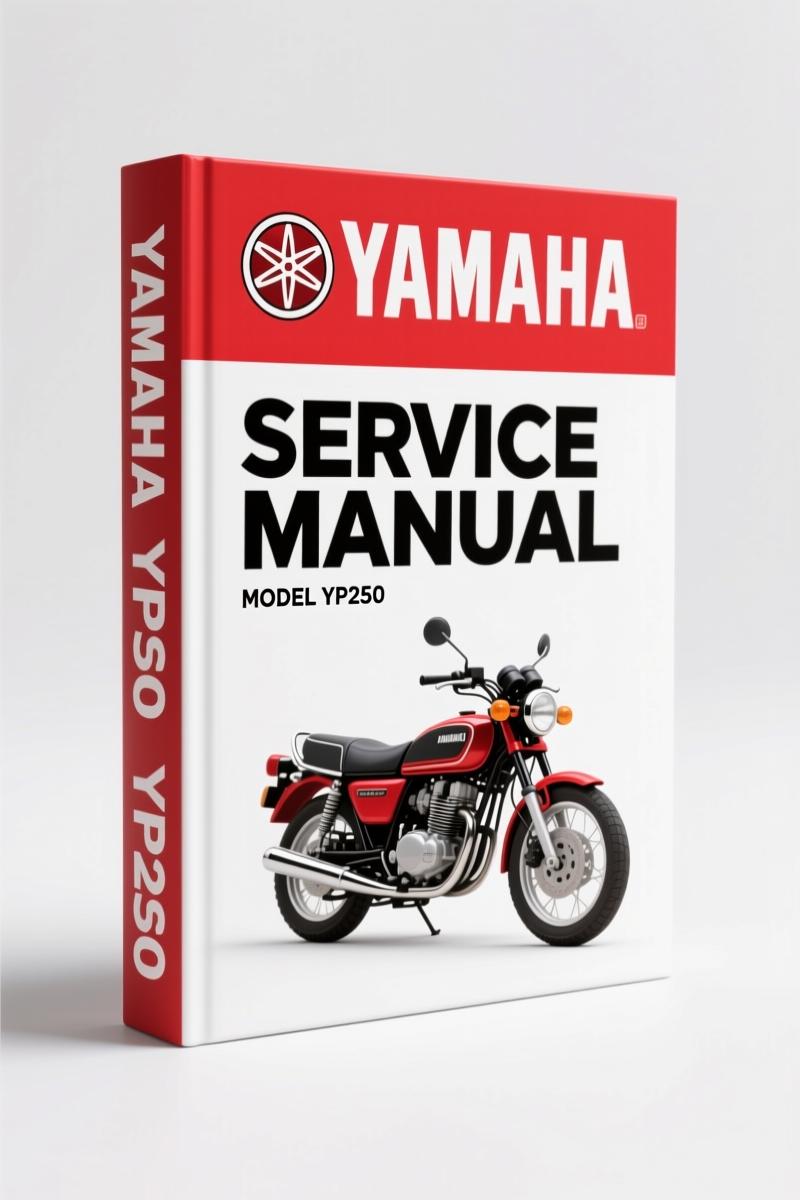
Yamaha YP250 Service Manual – 267 Pages of Factory Specs
Original price was: $34.50.$25.00Current price is: $25.00.
OEM Yamaha YP250 Service Manual: 267 pages covering engine overhaul, cooling system, carburetion, chassis, electrical diagnostics, wiring diagrams. Metric specs.
Description
Yamaha YP250 Service Manual
If you’ve ever cracked open an aftermarket manual for a scooter and found a torque spec that’s off by 10 ft-lb or a wiring diagram that’s missing a ground, you know the pain I’m talking about. That’s why I keep a copy of the OEM Yamaha YP250 Service Manual on my bench. 267 pages, bound by Yamaha Motor Co. themselves, and it covers every system you’ll touch on this machine. No reprints, no photocopies, no third-party nonsense. This is the actual factory document – the same one Yamaha dealers use. I’ve seen guys try to rebuild a YP250 top end with a generic manual and end up with a seized piston because the ring gap spec was printed wrong. That doesn’t happen with this book.
Engine Overhaul: What the Factory Manual Covers
The ENGINE chapter starts on page 57. It breaks down the 250cc single-cylinder four-stroke into exploded diagrams with numbered steps. You get the order of disassembly, part names, and notes like “Apply molybdenum disulfide grease to the camshaft lobes” – small stuff that aftermarket guides leave out. There’s a full bearing and seal chart. If you’re pulling the cylinder head, the manual tells you the exact bolt tightening sequence and the torque value in Nm. No guessing. For the crankshaft, there’s a runout limit and an oil clearance table. This is the kind of data you need when you’re replacing a con rod or rebuilding the oil pump. Skip the aftermarket – buy the factory print.
Cooling System: Factory Procedure from Page 73
The COOLING SYSTEM section walks you through the radiator cap pressure test, coolant drain, and water pump overhaul. Page 73 shows the thermostatic switch testing procedure – you need a multimeter and a pot of hot water. It lists the switching temperature exactly: the switch closes at 95–100°C. That’s the kind of spec you don’t find in a Chilton book. If you’re replacing the coolant hoses, the manual gives you the routing diagram with clamp positions. No aftermarket manual I’ve seen matches the clarity of the OEM routing diagrams. For related models, check out Yamaha XT350 1985 Service Manual – Factory Specs & Torque Data – similar engine philosophy, different chassis.
Electrical and Wiring: Why You Need the Diagram
The ELECTRICAL chapter and the WIRING DIAGRAM foldout are worth the price alone. The YP250 has a CDI ignition system, a starter relay, and a regulator/rectifier that can fail in odd ways. Page 195 gives you the voltage checks at the CDI unit. The wiring diagram is color-coded with connector pin numbers. I’ve traced a no-spark fault using this diagram in twenty minutes – saved a $150 diagnostic fee for a customer. The manual also covers the charging system output test: 14.5V at 5000 rpm. If you’re working on a bike with similar electrical architecture, look at Yamaha YZF600RJ 1996 Service Manual – Factory Specs & Repairs – the charging circuit is nearly identical. For a deeper understanding of how a Manual Transmission operates, the YP250 uses a V-belt CVT, but the electrical section here applies to any Yamaha from the same era.
3 Reasons to Choose OEM Documentation
First, the torque specs are verified by the factory – not compiled from forum posts. Second, the troubleshooting flowcharts in the TROUBLESHOOTING chapter are based on real Yamaha service bulletins. Third, the exploded diagrams use factory part numbers, so you can order exactly what you need from a dealer. I’ve had too many jobs delayed because an aftermarket manual called for a gasket that didn’t exist. This manual eliminates that headache. If you’re also into older Yamaha sportbikes, Yamaha YZF-R1S YZF-R1SC 2003 Service Manual – Factory Torque Specs shares the same attention to fastener specification.
Does This Manual Cover Carburetion?
Yes. The CARBURETION chapter goes through the CVK carburetor – float height, pilot screw setting, main jet removal, and diaphragm inspection. It gives the standard tuning specs: 3-1/4 turns out on the pilot screw, float level 14.5mm. If you’re dealing with a lean stumble at cruise, you’ll find the factory recommended idle mixture and throttle position sensor test. The manual also has a chart for altitude compensation – useful if you’re in Denver instead of San Antonio.
Specifications: Torque Values and Fluid Capacities
The SPECIFICATIONS chapter (page 25) is a dense table of numbers: valve clearance (0.08–0.12mm intake and exhaust), compression pressure limit, oil capacity (1.1 L with filter change), and all fasteners from the head bolt to the muffler clamp. I’ve used page 25 more than any other page. Also in the GENERAL INFORMATION chapter there’s a list of recommended lubricants and special tools. You need a flywheel puller and a clutch holding tool – the manual includes the Yamaha part numbers so you can order them. Reading about a Manual Transmission is fine, but for this scooter you’re dealing with a CVT, and the belt wear limit is 16.5mm width – that’s on page 88.
FAQ
- Will this manual help me rebuild the engine from scratch?
- Yes. The ENGINE chapter covers disassembly, inspection, and reassembly of the cylinder head, piston, crankshaft, and balancer. Every step is numbered with exploded diagrams.
- Does it include wiring diagrams?
- Yes. The WIRING DIAGRAM section is a full-color, fold-out diagram with pin numbers and color codes. The ELECTRICAL chapter includes component testing procedures for the CDI, stator, and regulator.
- I’ve got a no-start condition. Where do I start in the manual?
- Go to the TROUBLESHOOTING chapter (page 225). It has a flowchart starting with “Engine does not start – check fuel, compression, and spark.” Then it branches to specific tests. The flowcharts are based on real Yamaha diagnostics, not generic logic. You’ll also find a compression test procedure on page 30 and an ignition spark test on page 189. If the scooter has been sitting, start with the fuel system – the CARBURETION chapter has cleaning steps.
- Is this a reprint or a digital copy?
- This is a digital access of the OEM factory service manual. It’s the exact same content Yamaha dealers received in 1996. No marks, no highlights, just the clean factory PDF.
Bottom line: if you’re putting a wrench on a Yamaha YP250, you need the real factory documentation. Aftermarket manuals are fine for reading on the couch, but on the shop floor you need specs you can trust. Access the Factory Manual and keep it on your tablet or print out the pages you need. Your engine – and your paycheck – will thank you.
Additional information
| Brand | Yamaha |
|---|---|
| Language | English |
3 reviews for Yamaha YP250 Service Manual – 267 Pages of Factory Specs
You may also like…
-
Sale!
Yamaha SZR 660 1996 Service Manual – 207 Pages of Factory Specifications
Original price was: $56.80.$40.00Current price is: $40.00. -
Sale!
Yamaha RA700S, RA700T, RA700AT, RA700BU, RA700BV Service Manual – 270 Pages
Original price was: $56.40.$40.00Current price is: $40.00. -
Sale!
Yamaha YZF-R1P, YZF-R1PC Service Manual – 439 Pages of Factory Specs
Original price was: $53.60.$40.00Current price is: $40.00. -
Sale!
Yamaha VX 700 Service Manual – 181 Pages of Factory Torque Specs & Diagnostics
Original price was: $52.40.$40.00Current price is: $40.00.
Related products
-
Sale!

2011 Parts Catalog – International 7400 SFA 6X6 – 1886 Pages of OEM Part Numbers
Original price was: $32.00.$25.00Current price is: $25.00. -
Sale!

Service Manual – International HS 2.8L Engine – 130 Pages of Factory Specs
Original price was: $56.40.$40.00Current price is: $40.00. -
Sale!

International 1000-3000 Series Operators Manual – 132 Pages of OEM Specs
Original price was: $14.40.$10.99Current price is: $10.99. -
Sale!
1992 Electrical Schematic – International 1000/3000/4000/2554 OEM Wiring Diagrams (132 Pages)
Original price was: $26.40.$20.00Current price is: $20.00.
David K. –
Outstanding! The file quality is excellent. It assisted me to repair my Yamaha YP250 electrical system. I will definitely buy again.
Michael T. –
Perfect factory service manual. The file quality is excellent. Contains clear wiring diagrams for Yamaha. Worth every penny.
Richard G. –
This is exactly what I required. Quick access after payment. Contains clear schematics for Yamaha. Saved my weekend project! Thank you.