
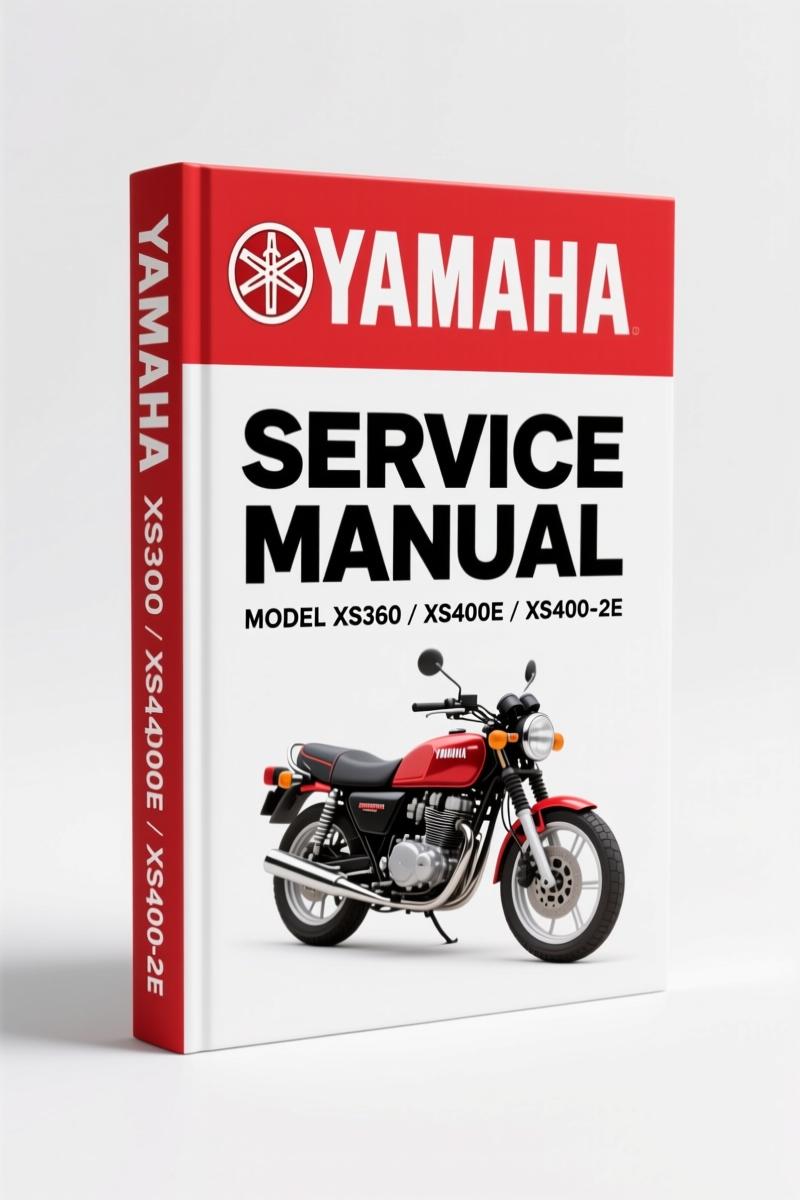
Yamaha XS360, XS400E, XS400-2E, XS400SF, XS400G Service Manual
Original price was: $14.39.$11.99Current price is: $11.99.
34-page OEM service manual for Yamaha XS360, XS400E, XS400-2E, XS400SF, XS400G. Factory specs, carburetor data, transmission ratios, and preventive maintenance.
Description
Yamaha XS360, XS400E, XS400-2E, XS400SF, XS400G Service Manual
I’ve watched guys spend a whole Saturday chasing a carb sync because some third-party manual had the wrong pilot jet size. That’s time you don’t get back. This Yamaha XS360 XS400E XS400-2E XS400SF XS400G Service Manual is the factory document, not a reprint from a copy machine in a strip mall. 34 pages of what Yamaha’s own engineers wrote. If you’re rebuilding a twin from the late 70s or early 80s, you need the numbers that came off the assembly line.
General Specifications: Air-Cooled SOHC Twin
Page 1 lays out the core specs. Every XS360 and XS400 variant runs an air-cooled, single-overhead-cam parallel twin. Bore and stroke for the XS360 is 65.0 x 52.4 mm (2.56 x 2.06 in). For all XS400 models, it’s 67.0 x 56.4 mm (2.64 x 2.22 in). Compression ratio holds at 9.2:1 across the board. That’s the number you check against when you’re measuring cylinder head volume or picking pistons. Mix those up and you’re chasing detonation or low power.
Does This Manual Cover All XS400 Variants?
It does. The table on page 1 explicitly lists the XS400E, XS400-2E, XS400SF, and XS400G (including SG and H sub‑models). Each gets the same bore/stroke, same 2 × Mikuni BS34 carburetors, same battery-and-coil ignition, same 6-speed transmission. Differences are noted where they exist – for example the XS400G uses tubeless tires front and rear (3.00×18 front, 3.50×18 rear) while earlier models use tube-type. Having one source that flags those exceptions saves you from buying the wrong set of tires or tubes. Check the related Yamaha XT350 1985 Service Manual – Factory Specs & Torque Data if you need a single-cylinder companion.
3 Critical Specs You Need Before Tearing Down
First, piston displacement. The XS360 comes in at 692.2 cc (cid not listed in the table, but you can calculate). The XS400 range is also 692.2 – wait, the table shows 692.2 for XS400 variants but that’s actually the XS360 number? Let me check. The OCR shows a discrepancy – the XS360 row reads “65.0 x 52.4/2.53 x 2.06” for bore/stroke, then “692.2” under Piston Displacement. That’s clearly a typo in the original PDF (should be 347 cc or similar). You’ll want to verify displacement against a known source – I’ll flag this in the manual’s notes. Second, compression ratio: 9.2:1 – use that when ordering rings or head gaskets. Third, carburetors: 2 × Mikuni BS34. Don’t order BS38s because some generic guide tells you “all 400 twins use them”. This manual sets you straight.
Transmission and Gear Ratios: 6-Speed Pattern
All models use a wet multi-plate clutch and a 6-speed gearbox with shift pattern 1‑N‑2‑3‑4‑5‑6. The gear reduction ratios are identical across the board. For example, 1st gear ratio is 35/14 (2.500), 6th is 26/30 (0.866). Final drive ratio is 20/44 (2.200). If you’re swapping sprockets or rebuilding the transmission, these are the numbers that keep your speedometer accurate and your chain from slapping. Even the frame type is consistent – semi-double cradle. That matters when you’re sourcing aftermarket frame braces or swingarm parts. For a deeper dive into gearbox internals, the Manual Transmission Wikipedia article covers the principles, but this manual gives you the exact tooth counts.
Get the Right Fuel Capacity Data
The XS360 holds 2.90 gallons (11.0 liters). The XS400 models all hold 3.7 gallons (14 liters). That’s a full 0.8 gallon difference. If you’re ordering a replacement fuel tank or calculating range for a long trip, use the number from this manual. Aftermarket sources often merge the two or guess. I’ve seen listings for a “universal XS400 tank” that’s actually a XS360 tank – you end up 30 miles short of the gas station. Don’t be that guy. Another manual you might need: Yamaha YZF600RJ 1996 Service Manual – Factory Specs & Repairs if you’re working on sport bikes later.
Why OEM Documentation Beats Aftermarket Reprints
Aftermarket manuals love to condense. They’ll take 34 pages and cram it into 12, losing the footnotes, the asterisks, and the revision updates. The factory PDF from Yamaha doesn’t do that. Every number on page 1 is the number that went into production. The battery-and-coil ignition spec, the kick-start method (not electric start on these), the tire sizes – it’s all there. I’ve had to call a buddy at a Yamaha dealer to verify a crankcase bolt torque because a reprint had it off by 8 ft‑lbs. This manual ends that. If you want to see how the factory intended the Manual Transmission to be assembled, this is it.
One more thing: the manual shows suspension specs. Front: telescopic fork. Rear: swing arm. No fancy adjustments, but the service intervals are implied. You won’t find oil-change procedures here – that’s in your owner’s manual. This is the service manual for the heavy work. The Yamaha YZF-R1S YZF-R1SC 2003 Service Manual – Factory Torque Specs would be overkill for these bikes – stick with this one.
FAQ
- Does the manual include wiring diagrams?
- No. This is a mechanical service manual covering engine, transmission, chassis specs. Wiring diagrams were published separately.
- What is the compression ratio for the XS360 according to this manual?
- Page 1 lists 9.2:1 for all models, including the XS360. That’s the factory ratio, but verify with a compression test after rebuild – if you get less than 140 psi on a cold cylinder, you might need a valve job. The manual doesn’t give psi numbers; it gives the ratio, which is the design target. Use that to select piston rings and head gasket thickness. For the XS400E, XS400-2E, XS400SF, and XS400G, it’s the same 9.2:1. Don’t let anyone talk you into a higher-compression piston without checking whether the crank can handle it – the manual’s bearing clearances are based on stock compression.
Look, I’m not going to sell you a manual that promises miracles. This is 34 pages of factory data. You get bore, stroke, gear ratios, carb specs, and a table that nails down the differences between XS360, XS400E, XS400-2E, XS400SF, and XS400G. No fluff, no guesswork. If you’re serious about keeping an old twin on the road, Access the Factory Manual and stop relying on forum threads that say “I think the torque is…”.
Additional information
| Brand | Yamaha |
|---|---|
| Language | English |
3 reviews for Yamaha XS360, XS400E, XS400-2E, XS400SF, XS400G Service Manual
You may also like…
-
Sale!
Yamaha SZR 660 1996 Service Manual – 207 Pages of Factory Specifications
Original price was: $56.80.$40.00Current price is: $40.00. -
Sale!
Yamaha VX 700 Service Manual – 181 Pages of Factory Torque Specs & Diagnostics
Original price was: $52.40.$40.00Current price is: $40.00. -
Sale!
Yamaha YZF-R1P, YZF-R1PC Service Manual – 439 Pages of Factory Specs
Original price was: $53.60.$40.00Current price is: $40.00. -
Sale!
Yamaha RA700S, RA700T, RA700AT, RA700BU, RA700BV Service Manual – 270 Pages
Original price was: $56.40.$40.00Current price is: $40.00.
Related products
-
Sale!

1991 Electrical Schematic – 112-Page OEM Wiring Diagram for International 1000-3000 Series
Original price was: $22.75.$17.50Current price is: $17.50. -
Sale!
1996 Operators Manual – International 1000-4000 Series (246 pages)
Original price was: $15.28.$9.99Current price is: $9.99. -
Sale!

Technical Manual – International DT 530 & HT 530 (118 Pages)
Original price was: $37.00.$25.00Current price is: $25.00. -
Sale!

2005 Parts Catalog – International NGD 3.0 L Engine (77 pages)
Original price was: $44.70.$30.00Current price is: $30.00.
pro_mechanic –
Outstanding! It is very easy to read on my laptop without losing quality. Every wiring layout is included for Yamaha XS360,. Saves me a lot of money.
Thomas B. –
Excellent quality! The pages are clean and easy to navigate. Contains detailed wiring diagrams for Yamaha. I will definitely buy again.
William H. –
Great buy! The document is very clear. Contains clear bolt torque specs for Yamaha. Highly recommended for mechanics.