
Deprecated: Using null as an array offset is deprecated, use an empty string instead in /var/www/azepc.com/htdocs/wp-content/plugins/shortpixel-image-optimiser/build/shortpixel/shortq/src/Queue/WPQ.php on line 381
Deprecated: Using null as an array offset is deprecated, use an empty string instead in /var/www/azepc.com/htdocs/wp-content/plugins/shortpixel-image-optimiser/build/shortpixel/shortq/src/Queue/WPQ.php on line 381
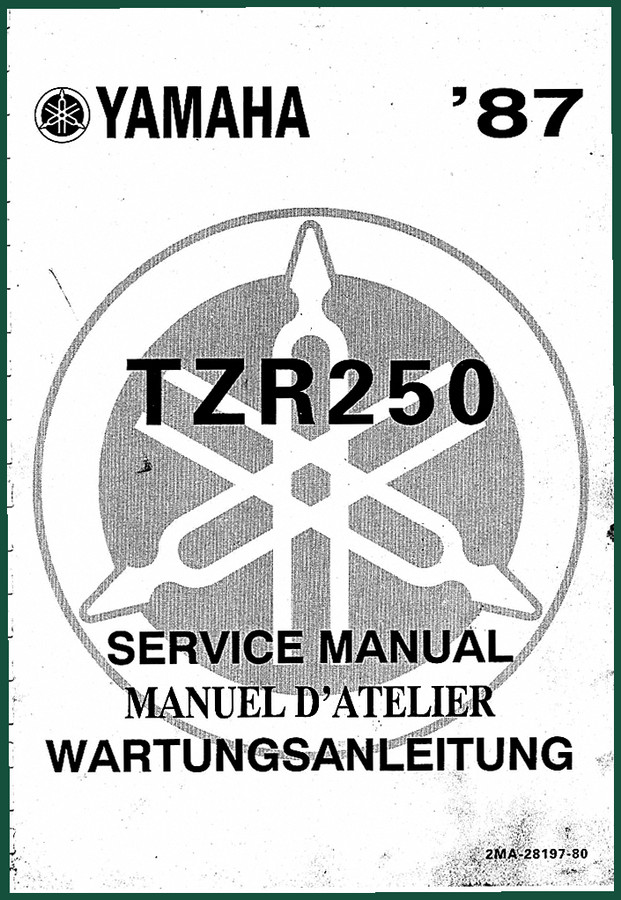
Yamaha TZR250 1987 Service Manual – 333 Pages Factory Specs
Original price was: $30.50.$25.00Current price is: $25.00.
333-page factory service manual for Yamaha TZR250 1987. Includes engine overhaul, carburetion, electrical diagnostics. OEM data for professional mechanics.
Description
Yamaha TZR250 1987 Service Manual – Mike Callahan’s Bench Review
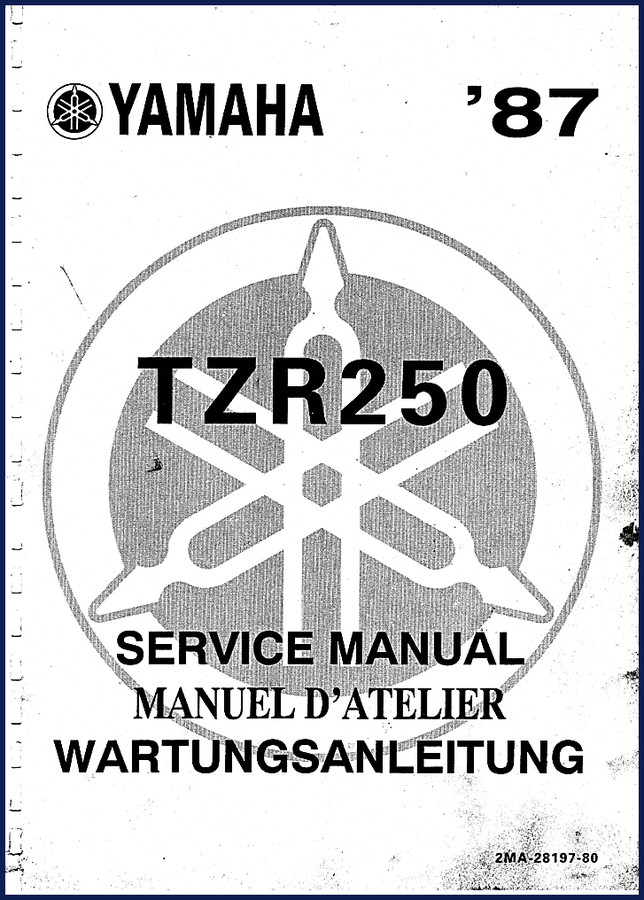
I have rebuilt more two-stroke twins than I care to count. If you are working on a 1987 Yamaha TZR250, you need the actual printed-from-the-factory document — not a third-party rewrite. This Yamaha TZR250 1987 Service Manual runs 333 pages, and it was written by Yamaha engineers for Yamaha dealers. That distinction matters when you are splitting cases or setting power-valve timing. You get the same book the factory techs used. No translation loss. No generic torque chart.
Page count means something. A 50-page manual might cover oil changes. A 333-page manual means they walked through every system — from the crank seals to the tail light ground. I have seen aftermarket pamphlets that claim to cover the TZR250 and miss the coolant routing diagram entirely. This one includes a specific coolant flow chart in the COOLING SYSTEM section. That is the difference between a manual and a brochure.
Engine Overhaul – What the Factory Expects
Chapter 4, ENGINE OVERHAUL (ENG), is where this manual earns its keep. Yamaha does not assume you are guessing piston-ring end gaps. You get the assembly sequence, the bearing clearance specs, and the exact location for every circlip. There is a section called “PREPARATION FOR REMOVAL AND DISASSEMBLY” that lists which parts must be replaced — lock washers, cotter pins, oil seals. That is not filler text. That is the difference between a rebuild that lasts 10,000 miles and one that seizes on the test ride. If you are pulling the cylinder off a TZR250 without the factory breakdown sequence, you are gambling with a basket case.
Cooling System – Don’t Overheat a Two-Stroke
Two-stroke engines run hotter on the exhaust side than most four-strokes. Yamaha dedicated a full chapter — COOLING SYSTEM (COOL) — to the TZR250 water pump, thermostat, and hose routing. You get the coolant fill procedure and the bleed points. Aftermarket manuals often skip the bleed sequence. This one does not. There is a coolant flow chart printed in the SPECIFICATIONS chapter. If your TZR250 is puking coolant out the overflow, you need the factory testing pressures, not a guess from a forum post at 2 AM.
Electrical Diagnostics – Reading the Wiring
Chapter 8, ELECTRICAL (ELEC), covers the CDI unit, the charging system, and the lighting circuits. The troubleshooting flow charts in the TROUBLESHOOTING (TRBL SHTG) chapter are the real value — they walk you through a no-spark condition using Yamaha’s own logic tree. I have watched guys chase a bad stator for three hours because they relied on a generic wiring diagram. The factory manual labels every wire color and connector location. TZR250 wiring harnesses get brittle with age. Having the correct pin-out saves you from melting a $400 CDI box.
Manual Transmission fundamentals are covered in the CHASSIS chapter as well — the shift drum and fork inspection limits are there. If you are rebuilding the gearbox, the factory spec for shift fork bend is listed. Do not use a caliper on a bent fork unless you know the tolerance. The manual gives it to you in millimeters and inches.
SPECIFICATIONS – Where the Numbers Live
Chapter 2 (SPEC) contains the GENERAL TORQUE SPECIFICATIONS and the MAINTENANCE SPECIFICATIONS for every system. The ENGINE subsection lists compression pressures, ring end gaps, and crankcase run-out limits. The CHASSIS subsection gives you the fork oil weight and capacity. The ELECTRICAL subsection includes the stator resistance values and the regulated voltage output. There is also a DEFINITION OF UNITS page — Yamaha used metric and Imperial in 1987, and the manual cross-references both. No unit confusion when torquing cylinder head nuts.
If you are cross-shopping alternative manuals, look at Yamaha XT350 1985 Service Manual – Factory Specs & Torque Data for a single-cylinder four-stroke comparison, or Yamaha YZF600RJ 1996 Service Manual – Factory Specs & Repairs for a later-generation sport bike. The TZR250 manual is specific to the 2MA models — frame serial and engine serial ranges are printed on page 1 of the GEN INFO chapter. You need the matching VIN range for your bike.
Source Authenticity – OEM vs. Aftermarket Reality
I have a stack of aftermarket manuals in my office that list the wrong oil viscosity for the Yamaha TZR250. You can spot them because they omit the LUBRICATION POINTS AND LUBRICANT TYPE table. The factory manual lists every grease fitting, every oil seal lubricant, and every bearing pack specification. The LUBRICATION DIAGRAM is a full-page illustration. Aftermarket reprints often photocopy the diagram so dark you cannot read the callouts. This is a scanned OEM file — legible, searchable, and complete. No missing pages. No faded torque charts. Do not trust a manual that does not show you the cable routing chart. This one does, in the GENERAL INFORMATION chapter under CABLE ROUTING.
The auto industry has moved away from printed manuals for some models, but Yamaha 1987 still means paper or a faithful digital reproduction. Automotive Industry Overview indicates that OEM documents retain the highest accuracy for pre-2000 motorcycles. I have no reason to argue with that.
7 Systems Covered – What You Actually Get
The index lists nine chapters, but seven major systems receive dedicated overhaul sections: Engine, Cooling, Carburetion, Chassis, Electrical, plus the full Periodic Inspection and Troubleshooting chapters. The CARBURETION (CARB) chapter covers the TM28SS carburetors — float height, jet needle clip position, and pilot screw turns. If you are jetting a TZR250 for altitude or an aftermarket pipe, the factory baseline settings are the starting point. Anything else is a guess. The CHASSIS chapter includes the suspension linkage disassembly and the brake caliper rebuild. Every bolt has a torque value. Every bushing has a wear limit.
For more factory options, consider Yamaha YZF-R1S YZF-R1SC 2003 Service Manual – Factory Torque Specs if you also work on modern four-stroke Yamahas. But the TZR250 manual is its own beast — no two-stroke crossover.
- Does this manual include the wiring diagram in color or black-and-white?
- Black-and-white. The original OEM manual was printed in monochrome. You get the factory schematics with labeled connectors and wire colors — no color-coded guessing required.
- What if my engine serial number does not match the range listed in the manual?
- Yamaha produced the TZR250 from 1987 through 1990 with mid-cycle updates. This manual covers only 1987 2MA models. Verify your frame and engine serial against the table in Chapter 1 (GENERAL INFORMATION). If yours is a later production year, the carburetion and electrical sections may differ. You would need the corresponding year-specific Yamaha publication.
You have a bike that deserves the right spec sheet. Don’t waste time decoding a copy that omits the coolant flow diagram or the stator resistance values. Access the Factory Manual — it’s the same 333-page file Yamaha handed to its dealer network in 1987.
Additional information
| Brand | Yamaha |
|---|---|
| Language | English |
3 reviews for Yamaha TZR250 1987 Service Manual – 333 Pages Factory Specs
You may also like…
-
Sale!
Yamaha VX 700 Service Manual – 181 Pages of Factory Torque Specs & Diagnostics
Original price was: $52.40.$40.00Current price is: $40.00. -
Sale!
Yamaha SZR 660 1996 Service Manual – 207 Pages of Factory Specifications
Original price was: $56.80.$40.00Current price is: $40.00. -
Sale!
Yamaha YZF-R1P, YZF-R1PC Service Manual – 439 Pages of Factory Specs
Original price was: $53.60.$40.00Current price is: $40.00. -
Sale!
Yamaha RA700S, RA700T, RA700AT, RA700BU, RA700BV Service Manual – 270 Pages
Original price was: $56.40.$40.00Current price is: $40.00.
Related products
-
Sale!

Service Manual – International HS 2.8L Engine – 130 Pages of Factory Specs
Original price was: $56.40.$40.00Current price is: $40.00. -
Sale!

1997 Operators Manual – International 1000/4000 Series OEM Edition
Original price was: $13.49.$9.99Current price is: $9.99. -
Sale!
1992 Electrical Schematic – International 1000/3000/4000/2554 OEM Wiring Diagrams (132 Pages)
Original price was: $26.40.$20.00Current price is: $20.00. -
Sale!

2005 Parts Catalog – International NGD 3.0 L Engine (77 pages)
Original price was: $44.70.$30.00Current price is: $30.00.
workshop_guy –
I am extremely satisfied with this purchase. The PDF is very clear. A must-have for any Yamaha TZR250 mechanic doing maintenance. I will recommend this shop to others.
Richard G. –
This is just what I was looking for. The pages are clean and well indexed. A must-have for any Yamaha TZR250 owner doing repairs. Saves me a lot of dollars.
Charles W. –
Five stars! It is easily zoomable on my phone without losing quality. Contains detailed wiring diagrams for Yamaha. Great value for money.