
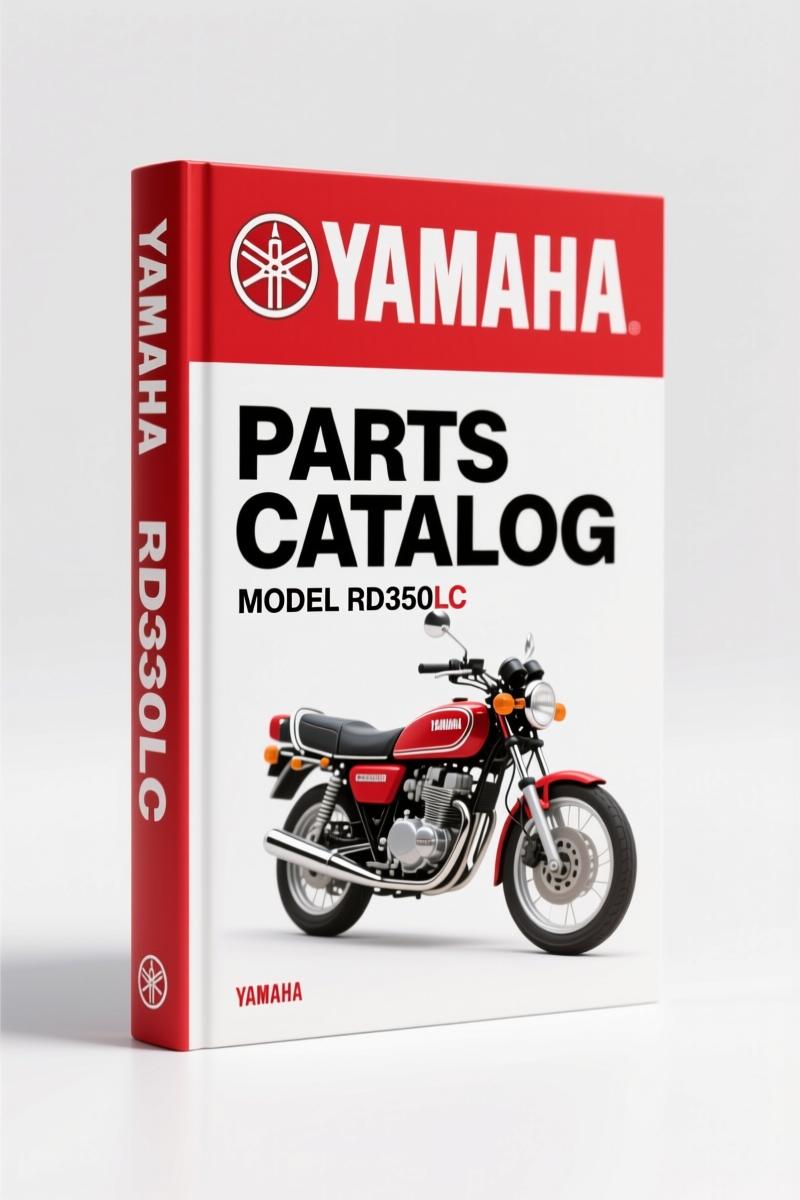
Yamaha RD350LC 1986 Parts Catalog – OEM Exploded Diagrams & Part Numbers
Original price was: $39.00.$25.00Current price is: $25.00.
OEM Yamaha RD350LC 1986 parts catalog: 88 pages of exploded diagrams, part numbers, and factory specifications for European models.
Description
Yamaha RD350LC 1986 Parts Catalog – OEM Factory Part Numbers
Let me tell you something about parts catalogs. If you’re working on a Yamaha RD350LC 1986 Parts Catalog and you don’t have the factory part numbers in front of you, you’re wasting time and money. I’ve seen guys order three different clutch covers because the aftermarket microfiche had the wrong suffix. This is the real deal – an original Yamaha publication, 88 pages of exploded diagrams and part lists, straight from the 1986 model year. No reprints, no third-party guesswork. You get the same document that Yamaha dealers used when the bike was new.
Flipping through the foreword (page 3 of the PDF), Yamaha spells it out: “When you are ordering replacement parts … refer to this Parts Catalogue and quote both part numbers and part names correctly.” They even tell you to watch for Yamaha Parts News updates – that’s how seriously they take accuracy. The catalog uses abbreviations like U.R. (use size and number as required) and A.P. (alternate parts), and it marks parts that aren’t supplied by Yamaha with a dash. You need that level of detail when you’re tracking down NOS parts for a 40-year-old two-stroke.
This isn’t a service manual. It won’t tell you how to rebuild the crank or set timing. What it does give you is the exact part number for every nut, bolt, gasket, and graphic kit on the RD350LC ’86 (1UA). Need a fuel tank graphic for the Silky White color? The catalog shows part number 3J1-29240-10, with a “for MXR” note and a color code key. That kind of precision keeps you from buying the wrong decal set for your frame number range (1WT-005101 and following).
7 Systems Covered in the Original Yamaha Parts Breakdown
Because the catalog is an OEM parts list, it covers every system on the bike: engine – from the crankcase halves to the pilot jets; frame – fuel tank, fenders, flasher lights; electrical – stator, CDI, harness; wheels and brakes; exhaust; controls; and bodywork. Each section starts with an exploded diagram and a table of part numbers, descriptions, quantities, and remarks. For example, the front flasher light assembly (2FS-83310-60) shows two per bike, with bulbs (115-83311-60, 6V 18W) listed individually. That’s how you avoid ordering a whole assembly when you only need a bulb.
Does This Manual Cover the RD350LC 1986 (1UA) Model?
Yes. The header on page 1 reads “YAMAHA PARTS CATALOGUE RD350LC’86 (1UA) EUROPE.” This version is for the European market, but the chassis and engine numbers (1WT-005101 and following) match many US gray-market imports. If you have a 1986 RD350LC with the 1UA frame code, this catalog is the correct reference. For the 1982 model, see the YAMAHA RD350LC 1982 Parts Catalog. Yamaha made running changes – don’t assume interchangeability.
Understanding the Part Numbering – No Room for Error
Yamaha used a 12-character part number system (e.g., 2W4-24110-00 XS). The suffix letters like “XS” or “GE” indicate color or sub-model. In the catalog, the “Remarks” column lists color abbreviations: SW for Silky White, NYB for New Yamaha Black. If you’re restoring a bike to original, you match those letters exactly. The catalog also notes assemblies with an indented dot (.) – for instance, the fuel tank assembly lists the tank itself and then the graphic kit separately. You don’t double-order.
3 Reasons to Choose OEM Documentation Over Aftermarket
First, part numbers from factory documents are guaranteed correct for the build date. Aftermarket catalogs often merge multiple years and drop the suffix, which is how you end up with a throttle cable that’s two inches too long. Second, you get the original exploded views that show exactly how parts interlock – helpful for tracking down missing washers or rubbers. Third, the catalog includes frame and engine serial number ranges, so you know if a part was superseded. I’ve seen enough bike shops charge labor for returning wrong parts that I won’t touch a job without the OEM list. For a high-performance two-stroke like the RD, precision matters. If you’re also working on other Yamahas, check the Yamaha YZF-R1 2002 Parts Catalog – OEM Factory Part Numbers or the Yamaha GTS1000AE 1993 Parts Catalog – Factory Microfiche PDF.
Color Codes and Graphic Applications – Get the Right Look
Page 5 of the PDF gives the color code table: GE = Silky White, 6G = New Yamaha Black. The graphic decals are listed with a color abbreviation in the Remarks column – for example, “MAX.RED” for the fuel tank graphic set. If you’re matching a factory paint scheme, you need this data. Aftermarket decals might look close, but the OEM catalog tells you exactly which kit goes with which color code. That’s the difference between a restoration and a paint job.
FAQ
- Is this the same as a service manual?
- No. A service manual covers repair procedures and specs. This parts catalog lists every component and its factory part number – no torque values, no step-by-step repairs. It’s for ordering parts accurately.
- Does this include part numbers for the engine and transmission internals?
- Yes. The catalog covers the complete engine assembly – pistons, rings, bearings, gears, seals, even the small screws inside the carburetor. Each component has its own line item with quantity per assembly. For example, the main nozzle and pilot jet are listed separately under the carburetor assembly.
- How do I use the color code and frame number info?
- Match your bike’s frame serial number (stamped on the steering head) to the range given in the foreword (1WT-005101 and following). Then use the color abbreviation in the Remarks column to confirm you’re ordering the correct graphic or painted part. The catalog also lists available colors (SW, NYB) so you can identify original finish.
- Will this help me find discontinued parts?
- It will give you the exact OEM number, which you can cross-reference with aftermarket suppliers or NOS dealers. The catalog also notes alternate parts (A.P.) and local made (L.M.) items, helping you decide when a non-Yamaha part is acceptable.
If you’ve got an RD350LC on the lift and you’re tired of guessing part numbers, this factory catalog is your reference. It cuts the BS and puts the right number in the order form. The document is 88 pages of OEM data, scanned directly from the 1986 Yamaha print. Access the Factory Manual and keep it on your phone or tablet – you’ll use it every time you open that parts fiche. For more context on motorcycle repair fundamentals, see the Automotive Industry Overview and the Internal Combustion Engine pages.
Additional information
| Brand | Yamaha |
|---|---|
| Language | English |
3 reviews for Yamaha RD350LC 1986 Parts Catalog – OEM Exploded Diagrams & Part Numbers
You may also like…
-
Sale!
Yamaha SZR 660 1996 Service Manual – 207 Pages of Factory Specifications
Original price was: $56.80.$40.00Current price is: $40.00. -
Sale!
Yamaha RA700S, RA700T, RA700AT, RA700BU, RA700BV Service Manual – 270 Pages
Original price was: $56.40.$40.00Current price is: $40.00. -
Sale!
Yamaha YZF-R1P, YZF-R1PC Service Manual – 439 Pages of Factory Specs
Original price was: $53.60.$40.00Current price is: $40.00. -
Sale!
Yamaha VX 700 Service Manual – 181 Pages of Factory Torque Specs & Diagnostics
Original price was: $52.40.$40.00Current price is: $40.00.
Related products
-
Sale!

2011 Parts Catalog – International 7400 SFA 6X6 – 1886 Pages of OEM Part Numbers
Original price was: $32.00.$25.00Current price is: $25.00. -
Sale!

1991 Operators Manual – International Truck OEM Specs (108 Pages)
Original price was: $13.63.$10.99Current price is: $10.99. -
Sale!

2011 Parts Catalog – International Truck OE Parts Documentation (1786 Pages)
Original price was: $34.50.$25.00Current price is: $25.00. -
Sale!

1995 Operators Manual – International 1000-4000 Series | OEM Documentation
Original price was: $12.49.$9.99Current price is: $9.99.
Richard G. –
This is exactly what I was looking for. The file quality is excellent. A must-have for any Yamaha RD350LC owner doing maintenance. I will recommend this shop to others.
workshop_guy –
Great buy! Instant access after checkout process. Contains detailed bolt torque specs for Yamaha. Saves me a lot of dollars.
pro_mechanic –
Perfect workshop guide. Immediate link after checkout. A must-have for any Yamaha RD350LC owner doing repairs. Saves me a lot of dollars.