
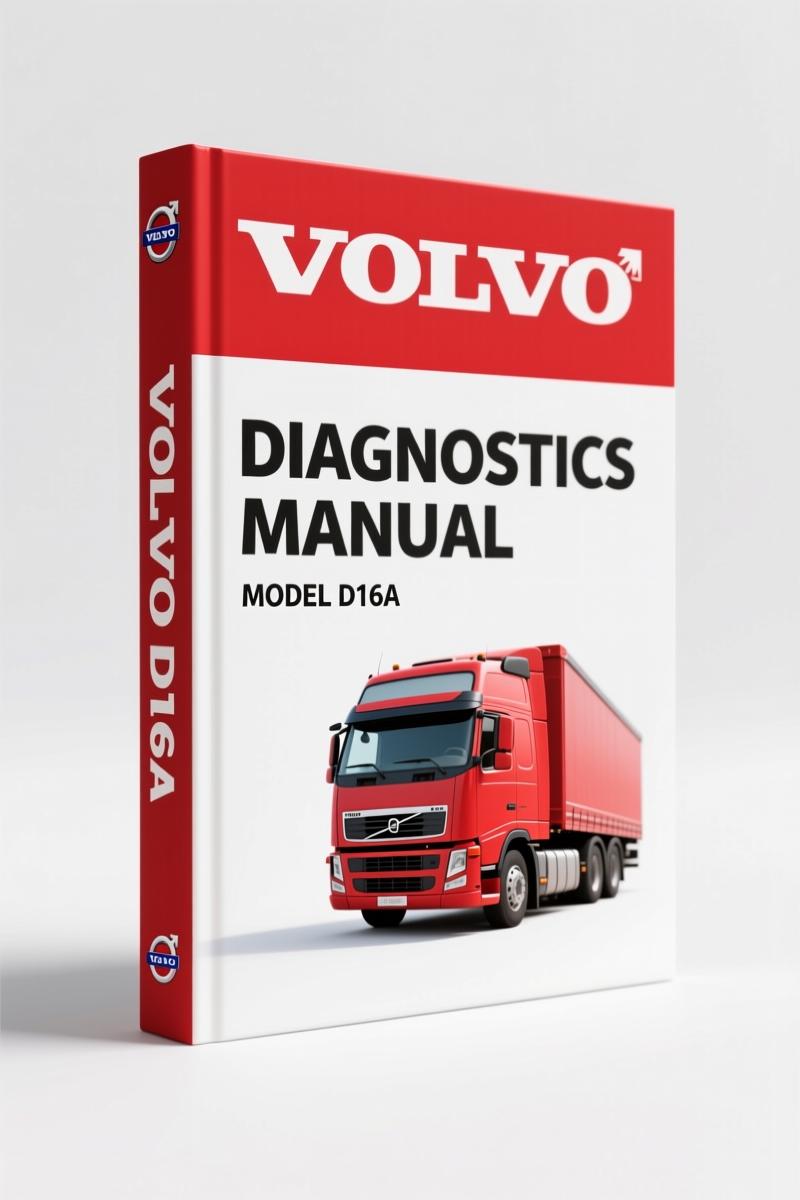
Volvo Penta D16A Diagnostics Manual – Factory Electrical Fault Tracing
Original price was: $42.60.$30.00Current price is: $30.00.
40-page OEM diagnostics manual for Volvo Penta D16A. Fault code tracing, brake circuits, engine speed signal diagnostics.
Description
Volvo Penta D16A Diagnostics Manual
If you’ve ever spent a Saturday chasing an electrical ghost on a D16A — intermittent cruise control dropouts, no fault codes, or the engine refusing to crank after a harness swap — you know the frustration. That’s why I keep a copy of the Volvo Penta D16A Diagnostics Manual on the bench next to my Fluke. At 40 pages it’s thin, but every page carries factory-level depth. The OEM procedure starts on page 1: “When checking the values specified in Fault tracing with the help of fault codes … make sure the starting key is in position Off.” Skipping that step? You’ll toast the control unit. I’ve seen it happen to guys who think they know better.
Electrical Fault Tracing: The OEM Procedure
The manual opens with a six-step sequence for using test unit 6899 — a specialized breakout box that lets you check pin voltages without back-probing the harness. Page 1 spells out the exact multimeter settings. For example, checking the engine speed signal from the injection pump? The expected reading at rest is 0 V DC, but during cranking it climbs to battery voltage. The manual gives you that spec in a table on page 4. You won’t find that in a Chilton’s reprint.
Three years ago I had a D16A that threw a fault code 5 (engine speed signal from injection pump faulty). The aftermarket wiring diagram showed the wrong pinout. This manual’s table on page 4 confirmed the correct terminal for the injection pump sensor and saved me two hours of chasing the alternator backup signal. That’s the difference between OEM documentation and a third-party PDF.
Fault Code 2 and 3: What They Mean
Fault code 2 means the control unit is not VSP programmed — the engine won’t start. Fault code 3 means the brake check was never performed or the brake contacts are faulty, and cruise control will be disabled. The manual notes that if the brake contacts are bad, the RESUME function won’t work, but you can still adjust engine speed with SET+ and SET-. That kind of behavioral detail is gold when you’re on site with a boat that won’t hold speed.
The brake circuit section covers both circuits: circuit 1 uses the standard brake light switch on the rear axle (216), and circuit 2 uses a separate contact 2008 for the EDC system on the front axle. The manual specifies that blocking valve must be pressed down and the air tanks charged. If you skip the air tank check, you’ll get false brake contact readings.
3 Critical Safety Steps Before Connecting Test Unit 6899
The manual repeats this twice: “It is essential that the starting key is in the Off position when the control unit cable harness is disconnected from the test unit and re-connected to the control unit.” That’s not a suggestion. I’ve seen a control unit get fried by a tech who left the key in Run while swapping the breakout box. The factory warning is in bold on page 2. Respect it. Also: make sure the air tanks are fully charged before testing brake circuits — the manual calls that out under fault code 3.
Does This Manual Cover All D16A Variants?
The D16A comes in several marine and industrial configurations, but this diagnostics manual applies to the EDC (Electronic Diesel Control) system common across the range. It covers fault codes 2 through 5, plus the “Other fault tracing” section for issues like high boost pressure or faulty clutch pedal break contacts. The manual does not include full engine mechanical repair specs — that’s a separate service manual. What it does cover is the electrical fault tracing from the control unit outward, including brake contacts, speed sensors, and the VSP programming parameter. For related electrical diagnostics, check Volvo MID 128 Engine Control Unit Fault Codes and Volvo MID 128 Fault Codes and Descriptions. If you’re working on a PM12 control unit, see VOLVO PM12 Diagnostics Manual.
The broader context of On-board Diagnostics (OBD) standards applies here, but Volvo Penta’s EDC system predates standard OBD-II. The manual uses its own fault code numbering and test unit. For driveline issues like Manual Transmission fault tracing, you’ll want the dedicated transmission manual.
Source Validity: OEM vs Aftermarket
This is a factory Volvo Penta publication — part number 47922011019, original PDF, 40 pages. Not a scanned reprint, not a third-party compilation. The binding? It’s a digital access in the original layout with the original bold warnings and tables. Aftermarket manuals often omit the test unit 6899 procedure because they don’t have rights to the diagrams. OEM manuals include every connector pin, every expected voltage, and every fault code description. If you’re working on a marine engine where a misdiagnosis means pulling a boat out of the water, you pay for that accuracy.
Frequently Asked Questions
- What fault codes does the manual cover?
- Fault codes 2 (VSP programming missing), 3 (brake contacts), 4 (lost engine speed signal), and 5 (faulty injection pump speed signal).
- Do I need test unit 6899 to use this manual?
- You can perform some checks with a multimeter, but the manual’s voltage tables assume you have the breakout box. The test unit isolates the control unit harness so you can measure without back-probing. I’ve done without it by building my own breakout cable, but the manual’s step-by-step is written for the factory tool. If you’re doing electrical diagnosis regularly, buy the tool. If not, you can still use the manual for fault code interpretation and brake contact testing — the procedures for fault code 3 don’t require the test unit. But for fault codes 4 and 5 you’ll need 6899 to get accurate readings at the control unit pins. I’ve had luck using a multimeter with piercing probes at the harness connector, but the readings can be noisy. The manual expects you to follow the exact procedure. Skip the test unit and you risk misreading a 0 V signal as a fault when it’s just a poor connection.
- Does the manual include wiring diagrams?
- It includes circuit descriptions and pin tables for the brake circuits and speed sensors, but not full harness routing diagrams. The focus is on diagnostic steps, not wire colors.
- Is this manual specific to the D16A only?
- Yes. It is written for the Volvo Penta D16A engine with EDC control. The fault codes and test procedures are not interchangeable with other Volvo engines.
Forty pages. OEM spec. No fluff, no reprints. If you’re tracing electrical faults on a D16A, this is the document you want open on the laptop next to the engine. Access the Factory Manual and get the correct voltage readings the first time.
Additional information
| Brand | Volvo Penta |
|---|---|
| Language | English |
3 reviews for Volvo Penta D16A Diagnostics Manual – Factory Electrical Fault Tracing
You may also like…
-
Sale!
Volvo Penta B7, B9, B12 2007 Wiring Diagram – Factory Electrical Schematics
Original price was: $71.10.$45.00Current price is: $45.00. -
Sale!
Volvo Penta FH, FM Technical Manual – Factory Specifications for Suspension & Emissions
Original price was: $79.00.$50.00Current price is: $50.00. -
Sale!
Volvo Penta D12A, D6B, D12C Technical Manual – 23-Page Factory Abbreviation Reference
Original price was: $67.50.$50.00Current price is: $50.00. -
Sale!
Volvo Penta TD520GE, TAD520GE, TD520VE, TD420VE, TAD420VE 2007 Workshop Manual
Original price was: $64.00.$50.00Current price is: $50.00.
Related products
-
Sale!

1989 Service Manual – International 1000-4000, 7000, 8000 Instruments
Original price was: $58.80.$40.00Current price is: $40.00. -
Sale!

2006 Service Manual – International DT 466E, 530E Diesel Engine
Original price was: $67.50.$50.00Current price is: $50.00. -
Sale!

Acura Integra 1998 Service Manual – 1891 Pages Factory OEM Documentation
Original price was: $31.75.$25.00Current price is: $25.00. -
Sale!

Technical Manual – International DT 530 & HT 530 (118 Pages)
Original price was: $37.00.$25.00Current price is: $25.00.
David K. –
Excellent workshop guide. It is easily zoomable on my tablet without blur. Contains precise schematics for Volvo Penta. Saves me hundreds of dollars.
Michael T. –
This is just what I needed. The file quality is excellent. Every torque spec is included for Volvo Penta Penta. Saves me a lot of money.
Charles W. –
I am very pleased with this transaction. It is easily zoomable on my phone without losing quality. It assisted me to troubleshoot my Volvo Penta Penta transmission. Saves me a lot of money.