
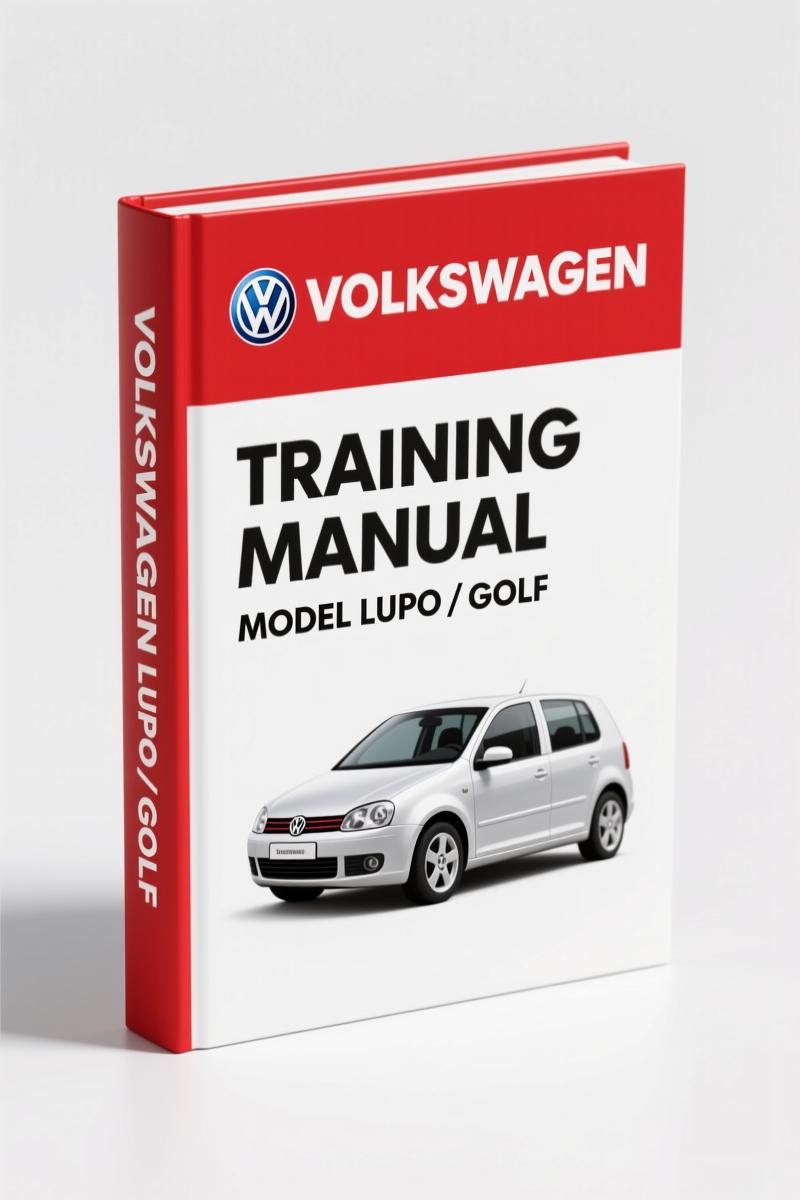
Volkswagen Lupo Training Manual – 88 Pages of TDI Engine Design & Function
Original price was: $42.30.$30.00Current price is: $30.00.
OEM Volkswagen training manual for Lupo TDI engines. 88 pages covering unit injector system, fuel supply, and engine management.
Description
Volkswagen Lupo Training Manual – What the Dealership Techs Use
If you’re wrenching on a Volkswagen Lupo and you don’t have the factory Training Manual sitting on your bench, you’re gambling with your time and parts. I’ve seen too many backyard jobs go south because someone trusted a generic write-up for a 1.2L TDI unit injector system. This 88-page Volkswagen Lupo Training Manual is what the dealership techs use when they’re up against a car that’s been cobbled together. There’s no substitute for the real thing.
This is SSP 223 — the Self-Study Programme that covers the 1.2L and 1.4L TDI engines with the pump injection system. It’s not a repair manual per se, but a deep-dive into design and function. The reason it belongs on your bench: understanding why something works prevents you from breaking it during a repair. The official repair literature references this training material. You can’t do the job right without knowing what the engineers intended.
Volkswagen Lupo Training Manual – What Makes It Different
Most aftermarket books cram generic TDI info into a single volume and call it done. This manual narrows the focus to the Lupo’s specific 3-cylinder TDI engines, including the ultra-economical 1.2L used in the Lupo 3L. The 88 pages are packed with cutaway diagrams, flow charts, and function descriptions that you won’t find in a Chilton or Haynes. The unit injector system chapter alone (starting on page 27) shows the exact fuel pressure routing and pintle nozzle operation. Need charge pressure specs? They’re in the engine management section starting on page 46.
Engine Mechanicals – What the Factory Expects
The engine mechanicals chapter (page 8) details the cylinder head, valve train, and the lightweight construction that makes these engines unique. The 1.2L TDI uses a balancer shaft and a reduced friction design to hit that 3-liter-per-100km fuel consumption target. Every torque spec for the camshaft and main bearings is referenced in the official Service Literature — not guessed at. You’ll see the exact sequences used at the factory. If you’re rebuilding one of these, you need this page open next to your torque wrench.
For the related Bosch Motronic system, cross-reference with the VW Self-Study Programme 253: Bosch Motronic MED 7 for gasoline engines, but for diesels, stick with this manual.
Unit Injector System: Factory Teardown
Starting on page 27, the unit injector system is broken down into its core components: the tappet, plunger, solenoid valve, and nozzle. The manual explains the hydraulic assist and the electronic control. You’ll learn how the ECM regulates injection timing and quantity for each cylinder. Aftermarket documentation often omits the solenoid valve test procedures. This manual doesn’t. It shows the electrical connections and the flow path. That’s the difference between a diag that takes an hour and one that takes a whole shift.
Power steering system on these cars? Grab the Volkswagen Self-Study Programme 225 Power Steering if you’re chasing a leak or a faulty pump.
Fuel Supply and Exhaust Systems Detail
The fuel supply chapter (page 38) covers the low-pressure circuit, the tandem pump, and the return flow restrictions. VW used a specific fuel cooler on the Lupo 3L — this manual shows its location and function. The exhaust system section (page 43) includes the turbocharger and the exhaust gas recirculation layout. If you’re dealing with a clogged EGR or a failed turbo actuator, the schematic on page 43 will save you from misrouting vacuum lines.
For towing setups on the platform, the Volkswagen Bora Golf Passat Trailer Guide 2009 Service is a separate manual — but this one stays on the engine side.
Does This Manual Cover the Lupo 3L Engine Management?
Absolutely. Page 76 is dedicated specifically to the special features of the Lupo 3L engine management. That includes the DS 085 electronic manual gearbox interface, the start-stop system, and the alternator management strategy. Most aftermarket guides treat the 3L as a trim level, but the engine side is completely different. This is the only place you’ll see the exact interaction between the engine control unit and the transmission control module for fuel-cut coasting. If you’re diagnosing a no-restart on a 3L, you need pages 76 through 79.
3 Sections That Save You from Parts-Peeling Mistakes
- The Function Diagram (page 70): A full wiring and signal flow diagram for the entire engine management system. Use it to trace faults without backprobing the wrong pin.
- Starter Motor (page 72): Shows the pinion engagement and the shunt-field circuit. The Lupo’s starter has a unique response to low battery voltage — this explains why.
- Service Section (page 79): Includes inspection intervals and fluid specifications. One overlooked detail: the 1.2L requires a specific oil viscosity for the unit injector camshaft. Page 79 lists it.
The automotive industry has evolved, but the fundamentals of these TDI engines haven’t changed. For context, check the Automotive Industry Overview on diesel injection history. And if you’re swapping a manual transmission, Manual Transmission specs apply to the Lupo’s 5-speed.
Source Validity: OEM Factory Documents vs. Aftermarket
This is a scanned, original VW Self-Study Programme. Not a recompiled PDF from a third party. The contents are not updated — the notice on page 2 states that explicitly because VW expects you to use the current Service Literature for repair procedures. That’s fine. The value here is the engineering knowledge that underpins those procedures. Aftermarket books cut the diagrams and simplify the theory. This doesn’t. If you want to understand how the tandem pump delivers fuel at 2,000 bar, you need the original flow chart on page 27. There’s no substitute.
FAQ – What Buyers Ask
- Does this manual cover the 1.4L TDI engine?
- Yes. The manual covers both the 1.2L and 1.4L TDI engines from the 2000-2003 model years, with the 1.2L getting extra detail for the Lupo 3L.
- Is this a repair manual or a training manual?
- It’s a Self-Study Programme — training material. It explains design and function. For torque specs and repair steps, you need the official Service Literature. This manual is meant to be read alongside the repair manual. Period.
- Can I use this for the Audi A2?
- Partially. The A2 used similar 1.2L and 1.4L TDI engines. The engine mechanicals and unit injector sections are directly applicable, but the vehicle-specific engine management (page 76) is Lupo 3L only. Refer to SSP 240 and 247 for A2 specifics.
- How are torque specs listed?
- Torque values are given in Newton-meters throughout the text. You’ll need to convert to foot-pounds for your inch-pound torque wrench. Page 8 lists the general engine fasteners. Always verify against the current Service Literature before final assembly.
Don’t let a cheap PDF ruin your weekend. Get the real documentation — access the Factory Manual now.
Additional information
| Brand | Volkswagen |
|---|---|
| Language | English |
3 reviews for Volkswagen Lupo Training Manual – 88 Pages of TDI Engine Design & Function
You may also like…
-
Sale!

Volkswagen Golf Jetta GTI Service Manual – 4954 Pages Official Specs
Original price was: $95.55.$65.00Current price is: $65.00. -
Sale!

Volkswagen Passat 1995 Repair Manual – Factory Wiring & Engine Specs
Original price was: $57.20.$40.00Current price is: $40.00. -
Sale!

Volkswagen Serie C 2003 Service Manual – OEM Factory Specs
Original price was: $53.60.$40.00Current price is: $40.00. -
Sale!

Volkswagen Phaeton Training Manual – Auxiliary Heater System (52 pages)
Original price was: $55.80.$45.00Current price is: $45.00.
Related products
-
Sale!

1989 Service Manual – International 1000-4000, 7000, 8000 Instruments
Original price was: $58.80.$40.00Current price is: $40.00. -
Sale!

2005 Parts Catalog – International NGD 3.0 L Engine (77 pages)
Original price was: $44.70.$30.00Current price is: $30.00. -
Sale!
1991 Electrical Schematic – 112-Page OEM Wiring Diagram for International 1000-3000 Series
Original price was: $22.75.$17.50Current price is: $17.50. -
Sale!
Acura NSX 1991 Service Manual – 1420 Pages OEM
Original price was: $102.05.$65.00Current price is: $65.00.
diy_master –
This is just what I required. Instant access after checkout process. Contains detailed schematics for Volkswagen. I will recommend this shop to others.
Robert M. –
Outstanding! The document quality is excellent. It assisted me to repair my Volkswagen Lupo electrical system. Saved my weekend project! Thank you.
Michael T. –
Great factory service manual. It is easily zoomable on my tablet without losing quality. Every spec sheet is provided for Volkswagen Lupo. Highly recommended for mechanics.