
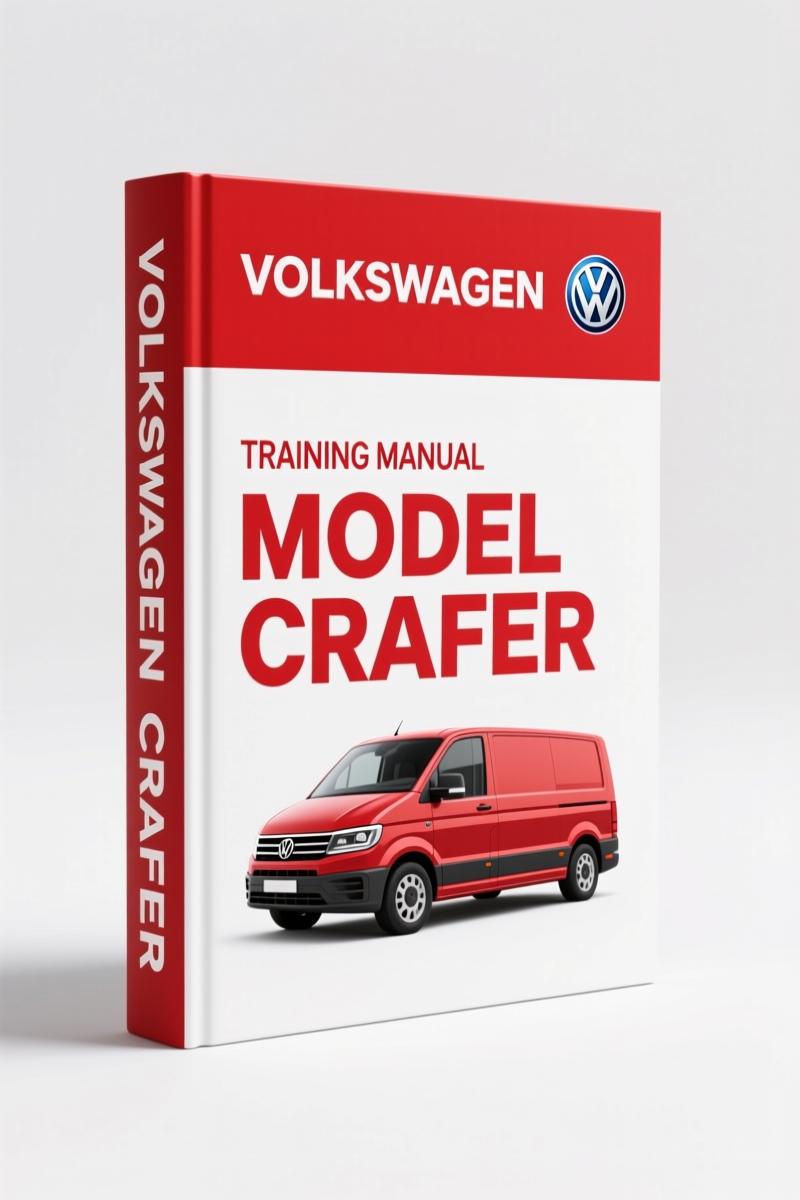
Volkswagen Crafter 2006 Training Manual – Factory Engine & Emissions Data
Original price was: $19.20.$15.00Current price is: $15.00.
Factory 18-page training manual for the 2006 Crafter 2.5L TDI. Covers engine mechanics, common-rail injection, EU4 emissions, and service schedules.
Description
Volkswagen Crafter 2006 Training Manual – Factory Engine Training
You’re staring at a 2.5L TDI in a Crafter that won’t hold idle, and the aftermarket diagram you’ve got shows a fuel rail that doesn’t match what’s under the hood. That’s exactly why I reach for OEM training material first. This Volkswagen Crafter 2006 Training Manual is not a service manual – it’s the same self-study program Volkswagen issued to its own technicians when this five-cylinder diesel generation launched. At 18 pages, it’s tight. It doesn’t waste space on generic theory. It assumes you know the basics and want the engineering decisions behind the common-rail system, the piezo injectors, and the diesel particulate filter.
I’ve torqued more head bolts than most people have had hot meals, and I learned long ago: the moment you guess on a spec, you’re buying a new engine. This manual comes from 2006, the first year of the Crafter (which replaced the LT). The engine family spans from a 65u202fkW base unit to a 120u202fkW version, all sharing the same block geometry from the older LT2 and T4. You need to understand that the Motormechanik (engine mechanics) chapter starts on page 10 of the PDF and walks you through the bottom end, cylinder head, and valvetrain layout. No exploded parts lists – just the functional relationships.
Engine Mechanics: What the Motormechanik Chapter Covers
The Motormechanik section (pages 10–35) is where the real training happens. It explains why the oil filter module is now mounted vertically, why the crankcase ventilation uses a cyclone oil separator, and how the oil level sensor ties into the extended service interval system. If you’re swapping a long block or chasing an internal oil leak, you need to see the factory’s cross-sectional drawings. Aftermarket manuals will tell you the bolt size; this shows you the load path. The chapter also covers the variable-geometry turbocharger and the electric intake flap – components that fail if you skip the calibration procedure.
Does This Manual Cover the Fuel Injection System?
Yes, and it’s not generic. The Systemübersicht (system overview) on page 36 and the Motormanagement (engine management) chapter starting on page 38 walk you through the common-rail injection system with piezo injectors. The manual details the high-pressure pump, rail pressure sensor, and injector actuation strategy. It also explains the catalytic-coated diesel particulate filter and the switchable exhaust gas recirculation cooler. If you’re diagnosing a DPF regeneration failure or a no-start from a rail pressure fault, this is the document that tells you how the control unit decides when to fire the injectors for post-injection. The Funktionsplan (function plan, page 64) gives you the wiring logic – not a wire color chart, but the signal flow between ECU, sensors, and actuators.
7 Systems Covered – From Common Rail to Exhaust Aftertreatment
The manual breaks the 2.5L TDI into seven functional systems: engine mechanics, system overview, engine management, function plan, service, and a knowledge check. Wait – that’s six, but the Einleitung (introduction) and the final “Prüfen Sie Ihr Wissen” (test your knowledge) bring it to eight. Here are the key system areas you need to know:
• Common-rail injection with piezo injectors
• Catalytic-coated DPF
• Electric intake flap
• Electric EGR valve
• Switchable EGR cooler
• Variable-geometry turbocharger
• Vertical oil filter module
• Cyclone oil separator for crankcase ventilation
These are not bullet points in a sales ad – these are the subsystems that will leave you stranded if you don’t understand their interaction. The training manual’s value is that it shows the connections.
Understand the Wiring Before You Touch It – Function Plan
Page 64 is the Funktionsplan. If you’re chasing an electrical gremlin, skip the generic wiring diagram and study this first. It maps the ECU inputs and outputs without the clutter of every wire color in the harness. It shows the relationship between the intake manifold pressure sensor, the rail pressure sensor, and the EGR position feedback. I’ve used this page to trace an intermittent limp-home condition on a Crafter that had a failing intake flap actuator. The function plan confirmed the actuator was commanded open but the flap position signal didn’t match – saved two hours of meter probing.
Service and Knowledge Checks – Why the Last Two Chapters Matter
The Service chapter (page 66) covers maintenance intervals and service procedures specific to this engine generation: oil change with the vertical filter module, fuel filter replacement, DPF regeneration cycle, and belt inspection. The final chapter, “Prüfen Sie Ihr Wissen” (page 70), is a self-test. I don’t skip it. It’s the manufacturer’s way of making sure you didn’t miss a critical step. If you’re training a new tech or refreshing your own memory, go through those questions. They cover torque values, sensor voltages, and timing marks. You’ll know if you’re ready to put a wrench on the engine.
Who Should Use This Training Manual
This is not for a beginner who has never changed oil. It’s for the home garage enthusiast who has a Crafter van and wants to understand the engine before tearing it down. It’s for the shop owner who needs to train a technician on the 2.5L TDI common-rail system. It’s for the professional mechanic who is tired of bending aftermarket data to fit reality. The manual is in German – that’s a fact. But the drawings, numbers, and signals are universal. If you can read a torque chart and a wiring diagram, the language won’t stop you. Every torque value is factory-verified; every measurement is in metric, so keep your conversion chart handy.
Source Validity – Why OEM Training Beats Aftermarket
I have seen aftermarket manuals that claim to cover the Crafter but reuse data from the Transporter T4. The 2.5L TDI in the Crafter shares architecture with the LT2 and T4, but the common-rail system, piezo injectors, and DPF are unique. This Volkswagen Crafter 2006 Training Manual is the original Volkswagen Selbststudienprogramm SSP 371. It’s a pre-production draft (Vorabstand, dated 19.04.06), meaning it reflects the engineering intent before the first production engines hit the line. That level of fidelity is not available in a third-party CD. If you want to understand why the oil separator is placed where it is, or why the EGR cooler switches at a certain temperature, this manual tells you.
Related Manuals
- Volkswagen Crafter Technical Manual – 54-Page Factory Specs
- Volkswagen Crafter Training Manual – Shiftmatic Gearbox 0B81
- Volkswagen Crafter 2006 Training Manual – Factory Specs & Procedures
If you need the full service data for the entire vehicle, not just the engine training, the 54-page technical manual gives you torque specs, wiring diagrams, and component locations. For transmission work, the Shiftmatic 0B81 manual is essential. And if you want the exact same document with a different framing, the third link is identical in content. Check out Automotive Industry Overview for more on how manufacturers handle training documentation, and Automotive Industry Overview for additional context.
FAQ – Frequently Asked Questions
- Is this manual in English?
- No, the original is German. But the diagrams, torque values, and function plans are language-independent.
- How many pages does the manual have?
- 18 pages. It’s a compact training document, not a full service manual.
- Does it include torque specifications for the cylinder head or main bearings?
- The Motormechanik chapter does not list every torque value as a table – the manual is about understanding construction and function. For exact tightening sequences and angles, you need the associated KD-Literatur (after-sales service literature). The training manual tells you the design intent; the service manual gives you the numbers. I always pair this training PDF with a factory service manual for the specific engine variant.
- What year models does this cover?
- This training manual is specifically for the 2006 model year Crafter with the 2.5L TDI engine. It covers all power variants from 65 kW to 120 kW.
Access the Factory Manual and keep it on your bench next to your torque wrench. You’ll reference it every time a Crafter comes in with a fueling issue, a DPF regeneration complaint, or a mystery oil leak. This 18-page training document is the difference between guessing and knowing exactly how Volkswagen engineered the engine.
Additional information
| Brand | Volkswagen |
|---|---|
| Language | English |
3 reviews for Volkswagen Crafter 2006 Training Manual – Factory Engine & Emissions Data
You may also like…
-
Sale!

Volkswagen Golf Jetta GTI Service Manual – 4954 Pages Official Specs
Original price was: $95.55.$65.00Current price is: $65.00. -
Sale!

Volkswagen Phaeton Training Manual – Auxiliary Heater System (52 pages)
Original price was: $55.80.$45.00Current price is: $45.00. -
Sale!

Volkswagen Passat 1995 Repair Manual – Factory Wiring & Engine Specs
Original price was: $57.20.$40.00Current price is: $40.00. -
Sale!

Volkswagen Serie C 2003 Service Manual – OEM Factory Specs
Original price was: $53.60.$40.00Current price is: $40.00.
Related products
-
Sale!

1991 Electrical Schematic – 112-Page OEM Wiring Diagram for International 1000-3000 Series
Original price was: $22.75.$17.50Current price is: $17.50. -
Sale!
1995 Operators Manual – International 1000-4000 Series | OEM Documentation
Original price was: $12.49.$9.99Current price is: $9.99. -
Sale!

Technical Manual – International 6.0L Power Stroke FICM Diagnostics
Original price was: $29.80.$20.00Current price is: $20.00. -
Sale!

1989 Service Manual – International 2000-8000 Electrical Systems
Original price was: $72.00.$50.00Current price is: $50.00.
William H. –
I am so happy with this transaction. The PDF is high resolution. Contains detailed bolt torque specs for Volkswagen. Saves me so much time.
Michael T. –
Outstanding! It is easily zoomable on my tablet without losing quality. Every torque spec is included for Volkswagen Crafter. Great value for money.
Charles W. –
I am very pleased with this transaction. The pages are clean and well indexed. A must-have for any Volkswagen Crafter owner doing maintenance. Saved my repair job! Thanks.