
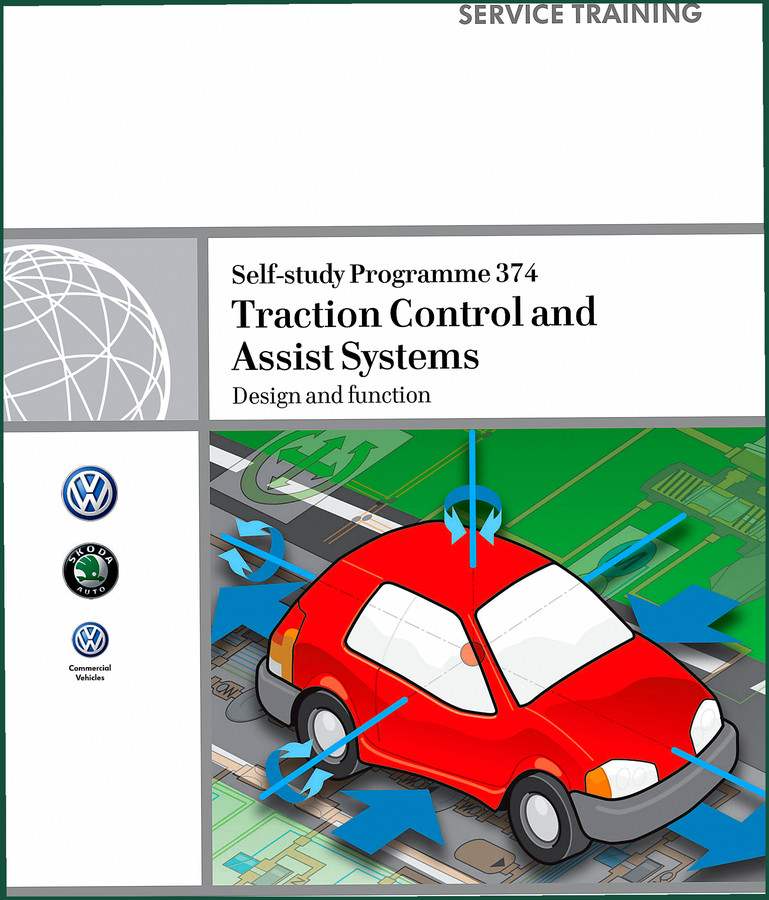
Volkswagen Audi, VW, Skoda Training Manual – Traction Control Systems
Original price was: $39.90.$30.00Current price is: $30.00.
OEM training manual covering ABS, ESP, hill assist, adaptive cruise for VW, Audi, Skoda. 88 pages of factory system design.
Description
Volkswagen Audi, VW, Skoda Training Manual – SSP 374 Traction Control and Assist Systems
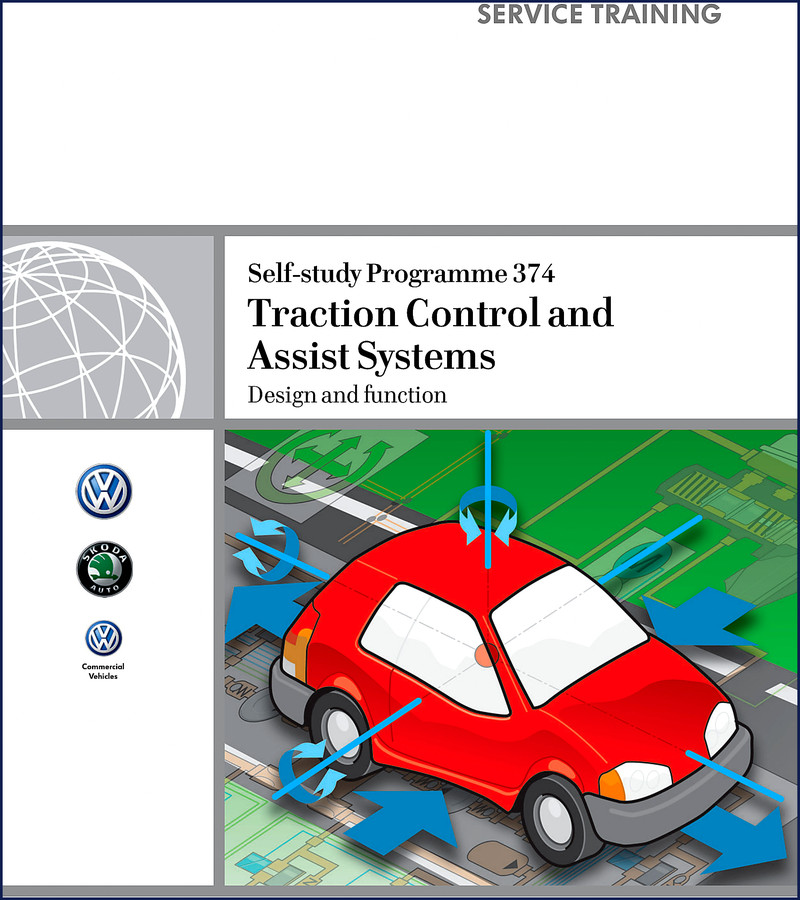
If you’ve ever chased a no‑communication ABS module on a late‑model Volkswagen or Audi, you know the feeling. You pull a schematic from some aftermarket site, the pinout doesn’t match, and suddenly you’re three hours into a job that should’ve been one. This Training Manual (Self‑Study Programme 374) is not a workshop repair manual — it’s the design‑and‑function guide that tells you why the system behaves the way it does. That knowledge saves time. It saves parts. And it keeps you from replacing a good hydraulic unit because you misread a signal.
The manual runs 88 pages and covers traction control systems across VW, Audi, and Skoda platforms. It was written by the engineers who designed the hardware. No aftermarket interpretation. No third‑party rewrites. Just the factory’s own explanation of how the anti‑lock brake system (ABS), electronic stabilisation programme (ESP), and every assist system work together. You’ll find the chapter layout on page 3: Introduction, Sensors, Traction Control Systems, Auxiliary ESP Functions, Assist Systems, Annex, and a Test Yourself section.
Traction Control Systems Covered in This Manual
This is the meat of the book. Page 15 kicks off traction control systems with the anti‑lock brake system (ABS). Then it breaks down brake systems with intervention only, brake systems with additional engine intervention, and the full electronic stabilisation programme (ESP). Each section walks through the hydraulic circuit, solenoid operation, and control logic. If you’ve ever needed to understand why a Brake system cuts throttle on a Skoda Octavia during a corner, the answer is here — and it’s not in a generic Chilton manual.
Sensors: Passive vs Active Speed Sensors
Starting on page 8, the manual explains the difference between passive and active speed sensors. It covers acceleration sensors and the yaw rate sensor. This is critical when diagnosing intermittent ABS faults. A passive sensor gives a voltage signal that degrades with RPM. An active sensor uses a Hall effect or magnetoresistive element and can detect direction of rotation. The manual shows the waveform you should see on a scope. It also explains how the control module processes those signals to calculate wheel slip. Aftermarket manuals typically gloss over this. This factory Training Manual gives you the engineering basis.
Auxiliary ESP Functions – What the Book Covers
Pages 48 through 60 detail auxiliary ESP functions. These include hydraulic brake assist, hydraulic brake servo, overboost, full rear axle deceleration, vehicle/trailer stabilisation, and roll‑over prevention. Each function is explained with system diagrams and component cut‑aways. For example, the hydraulic brake assist section shows how the ESP pump builds pressure independently of the driver’s pedal input. That’s the kind of detail that helps you diagnose a spongy pedal that only appears during emergency stops.
Assist Systems for Real‑World Driving
Starting on page 62, the manual covers hill descent assist, hill start assist, AUTO HOLD, dynamic starting assist, brake disk dry braking, countersteering support, adaptive cruise control, and front assist. These systems are often interconnected. For instance, AUTO HOLD uses the same hydraulic valves as the hill start assist. The manual explains the sensor inputs and actuator outputs for each. If you’re retrofitting or troubleshooting a system that isn’t activating, this section tells you the prerequisite conditions. No guesswork.
Why Factory Training Manuals Beat Aftermarket Data
You cannot trust aftermarket documentation for traction control systems. I’ve seen wiring diagrams that swapped the left and right front wheel speed sensor pins. That kind of error sends you down a rabbit hole. This Training Manual is VW‑AG internal training material. It wasn’t written for public sale; it was written for dealer technicians in Wolfsburg. That means the abbreviations, the logic flow, and the component locations are correct. You can cross‑reference it with the official workshop manual for your specific model. Want more from the same series? See related manuals: Volkswagen Audi CANbus Training Manual Introduction, Volkswagen Audi Self-Study Programme 224 Service Interval, and SSP 257 Electric Vacuum Pump for Brake Servo Unit. For broader context, check the Automotive Industry Overview and Manual Transmission articles from reputable sources.
What This Training Manual Does Not Cover
This is a self‑study programme. It does not contain step‑by‑step repair procedures or torque specifications. Page 2 explicitly states: “The self‑study programme is not a workshop manual!” You cannot use it to replace a wheel speed sensor or bleed the brake system. But if you bring this manual into the shop alongside your factory repair manual, you’ll understand why the procedure calls for a certain test step. It’s the difference between following a checklist and actually knowing the system.
- Is this manual vehicle‑specific? Will it work for my 2015 VW Golf?
- No. This is a fundamental training manual covering system designs shared across multiple Volkswagen Group platforms. It explains concepts like ABS, ESP, and hill assist that apply to many models. For vehicle‑specific repair data, you need the corresponding workshop manual for your exact year and model.
- I’m a DIYer with basic tools. Can I use this to fix my Audi Q5’s ABS light?
- Yes and no. This manual will help you understand what the ABS control module is looking for from the wheel speed sensors and yaw rate sensor. It shows you the sensor types and how they fail. But for the actual diagnostic trouble codes, wire colors, and connector pinouts, you still need an Audi‑specific repair manual. Use this as the theory companion, not the repair guide.
If you work on VW, Audi, or Skoda vehicles and you want to stop burning billable hours guessing at traction control faults, get this Training Manual on your bench. [Access the Factory Manual] from AutoRepairManuals today – it’s the same 88‑page PDF used in the VW training program, without any reprints or third‑party edits.
Additional information
| Brand | Volkswagen |
|---|---|
| Language | English |
3 reviews for Volkswagen Audi, VW, Skoda Training Manual – Traction Control Systems
You may also like…
-
Sale!

Volkswagen Serie C 2003 Service Manual – OEM Factory Specs
Original price was: $53.60.$40.00Current price is: $40.00. -
Sale!

Volkswagen Golf Jetta GTI Service Manual – 4954 Pages Official Specs
Original price was: $95.55.$65.00Current price is: $65.00. -
Sale!

Volkswagen Passat 1995 Repair Manual – Factory Wiring & Engine Specs
Original price was: $57.20.$40.00Current price is: $40.00. -
Sale!

Volkswagen Phaeton Training Manual – Auxiliary Heater System (52 pages)
Original price was: $55.80.$45.00Current price is: $45.00.
Related products
-
Sale!

2005 Parts Catalog – International NGD 3.0 L Engine (77 pages)
Original price was: $44.70.$30.00Current price is: $30.00. -
Sale!

Technical Manual – International 6.0L Power Stroke FICM Diagnostics
Original price was: $29.80.$20.00Current price is: $20.00. -
Sale!

1989 Service Manual – International 1000-4000, 7000, 8000 Instruments
Original price was: $58.80.$40.00Current price is: $40.00. -
Sale!

2011 Parts Catalog – International Truck OE Parts Documentation (1786 Pages)
Original price was: $34.50.$25.00Current price is: $25.00.
diy_master –
Excellent quality! The document quality is excellent. Every spec sheet is included for Volkswagen Audi,. Saves me so much time.
Michael T. –
Highly recommended! It is very easy to read on my tablet without blur. It helped me to fix my Volkswagen Audi, engine. Saved my weekend project! Thanks.
William H. –
I am so happy with this purchase. The PDF looks clean. It guided me to fix my Volkswagen Audi, electrical system. Saves me so much time.