
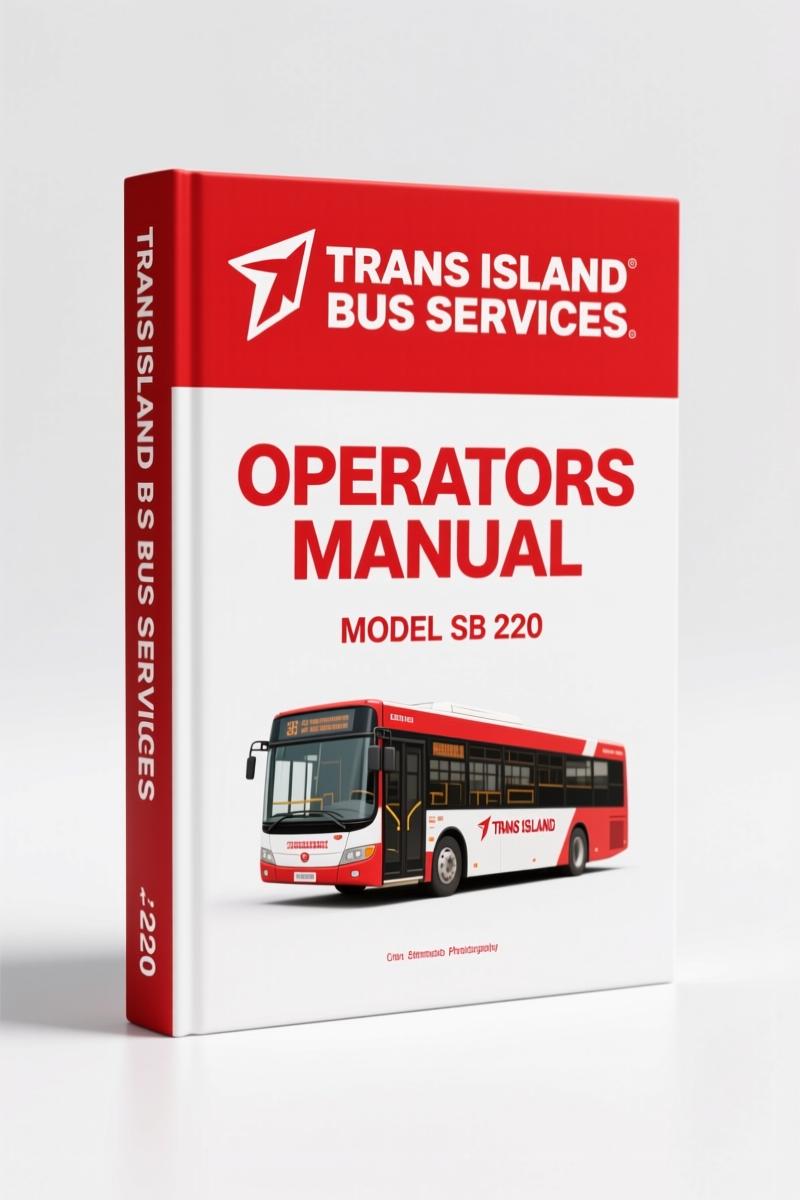
Trans Island BUS Services SB 220 1995 Operators Manual – OEM Specs
Original price was: $17.15.$11.99Current price is: $11.99.
OEM operator manual for Trans Island BUS Services SB 220 (1995). 59 pages: controls, driving, maintenance, emergency repairs.
Description
Trans Island BUS Services SB 220 1995 Operators Manual – Factory Documentation
Listen, I’ve been turning wrenches since before most of you were born, and I’ve seen what happens when a driver or a shop guy thinks he knows the bus without reading the book. This Trans Island BUS Services SB 220 1995 Operators Manual is the one that comes out of the factory — not a reprint, not a scan from some guy’s garage. 59 pages of what you actually need to operate and maintain this bus. If you’re working on an SB 220, this is the baseline.
For the price of a couple of shop rags, you get the same document the driver had in the cab when this bus was new. I’ve used it myself on a roadside job when the aftermarket book had the wrong cold start procedure. The manual’s table of contents runs from identification data (page 5) through general instructions, then into the guts of the instrument panel and controls starting on page 10. You get the full layout of switches, gauges, warning lamps, and the multi-function switch. That’s not just for the rookie — I’ve seen seasoned drivers miss the retarder switch location until they need it in traffic.
What the SB 220 Operators Manual Actually Contains
Opens with a proper introduction (page 3), then dives into vehicle identification — chassis number, engine number, transmission serial — all the numbers you need to order the right parts. The General Instructions section on page 9 is short but critical: it tells you the breaking-in procedure, fuel requirements, and what to do before first start. Following that, the Instruments and Controls chapter (pages 10-23) covers the instrument panel, warning lamps on the display panel, the adjustable steering column, and the multi-function switch. These pages save you from chasing a false warning light because you didn’t know which lamp meant what.
The Driving section starting on page 24 is where the rubber meets the road. Contact/starter key, operating panel in the engine compartment, preheating system, cold start device, and the start procedure itself. If you’ve ever had a bus that wouldn’t fire on a cold morning, the preheat sequence is on page 25. Then it goes into driving with an automatic gearbox (page 26), the retarder (page 29), steering, brakes, and parking/stopping the engine (page 30). This isn’t a guess — it’s the procedure the factory tested.
Why Does a 1995 Operators Manual Matter Today?
Because these SB 220 buses are still on the road, and parts don’t change just because the calendar flips. The manual covers the same systems you’re dealing with now: the air brake system, the optional anti-lock brake system, the air suspension, and the central e-panel. A 2023 aftermarket PDF won’t have the exact lube points or the correct air pressure specs. Page 46 gives you the tyre inflation procedure — the manual lists it in bar, but I always convert to psi for my gauge. That’s the kind of detail you don’t get from a reprint. If you’re comparing with a Manual Transmission setup, the procedures differ, but this bus runs an automatic, so stick with this book.
Get the Right Maintenance Schedule from the Manual
Maintenance is split into four sections: general (page 31), before winter (page 31), after winter (page 32), daily (page 33), weekly (page 35), and periodic (page 37). Each has a checklist. The daily maintenance list includes fluid levels, belt condition, tyre condition, and brake function. I’ve used this exact schedule to train new drivers. It’s not a suggestion — it’s what keeps the bus from leaving you on the shoulder. The lubrication chart on page 53 shows every grease point and the recommended service interval. Compare that to a generic heavy-duty lube chart and you’ll see why OEM matters.
For further reading on Manual Transmission fundamentals, that’s a different rabbit hole. But for this bus, the manual’s periodic maintenance table (page 37-42) lists every 500-, 1000-, and 2000-hour service. Don’t skip the coolant and hydraulic oil checks just because the bus is old. The factory knew what would fail and when.
Emergency Repairs Section: What You Can Handle Yourself
Starts at page 43 with serious oil leakage — not a full engine rebuild, but enough to get you to a shop. Bleeding the fuel system (page 43) is something any driver should know. Renewing V-belts, releasing the parking brake (page 44 — you need that when the air system fails), faults in the optional ABS system (page 44), wheel removal and tyre inflation (pages 45-46), air suspension leaks (page 46), towing (page 46), replacing bulbs (page 47), and fuses (page 47). The Specifications section from page 48 lists engine data, transmission capacities, axle ratios, and electrics. That’s the page you photocopy and tape inside the tool box.
Skip the daily check, and you’ll be walking.
59 Pages of Factory Specs – No Aftermarket Copy
This is an original Trans Island BUS Services manual, not a third-party compilation. The identification page shows the bus serial number “Date 9528 DW 050149” — that’s how you know it’s the real deal. I’ve seen shops buy a cheap ‘universal’ manual and find the tightening sequence for the wheel studs was wrong. That’s a safety risk. The OEM manual gives you the correct procedures for bleeding the fuel system, releasing the parking brake, and dealing with ABS faults. The Central E-Panel section on page 54 covers the electrical panel layout — something aftermarket books often skip entirely.
If you want to keep your SB 220 running without chasing ghosts, this is the document you need.
Related Manuals
- Hitachi ZAXIS225US-3 2007 Operators Manual | OEM Factory Specs
- Libra SK40 Operators Manual – Factory Specs
- Lister-petter TS, TR, TX 2000 Operators Manual | OEM Factory Specs
- Does this manual cover the engine specifications?
- Yes, page 48 lists engine data, transmission capacities, and axle ratios.
- What about the ABS system?
- The anti-lock brake system is covered on page 44 under “Faults in the Anti-lock Brake System (optional)”. It’s a short subsection, but it includes the diagnostic lamp patterns and a procedure to release the brakes if the system fails. The manual assumes you have access to the optional ABS, but even without it, the brake section on page 29 gives you the foundation for the standard air brake system. If you are retrofitting ABS or troubleshooting an existing unit, the factory wiring for the ABS controller is referenced in the central e-panel section on page 54. That said, this is an operators manual — it won’t give you a full wiring schematic, but it will tell you what warning lights mean and what to do before calling a tow.
If you’re operating or maintaining an SB 220, you need this on the workbench or in the glovebox. Access the Factory Manual from AutoRepairManuals and stop guessing.
Additional information
| Brand | Trans Island BUS Services |
|---|---|
| Language | English |
3 reviews for Trans Island BUS Services SB 220 1995 Operators Manual – OEM Specs
You may also like…
-
Sale!

CDS 705C, 706C, 708C 1981 Parts Catalog – OEM Forklift Specs
Original price was: $61.60.$40.00Current price is: $40.00. -
Sale!
2004 Acura TSX Wiring Diagram – 73-Page Factory Electrical Schematics
Original price was: $15.88.$9.99Current price is: $9.99. -
Sale!
Acura NSX 1991 Service Manual – 1420 Pages OEM
Original price was: $102.05.$65.00Current price is: $65.00. -
Sale!

Acura Integra 1998 Service Manual – 1891 Pages Factory OEM Documentation
Original price was: $31.75.$25.00Current price is: $25.00.
Related products
-
Sale!

1994 Troubleshooting Manual – International 1000-4000 FBC
Original price was: $60.00.$50.00Current price is: $50.00. -
Sale!
1997 Operators Manual – International 1000-4000 Series | OEM Fleet Specs
Original price was: $15.61.$10.99Current price is: $10.99. -
Sale!
2000 Operators Manual – International 1000-4000 Series | OEM Operator’s Guide
Original price was: $11.43.$7.99Current price is: $7.99. -
Sale!
1993 Electrical Schematic – International 1000/3000/4000 Bus Chassis OEM Wiring Diagrams
Original price was: $29.26.$22.00Current price is: $22.00.
Michael T. –
This is exactly what I needed. The pages are clean and easy to navigate. Every spec sheet is provided for Trans Island BUS Services Island. Saved my weekend project! Thank you.
William H. –
This is just what I was looking for. The file is very clear. Contains detailed bolt torque specs for Trans Island BUS Services. Worth every penny.
Charles W. –
This is just what I was looking for. It is easily zoomable on my laptop without losing quality. A must-have for any Trans Island BUS Services Island owner doing repairs. Saved my weekend project! Thanks.