
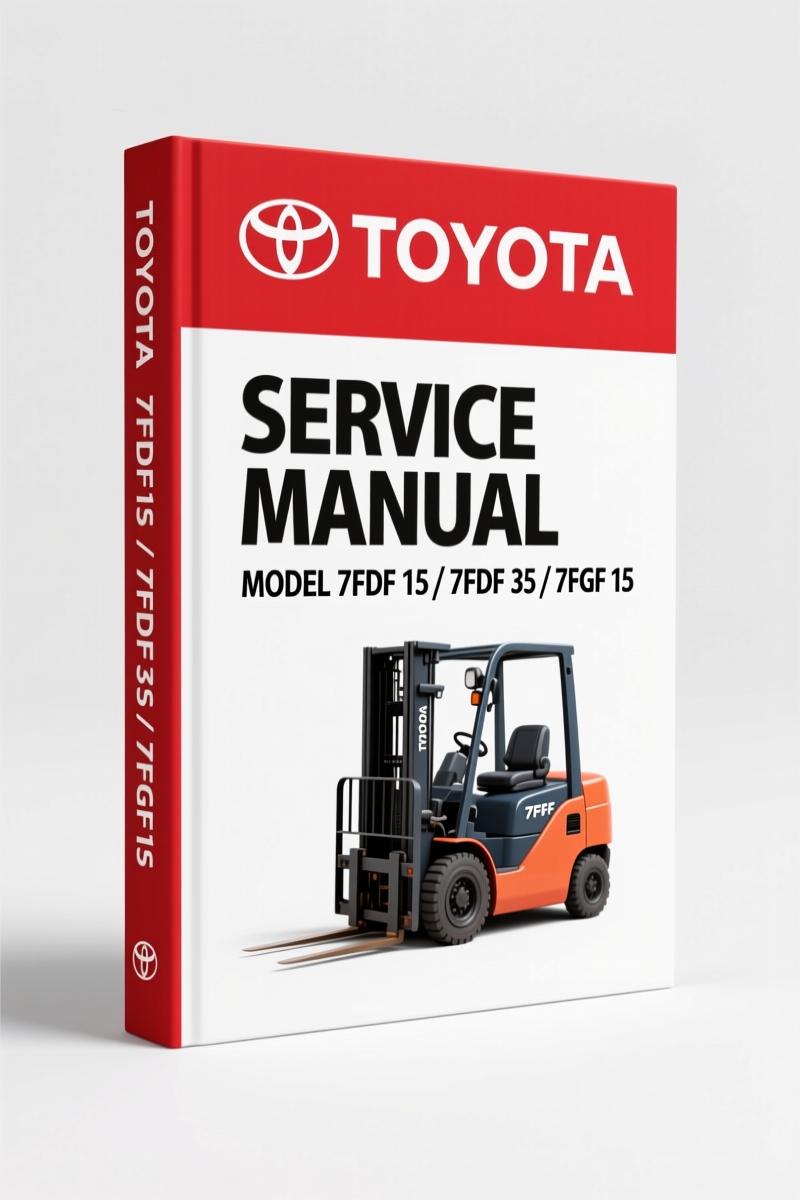
Toyota 7FDF 15, 7FDF 35, 7FGF 15, 7FGF 35 Service Manual – 612 Pages
Original price was: $59.85.$45.00Current price is: $45.00.
612-page factory service manual for Toyota 7FDF 15, 7FDF 35, 7FGF 15, 7FGF 35. Engine, transmission, brake, cylinder, valve specs. OEM procedures only.
Description
Toyota 7FDF 15, 7FDF 35, 7FGF 15, 7FGF 35 Service Manual – Factory OEM Specs You Can Trust
Heard enough aftermarket manuals that give you a torque value off by 10 ft-lb and call it “close enough”? Pulled a cylinder head on a Toyota 7FDF 15, 7FDF 35, 7FGF 15, 7FGF 35 Service Manual and watched the lift truck leak oil because the bolt torque table was generic? This is the 612-page OEM manual that BT Svenska AB (Toyota’s authorized European distributor) put together. It’s the same book that goes on the dealer tech’s bench. No translation errors, no “third-party adaptation”. You get the actual tightening torque table from page 0-12, the high-pressure hose fitting specs from page 0-13, and the safe load angle chart from page 0-14. That’s not marketing copy – that’s the content.
Engine and Transmission: Two Core Systems Covered
Chapter 1 (Engine) and Chapter 2 (Transmission) run 1DZ-II engine work and the torque-converter automatic transmission used on these 1.5–3.5 ton lifts. The manual shows you the valve clearance procedure – you’ll need a feeler gauge and a 10mm wrench – and the transmission disassembly sequence. No “refer to another manual” fluff. You get the OEM flow diagrams for the hydraulic control valve inside the trans. If you’ve ever fought a no-start on a 7FGF35 because the SAS system locked the engine, Chapter 15 (SAS) covers the override logic. Page 0-7 gives you operational tips that include how to avoid crushing the wiring harness during engine R&R.
Brake and Steering: Safety Specs You Need
Chapter 7 (Steering) and Chapter 8 (Brake) are where most DIY guys kill hours. The steering cylinder – covered in Chapter 12 (Cylinder) – has a specific seal kit cross-reference that aftermarket catalogs get wrong. The brake section includes the parking brake adjustment procedure for the drum-in-disc unit. Torque for the wheel cylinder bleeder? It’s in the torque table on page 0-12. I want you to have that number before you crack a line. A brake line that leaks on a forklift loaded with 3 tons puts the operator at risk. The manual lists the tightening torque for every brake line flare nut – something most repair sheets omit.
What Torque Values Are Listed in the General Section?
Open to page 0-11 and you see “Standard Bolt & Nut Tightening Torque” with bolt strength type identification. Then page 0-12 has the actual torque table for metric bolts – M6 through M20, three strength grades. Page 0-13 covers precoat bolts and high-pressure hose fitting torque. Need the component weights for safe lifting? Page 0-15 lists every major assembly weight. This is the kind of data that keeps your hoist cable from snapping. It’s also the data that aftermarket manuals either leave out or copy from a 1990s Land Cruiser manual. Not this one.
Cylinder and Valve Work: OEM Procedure
Chapter 12 (Cylinder) covers all hydraulic cylinders – mast tilt, lift, and steering. The manual walks you through disassembly, seal replacement, and gland nut torque. Valve work – the SAS control valve and oil control valve – is in Chapters 14 and 15. The oil pump chapter (13) gives you the pump gear backlash spec. I’ve watched a junior tech shave down a pump gear because he guessed the clearance. Don’t guess. The factory spec is printed. If you strip a gland nut because you used an impact gun at full torque, that’s a $400 cylinder. The manual tells you to use a torque wrench – and gives you the number.
612 Pages of Factory Data – No Aftermarket Guessing
The difference between this manual and a $20 PDF from a third-party site is the line “BT Svenska AB” on the cover. That means Toyota authorized this publication. The OCR scan is clean – the tables are legible, the illustrations are vector-grade. Every chapter from General (0) through Appendix (16) is included: Front Axle (5), Rear Axle (6), Material Handling System (10), Mast (11), Differential (4), Propeller Shaft (3). The appendix contains wiring diagrams for the circuit tester method on page 0-9. This is the real thing. Want to compare with other Toyota service documentation? Check out Toyota SCP10, NCP1, NLP10 2001 Service Manual – Factory OEM for passenger car specs, or Toyota K311 Service Manual – Factory OEM CVT Specs & DTC Charts for transmissions. For a later-generation forklift, see Toyota 8FGF 8FDF15 8FDF30 2007 Service Manual – Factory OEM Specs. And if you need to verify Toyota’s overall approach to service documentation, visit Automotive Industry Overview from Toyota’s own site. More background on the industry standards can be found at Automotive Industry Overview.
Who This Manual Is For – And Who Should Walk Away
If you own a 7FDF15, 7FDF35, 7FGF15, or 7FGF35 and you change your own oil, swap hydraulic filters, or replace brake shoes – this manual pays for itself the first time you avoid a stripped bolt. If you run a small repair shop and see one of these lift trucks once a month, you need the OEM torque specs to keep the liability off your insurance. Beginners should have a basic socket set, a torque wrench, and the willingness to read a table. The manual assumes you know how to use a multimeter (page 0-9 shows you how to connect it for continuity tests) and that you can follow a sequence without skipping steps. If you don’t own safety stands, buy some before you open page 0-8 (hoisting the vehicle). I won’t sugarcoat it – this is a dense manual. But everything you need is in the bolded headings and the torque table.
- Q: Does this manual include wiring diagrams for the electrical system?
- A: No. This is a service manual for mechanical and hydraulic systems. The electrical content is limited to the circuit tester method on page 0-9 and the SAS control unit diagnostics. Full wiring harness diagrams are not in this volume.
- Q: Can I use this manual for a 7FGF20 model?
- A: The manual covers models 7FDF 15, 7FDF 35, 7FGF 15, and 7FGF 35. The vehicle model table on page 0-3 lists 42-7FGF20 and 62-7FDF20 under the 2.0-ton series with the 1DZ-II engine. If your forklift carries a 7FGF20 model plate, the engine and transmission procedures are identical. However, the mast and cylinder dimensions may differ. Verify your frame number against the list on page 0-4. When in doubt, compare the component weights on page 0-15 – if the mast weight matches, you’re good. Otherwise, treat the manual as a reference and double-check clearances. Many hydraulic repair steps transfer, but never assume a seal part number crosses.
If you’re still debating whether to trust a printed OEM source over a forum thread, look at the page count: 612. That’s 612 pages of Toyota’s engineering. Not a bullet list. Not a YouTube comment. Factory spec. Access the Factory Manual and keep it within arm’s reach of your work bench.
Additional information
| Brand | Toyota |
|---|---|
| Language | English |
2 reviews for Toyota 7FDF 15, 7FDF 35, 7FGF 15, 7FGF 35 Service Manual – 612 Pages
You may also like…
-
Sale!

Toyota 6FGCU33, 6FGCU45 1997 Service Manual – Factory Forklift Repair
Original price was: $94.25.$65.00Current price is: $65.00. -
Sale!

Toyota 5FBE10, 5FBE15, 5FBE18, 5FBE20 Service Manual – 463 Pages
Original price was: $102.05.$65.00Current price is: $65.00. -
Sale!
Toyota 5FBE10, 5FBE13, 5FBE15, 5FBE18, 5FBE20 Service Manual – 463 Pages
Original price was: $102.05.$65.00Current price is: $65.00. -
Sale!

Toyota 7FGU35 7FGU80 2005 Service Manual – 136 Pages Official Factory Data
Original price was: $82.55.$65.00Current price is: $65.00.
Related products
-
Sale!

2011 Parts Catalog – International Truck OE Parts Documentation (1786 Pages)
Original price was: $34.50.$25.00Current price is: $25.00. -
Sale!

1989 Service Manual – International 1000-4000, 7000, 8000 Instruments
Original price was: $58.80.$40.00Current price is: $40.00. -
Sale!

Technical Manual – International DT 530 & HT 530 (118 Pages)
Original price was: $37.00.$25.00Current price is: $25.00. -
Sale!
1994 Troubleshooting Manual – International 1000-4000 FBC
Original price was: $60.00.$50.00Current price is: $50.00.
gearhead88 –
Excellent factory service manual. The file looks clean. Contains clear wiring diagrams for Toyota. Highly recommended for mechanics.
David K. –
This is just what I needed. The scan is high-quality and easy to navigate. Contains clear wiring diagrams for Toyota. Saved my repair job! Thanks.