
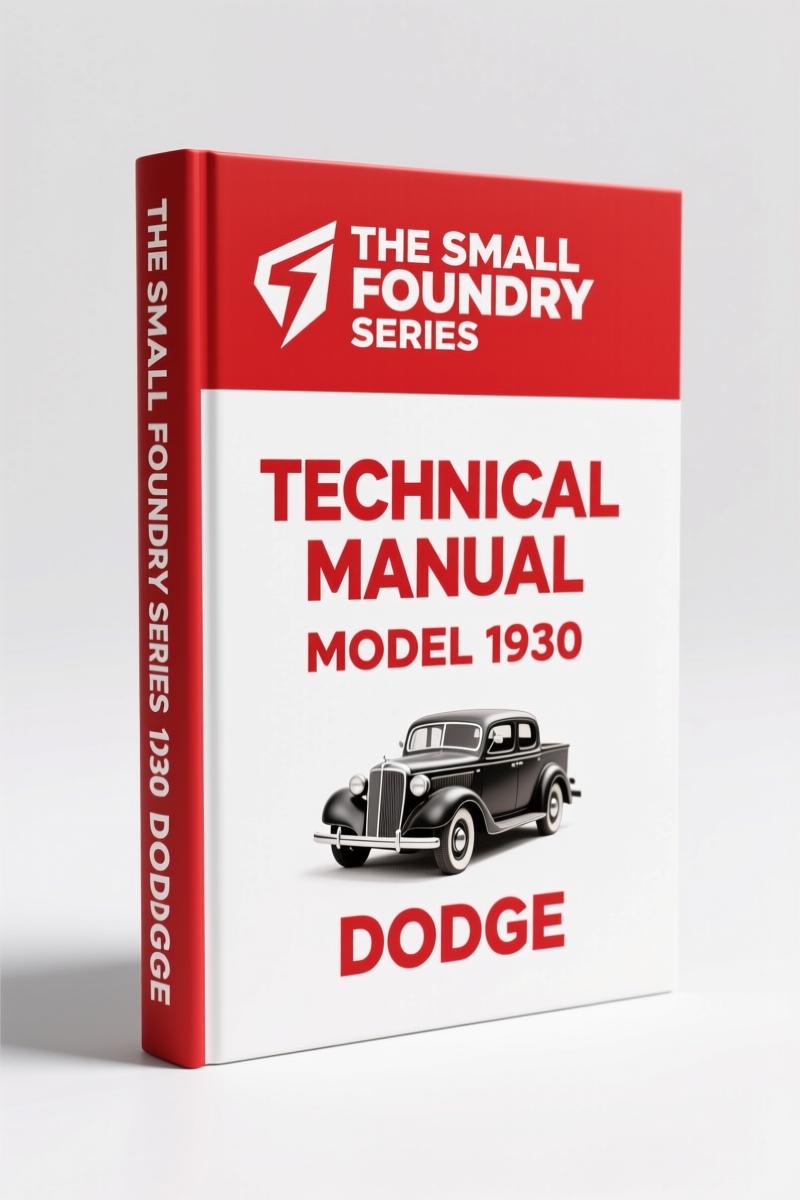
The Small Foundry Series 1930 Dodge 2004 Technical Manual – 34 Pages
Original price was: $50.92.$38.00Current price is: $38.00.
34-page factory manual for designing and machining pistons for 1930 Dodge engines. Covers casting, rings, and machining tolerances.
Description
Got a 1930 Dodge with a seized engine? You aren’t finding off-the-shelf pistons for that block. I’ve been there. That’s why this 2004 technical manual from The Small Foundry Series 1930 Dodge 2004 Technical Manual exists – it walks you through the entire process from piston design to finished part. 34 pages, and every one of them has usable data. The author, Stephen Chastain, is a mechanical engineer. He doesn’t leave you guessing. You’ll learn how to determine head thickness using heat flow formulas, design ring grooves for high loads, and even cast your own piston blanks if you have a foundry. This is the kind of information you’d pay a machinist hundreds of dollars for, and it’s all laid out in one slim manual. No fluff, no filler – just the math and methods you need. Page 4 starts the design section, and that’s where you begin.
Piston Design Basics and Thermal Loading
Section I covers basic data – common dimensions, thermal loading, and bhp per square inch. This is where you figure out the alloy and the shape you need. Don’t skip the thermal loading part; it’s why pistons crack under high temperature. The manual gives you the formulas to calculate expansion and clearance so your piston doesn’t seize or rattle.
What Goes Into Head Thickness Calculation?
The formula for flat plate and heat flow are in Section II. You’ll find empirical formulas that let you avoid guesswork. If you get head thickness wrong, the piston will either overheat or fail under combustion pressure. Page 4 is where the design section begins, and the head thickness part is critical – treat it as a spec.
6 Design Factors for Rings and Wrist Pins
Section III breaks down ring belt, groove depth, expansion, pin bosses, loading, and pin ovalization. Each factor has a specific design rule. The ring design sub-section shows you how to match modern rings to antique grooves – a common problem when restoring a 1930 Dodge. Pay attention to the pin ovalization data; it’s not in generic manuals.
Master the Casting and Feeding Process
If you have a foundry, Section IV covers filters, feeding, and solidification. This is for casting your own blanks. The manual assumes you have basic foundry skills, but it gives the specific parameters for piston alloys. Feeding and solidification are where most home casters mess up; this section tells you how to avoid shrink cavities.
Making Replacement Pistons: From Pattern to Machining
Section V and VI take you from patterns and cores to lathe and mill operations. Ovalization and miscellaneous operations are covered. Every tool list is given. If you’re committed to making your own pistons, this is the section you’ll use most. The machining chapter includes specific lathe operations for turning ring grooves and cutting wrist pin bores.
This isn’t a scanned reprint or a third-party compilation. The Small Foundry Series is the original publisher. The ISBN is 0-9702203-4-0. The data hasn’t been filtered through a generic aftermarket provider. You’re getting the exact values Stephen Chastain published in 2004. That matters when you’re machining to 0.001″ tolerances.
For other restoration projects, you might need additional manuals. Check out the Drogobych Crane КТА-16, КТА-25, КТА-28 2004 Installation Manual for your shop equipment. For new engines, the Injectocean Diablo, Murciélago, Defender, Discovery, Freelander Technical Manual covers advanced systems. And for Eastern European vehicles, the Minsk MMVZ-3.11212 Technical Manual – Factory Specs is a solid resource. For a broader look at automotive technology, the Automotive Industry Overview and Manual Transmission pages provide context.
- Does this manual cover torque specifications for the 1930 Dodge?
- No torque specs. This manual is for piston making, not engine assembly.
- Can I use this manual for an engine other than the 1930 Dodge?
- Yes. The design formulas work for any engine. Stephen Chastain includes generic methods for thermal loading, ring groove depth, and wrist pin ovalization. The 1930 Dodge is used as an example; the math applies across engines. You’ll need to adapt bore and stroke dimensions, but the principles are universal. Section I gives common dimensions that you can substitute for your own engine’s specs. Even the casting and machining chapters are transferable. If you’re restoring an old engine that has no available pistons, this manual will save you.
You can keep hunting for NOS pistons or pay a machinist a fortune, or you can learn to do it yourself. Access the Factory Manual and start producing the parts your 1930 Dodge needs.
Additional information
| Brand | The Small Foundry Series |
|---|---|
| Language | English |
2 reviews for The Small Foundry Series 1930 Dodge 2004 Technical Manual – 34 Pages
You may also like…
-
Sale!
Acura NSX 1991 Service Manual – 1420 Pages OEM
Original price was: $102.05.$65.00Current price is: $65.00. -
Sale!

CDS 705C, 706C, 708C 1981 Parts Catalog – OEM Forklift Specs
Original price was: $61.60.$40.00Current price is: $40.00. -
Sale!
2004 Acura TSX Wiring Diagram – 73-Page Factory Electrical Schematics
Original price was: $15.88.$9.99Current price is: $9.99. -
Sale!

Acura Integra 1998 Service Manual – 1891 Pages Factory OEM Documentation
Original price was: $31.75.$25.00Current price is: $25.00.
Related products
-
Sale!

1991 Operators Manual – International Truck OEM Specs (108 Pages)
Original price was: $13.63.$10.99Current price is: $10.99. -
Sale!

1999 Operators Manual – International 1000-4000 Series | OEM Specs
Original price was: $11.67.$7.99Current price is: $7.99. -
Sale!

2011 Parts Catalog – International 7400 SFA 6X6 – 1886 Pages of OEM Part Numbers
Original price was: $32.00.$25.00Current price is: $25.00. -
Sale!
1995 Operators Manual – International 1000-4000 Series | OEM Documentation
Original price was: $12.49.$9.99Current price is: $9.99.
Charles W. –
Outstanding! The pages are clean and well indexed. A must-have for any The Small Foundry Series Small mechanic doing repairs. Saves me hundreds of dollars.
workshop_guy –
This is exactly what I was looking for. Instant access after checkout. Contains detailed wiring diagrams for The Small Foundry Series. Saved my repair job! Thank you.