
Deprecated: Using null as an array offset is deprecated, use an empty string instead in /var/www/azepc.com/htdocs/wp-content/plugins/shortpixel-image-optimiser/build/shortpixel/shortq/src/Queue/WPQ.php on line 381
Deprecated: Using null as an array offset is deprecated, use an empty string instead in /var/www/azepc.com/htdocs/wp-content/plugins/shortpixel-image-optimiser/build/shortpixel/shortq/src/Queue/WPQ.php on line 381
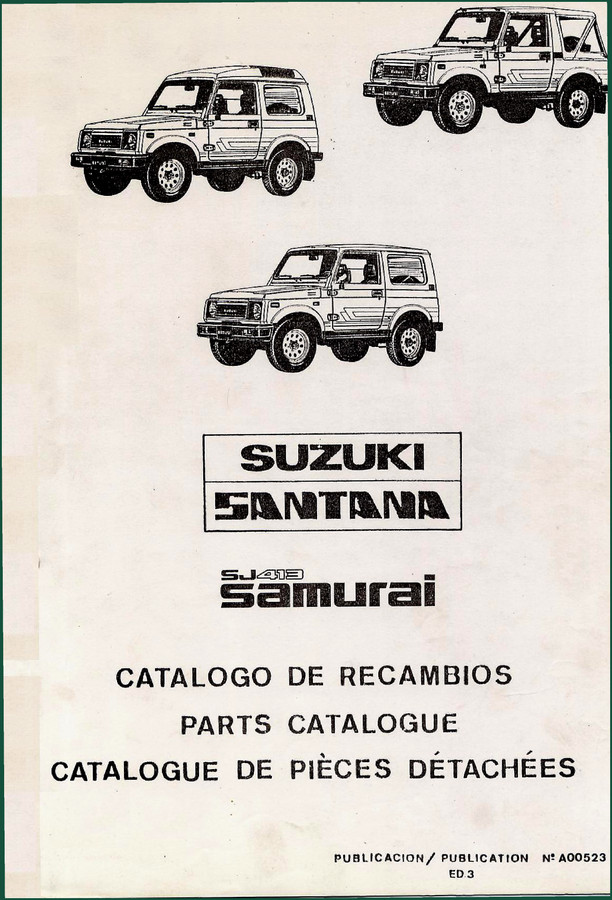
Suzuki Samurai, SJ410 Parts Catalog – 235-Page OEM Exploded Diagrams
Original price was: $31.74.$23.00Current price is: $23.00.
Factory Suzuki Samurai SJ410 parts catalog – 235 pages of OEM exploded diagrams for accurate part identification.
Description
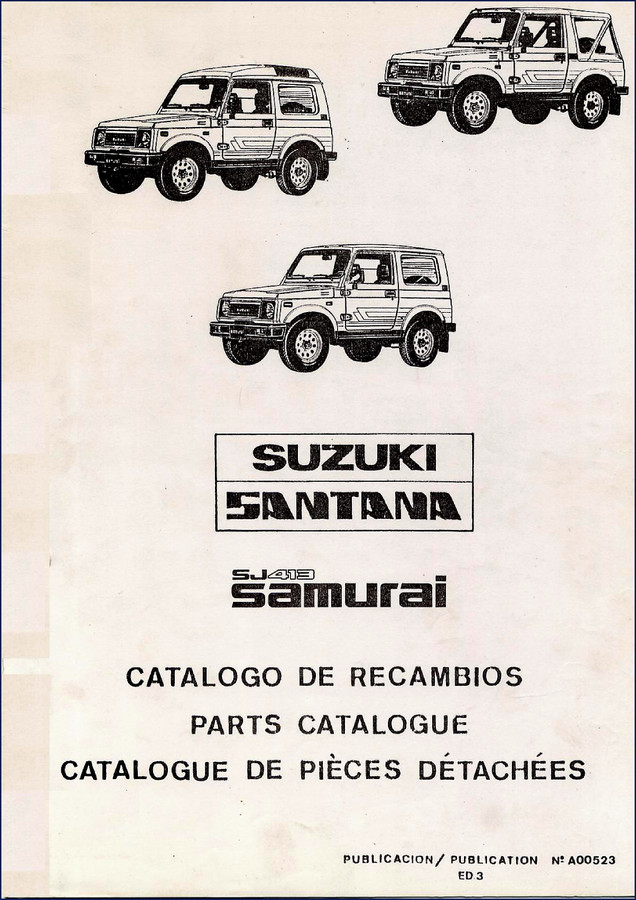
If you’ve ever tried ordering parts for a Suzuki Samurai or SJ410 from a generic aftermarket catalog, you know the drill. You get a box with something that looks close but doesn’t fit. Then you’re down a week and still have a hole in your drivetrain. This is the factory Suzuki Samurai, SJ410 Parts Catalog — 235 pages of exploded diagrams and OEM part numbers. It’s what the dealer used to order the right bearing, seal, or bracket the first time.
What This Parts Catalog Covers
That index on page 3 lists every figure from FIG. 1 B-02 through FIG. 75 J-12. Each figure corresponds to a specific system — engine block, cylinder head, transmission, transfer case, front and rear axles, steering, suspension, body panels, and electrical components. The letter prefix tells you the section: B for engine, C for clutch and transmission, D for transfer case and driveline, E for front axle, F for rear axle, G for steering and suspension, H for wheels and brakes, I for electrical, J for body. The number after the letter is the specific figure within that section. So if you need a part for the transfer case, you head to figure J-12 on page 75. Every component is numbered and cross-referenced to the OEM part number in the table below the diagram.
Using the Figure-Based Index
Don’t skip the index on page 3. It’s your roadmap. Each figure has a page number printed in the corner — for example, FIG. 75 J-12 appears on page 75. That’s where you’ll find the exploded view of the transfer case assembly. The diagrams are dense but clean. Suzuki’s original layout puts the part numbers in a table adjacent to the drawing, with columns for figure reference number, part number, description, and quantity. If you’re looking for a specific bolt, gasket, or shim, you scan the drawing to find the label number (like 1, 2, 3), then read the table for the part number. This system beats any aftermarket catalog because the data came straight from the assembly line. Aftermarket books often guess at groupings or merge model years; this one doesn’t.
FIG. 75 J-12: Transfer Case Assembly Breakdown
For the SJ410 and Samurai, the transfer case is a common failure point. FIG. 75 J-12 shows every internal component — from the input shaft and bearings to the shift fork and detent springs. Each part is labeled with a number that corresponds to the OEM part number listed in the table. If you need the correct shifter seal or the oil slinger, you look at the diagram, find the label, and write down the part number. No cross-referencing required. This catalog also covers the SJ413, which shares many drivetrain parts with the Samurai. If you’re rebuilding a transfer case, you’ll also want the service manual for torque specs, but for buying parts, this catalog is the final word. Suzuki Samurai Sidekick Tracker 1986-1996 Repair Manual covers the full vehicle if you need repair procedures alongside the parts catalog.
Why OEM Documentation Beats Aftermarket Catalogs
Aftermarket parts catalogs frequently combine multiple model years into one figure, or worse, they drop superseded part numbers without indicating the revision. Suzuki’s own catalog — the publication number A00523 — was printed for dealer parts departments. It shows every part that was originally installed, including hardware like bolts, washers, and cotter pins. Those details matter. A generic catalog might list “bearing, transfer case” without specifying the inner race diameter or the snap ring groove location. Here, you get the exact part number that Suzuki assigned, which means you can order it from any dealer and it will fit. I’ve been burned by aftermarket wiring diagrams and engine parts lists, and I won’t rely on them. This catalog is scanned from the original Suzuki print, not a reprint with missing pages. 1992 Suzuki Samurai A/C Installation Manual | 38 Pages is another factory document that fills the same need — OEM accuracy for a specific subsystem.
3 Reasons to Verify with Factory Specs
- Bolt Grades and Washers: The diagram shows exactly which washer and bolt go where. A wrong bolt can strip the aluminum housing or shear off under load.
- Seal Dimensions: Gaskets and seals have specific part numbers based on thickness and material. Using a universal seal often leads to leaks within a hundred miles.
- Bracket Geometry: Engine mounts, transmission brackets, and body panels have revisions that aren’t obvious from aftermarket photos. The figure number includes the revision indicator in the suffix (e.g., 70-1). You get the updated part, not the original flawed one.
Each of those reasons alone justifies the cost of this catalog. When you’re chasing a drivetrain vibration or a fluid leak, having the correct part number the first time saves you from ordering twice. I’ve seen guys buy three different seals before finding the right one — that’s three round trips to the parts store and a lot of wasted time. This catalog eliminates that.
For broader industry context on why factory documentation matters, the Automotive Industry Overview discusses quality standards in repair information. If you’re working on electrical components, the Automotive Battery guide explains battery specs, though for the Samurai you’ll want to stick with the factory parts catalog for the battery tray and cables.
Another Suzuki parts catalog available here is the Suzuki GSX600F 2005 Parts Catalog – OEM Factory Specs, if you work on their motorcycles as well.
Frequently Asked Questions
- Does this catalog include torque specifications?
- No, it is a parts catalog, not a service manual. Torque values are in the factory service manual.
- How do I find a part number for the transfer case?
- Turn to FIG. 75 J-12 on page 75 of the catalog. That figure shows the exploded view of the transfer case assembly with each component labeled. Below the diagram is a table that cross-references each label number to the OEM part number, description, and quantity per vehicle. Suzuki’s original catalog uses these figure numbers to organize the entire vehicle system by group. The ‘J’ section covers the transfer case and related driveline components. If you need the specific gasket or seal, identify it visually from the diagram and then order the exact Suzuki part without guessing or relying on aftermarket cross-references that often mismatch. This method ensures you get the correct revision for your SJ410 or Samurai.
Whether you’re restoring a Samurai or swapping parts on an SJ410, having this catalog on your tablet or printed out saves you from ordering the wrong part. Access the Factory Manual from AutoRepairManuals and get the real numbers.
Additional information
| Brand | Suzuki |
|---|---|
| Language | English |
3 reviews for Suzuki Samurai, SJ410 Parts Catalog – 235-Page OEM Exploded Diagrams
You may also like…
-
Sale!
Suzuki Hatch Service Manual – 151 Pages Factory Repair Data
Original price was: $54.80.$40.00Current price is: $40.00. -
Sale!
Suzuki GSX-R600 Service Manual – 2001-2002 Factory Repair Data
Original price was: $51.60.$40.00Current price is: $40.00. -
Sale!
Suzuki SWIFT 1988 Service Manual – Factory Repair Docs for 1300 GTi
Original price was: $67.05.$45.00Current price is: $45.00. -
Sale!
Suzuki GC415 2004 Service Manual – 770 Pages Factory Specs
Original price was: $58.95.$45.00Current price is: $45.00.
Related products
-
Sale!

2011 Parts Catalog – International 7400 SFA 6X6 – 1886 Pages of OEM Part Numbers
Original price was: $32.00.$25.00Current price is: $25.00. -
Sale!

1989 Service Manual – International 1000-4000, 7000, 8000 Instruments
Original price was: $58.80.$40.00Current price is: $40.00. -
Sale!

Technical Manual – International DT 530 & HT 530 (118 Pages)
Original price was: $37.00.$25.00Current price is: $25.00. -
Sale!

2012 Service Manual – Body Builder Electrical Systems 480 Pages
Original price was: $48.28.$34.00Current price is: $34.00.
Charles W. –
Excellent workshop guide. The file looks clean. Contains precise wiring diagrams for Suzuki. Worth every penny.
William H. –
Excellent OEM spec sheet. The pages are clean and easy to navigate. It helped me to repair my Suzuki Samurai, engine. Saved my weekend project! Thanks.
John S. –
Superb resource! It is very easy to read on my iPad without losing quality. Contains detailed schematics for Suzuki. Saves me so much time.