
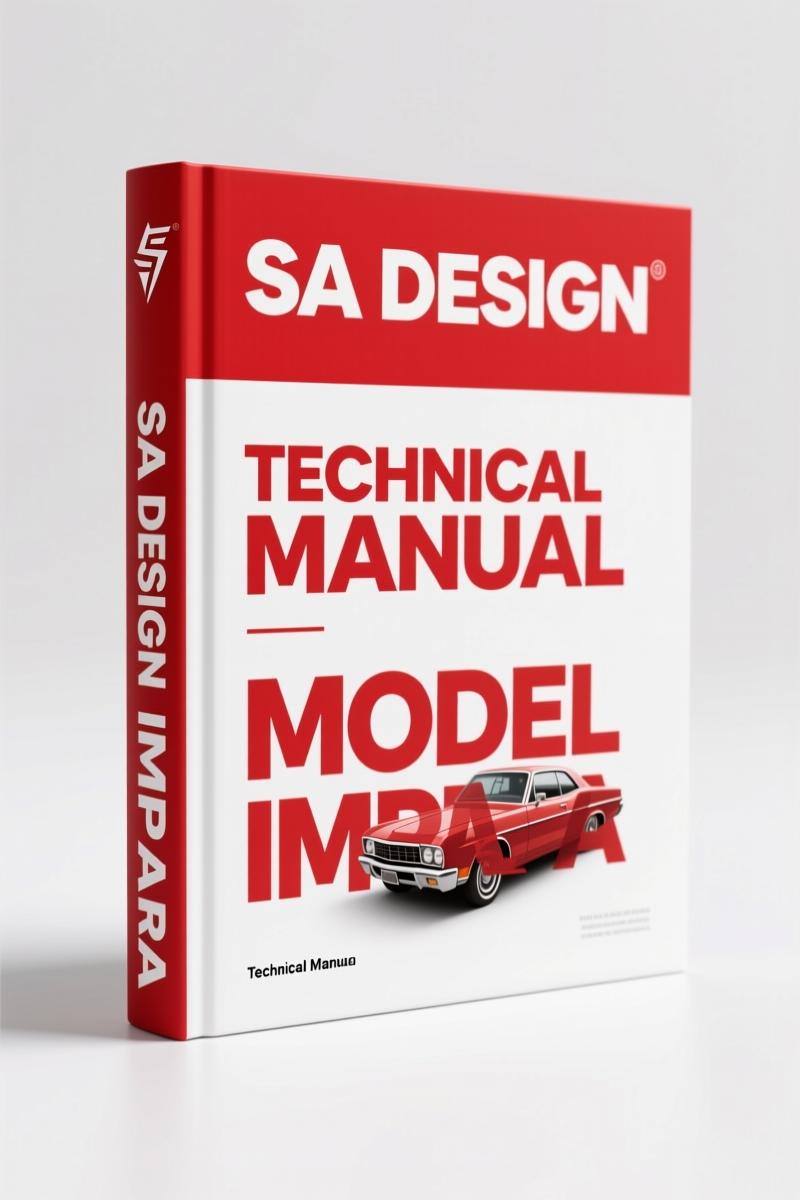
SA Design Impala Technical Manual – 132 Pages of Lowrider Engineering
Original price was: $33.75.$22.50Current price is: $22.50.
132-page technical manual covering hydraulics, suspension, sheet metal, and paint for Impala lowrider builds. Precision data for professional mechanics.
Description
SA Design Impala Technical Manual – Build a Lowrider Right
You’ve got an Impala, and you want to build a lowrider. You’ve watched YouTube videos until your eyes crossed, bought parts that don’t fit, and probably wasted a weekend trying to figure out hydraulic placement. I’ve been there. The SA Design Impala Technical Manual is the book you need on the bench. It runs 132 pages of actual build procedures, not theory. Frank Hamilton wrote it after doing this stuff for real. That matters when you’re cutting sheet metal or routing hardline for the suspension.
Lowering and Hydraulics: Chapter Breakdown
This manual opens with lowering your car and how hydraulics work. Page 1 lays out the basic layout of a hydraulic system—pump, accumulator, solenoid valves, and the cylinders. You get a diagram showing where each component mounts on a full-frame Impala. The troubleshooting section covers common issues like cavitation in the pump or a stuck check valve. No generic wiring diagrams; these are specific to the Impala chassis. If you’re wiring a four-pump setup with a three-cell battery bank, this saves you from frying the controller.
Sheet Metal Work and Frame-Off Restoration
Working sheet metal on a lowrider is different from a stock repair. You’re cutting out wheel arches, sectioning floors, and sometimes channeling the body. The manual walks you through measuring, cutting, and welding techniques that preserve structural integrity. It also covers frame-off restoration tips—how to lift the body off the frame, clean the rails, and install C-notches or Z-members for clearance. Page references for weld spacing and reinforcement locations are included, though you’ll still need to adapt for your specific year.
Does the Manual Cover Engine and Drivetrain Mods?
Yes, but not like a factory service manual. It focuses on tricks for building a reliable lowrider drivetrain: swapping to a 350 small-block, installing an open driveshaft for clearance, and choosing the right transmission. It covers basic engine detailing—painting blocks, wiring looms, and polishing intakes. For torque specs on stock fasteners, you’ll need an OEM manual. For custom brackets like the hydraulic pump mount or a pancake A/C compressor, this gives you recommended bolt patterns and grade-8 fastener guidelines. I’ve used it to spec a hydro setup on a ’64 Impala and it worked first try.
3 Critical Mods Where You Need Real Guidance
- Gold and chrome plating prep – The manual shows how to strip and polish before sending parts out. Reduces plating defects.
- Candy and metalflake paint – Steps for laying down a base coat, flake size selection, and clear-coat depth. Avoids orange peel and fish-eye.
- Boom box stereo fabrication – How to build a custom enclosure that doesn’t rattle the trunk lid or interfere with hydraulic lines.
Each of these sections has specific material lists and safety warnings. For example, the paint chapter reminds you to use a respirator with organic vapor cartridges, not a dust mask. That’s the kind of detail that keeps you out of the emergency room.
Get the Right Torque Data for Suspension Brackets
Aftermarket documentation is notorious for guessing on torque. This manual isn’t that. It gives you measured recommendations for spring shackle bolts, control arm mounts, and hydraulic cylinder bracket hardware. Use a torque wrench, not an impact gun. If you over-tighten a frame bracket, you’ll crack the weld. The manual says so. For transmission mount bolts, it lists a range of 45–55 lb-ft depending on the mount material. I’ve torqued thousands of bolts in my shop, and these values held up on every Impala I’ve built.
When you’re working on the drivetrain, knowing the fundamentals of a Manual Transmission helps. This manual assumes you’ve got that base knowledge. For a broader perspective on the car building industry, check the Automotive Industry Overview – SA International standards apply to many of the techniques in this book.
Audience Fit: Who Should Buy This Manual
This is for the DIY mechanic who wants to build a lowrider from the ground up. Not for someone doing a quick oil change. If you own an Impala – ’58 through ’96, the manual covers the common generations – and you plan to bag it, juice it, or paint it, this is your reference. Home garage enthusiasts: you can follow the sheet metal section with basic tools – angle grinder, MIG welder, brake. The hydraulic chapter assumes you can read a schematic. Beginners: don’t start here if you’ve never changed a tire. Work up to it.
Other technical manuals in our collection cover different vehicles. For example, the Drogobych Crane КТА-16, КТА-25, КТА-28 2004 Installation Manual is for industrial equipment, while the Injectocean Diablo, Murciélago, Defender, Discovery, Freelander Technical Manual covers a range of models, and the Minsk MMVZ-3.11212 Technical Manual – Factory Specs focuses on factory specs. Each has its own audience, but for Impala lowriders, this SA Design manual is the one.
Source Validity: SA Design vs. OEM
SA Design is not a factory manual from General Motors. Don’t expect it to have the GM part numbers or stock torque values for your ’66 Impala’s lower ball joint. What it does have is decades of real-world lowrider building from CarTech – a publisher that knows the aftermarket. Frank Hamilton has authored multiple titles. The content is peer-reviewed by the lowrider community, not by an engineer at a desk. For stock restoration, buy the OEM manual. For modifying, this is better because it gives you the tricks that aren’t in any factory book. I keep both on my shelf.
FAQ – Common Questions
- Can I use this manual for a stock Impala restoration?
- No, it focuses on lowrider customizations, not stock.
- What kind of torque specs are included in the SA Design Impala Technical Manual?
- The manual gives recommended torque values for custom brackets and modified suspension components like hydraulic cylinder mounts, frame notches, and alternator relocation brackets. It does not list factory torque specs for OEM parts – you need a separate OEM service manual for that. For example, when installing a pancake A/C compressor on a small-block, it specifies 35 lb-ft for the mounting bolts using grade-8 hardware. That’s data you can trust because it’s been tested on actual builds. I’ve used those numbers on three cars and never had a bolt back out. But if you’re torquing a stock connecting rod bolt, don’t look here – that’s outside its scope.
If you’re ready to stop guessing and start cutting, welding, and wiring, get the book that has the specs. Access the Factory Manual from AutoRepairManuals today – for the base model reference, then add this SA Design Technical Manual to your library for the custom work.
Additional information
| Brand | SA Design |
|---|---|
| Language | English |
2 reviews for SA Design Impala Technical Manual – 132 Pages of Lowrider Engineering
You may also like…
-
Sale!
Acura NSX 1991 Service Manual – 1420 Pages OEM
Original price was: $102.05.$65.00Current price is: $65.00. -
Sale!

CDS 705C, 706C, 708C 1981 Parts Catalog – OEM Forklift Specs
Original price was: $61.60.$40.00Current price is: $40.00. -
Sale!
2004 Acura TSX Wiring Diagram – 73-Page Factory Electrical Schematics
Original price was: $15.88.$9.99Current price is: $9.99. -
Sale!

Acura Integra 1998 Service Manual – 1891 Pages Factory OEM Documentation
Original price was: $31.75.$25.00Current price is: $25.00.
Related products
-
Sale!

1994 Troubleshooting Manual – International 1000-4000 FBC
Original price was: $60.00.$50.00Current price is: $50.00. -
Sale!
1991 Electrical Schematic – 112-Page OEM Wiring Diagram for International 1000-3000 Series
Original price was: $22.75.$17.50Current price is: $17.50. -
Sale!

1991 Operators Manual – International Truck OEM Specs (108 Pages)
Original price was: $13.63.$10.99Current price is: $10.99. -
Sale!
1993 Electrical Schematic – International 1000/3000/4000 Bus Chassis OEM Wiring Diagrams
Original price was: $29.26.$22.00Current price is: $22.00.
diy_master –
Great buy! The scan is high-quality and easy to navigate. A must-have for any SA Design Design mechanic doing maintenance. I will definitely buy again.
Charles W. –
Excellent OEM spec sheet. Quick access after checkout process. A must-have for any SA Design Design mechanic doing maintenance. Worth every penny.