
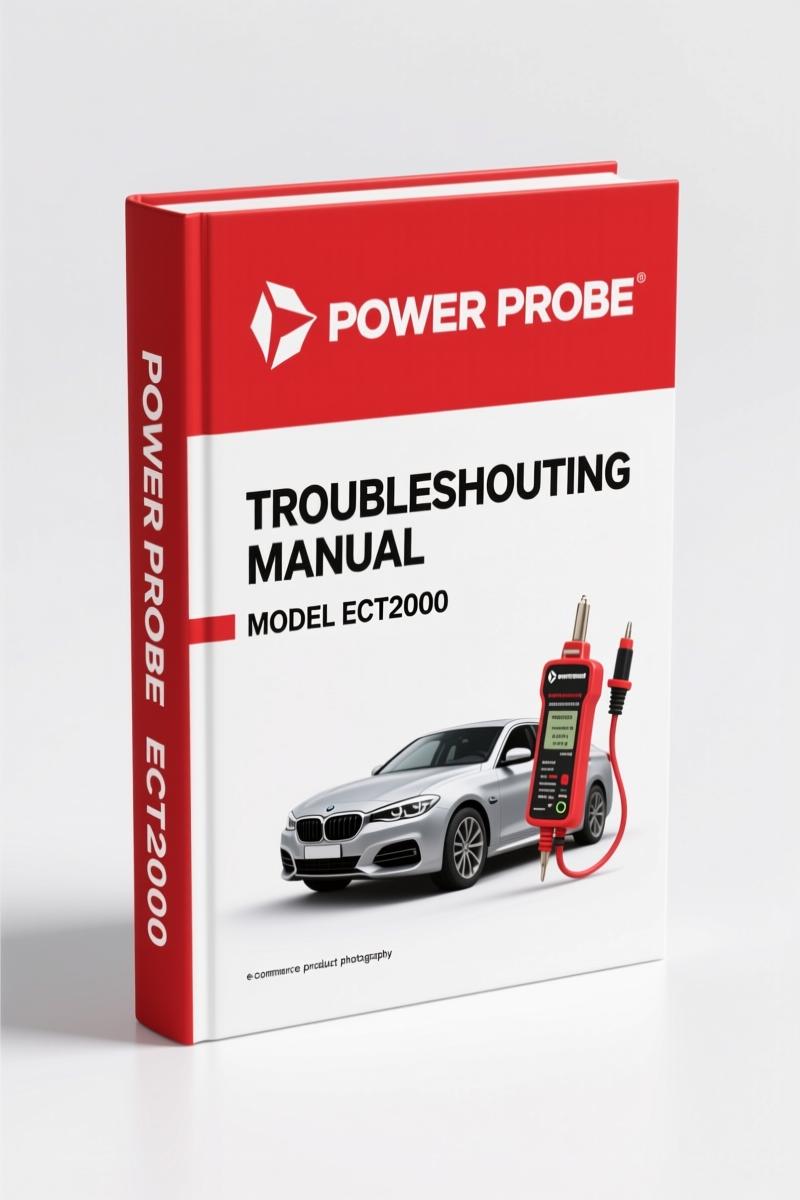
Power Probe ECT2000 Troubleshooting Manual – OEM Electrical Diagnosis
Original price was: $32.85.$22.50Current price is: $22.50.
27-page factory troubleshooting manual for Power Probe ECT2000. Covers short-to-ground, open circuit, and battery drain diagnostics with OEM precision.
Description
Power Probe ECT2000 Troubleshooting Manual
If you’ve ever chased an electrical gremlin for hours and ended up replacing a part that wasn’t bad, you know the drill. The Power Probe ECT2000 Troubleshooting Manual is the cure for that kind of wasted time. This is the factory document straight from Power Probe – 27 pages of what to do when your circuit goes dead, grounds out, or draws current when it shouldn’t. No third-party interpretations, no generic wiring guesses. This is the actual procedure used by the engineers who designed the ECT2000.
I’ve seen DIYers blow fuses and professional techs pull their hair out over intermittent shorts. The ECT2000 is a beast of a tool, but without the manual, you’re flying blind. The manual walks you through every mode: Pulse Mode, Sensitivity Locking, and the directional tracing features. Page 2 lists the table of contents including characteristics of the Short/Grounded signal and the Open circuit signal. You get the exact steps to isolate a circuit, verify the fault, and pinpoint the damage. This isn’t a theory book – it’s a workbench manual.
How to Trace a Short Circuit to Chassis Ground
This section (page 17) is the one you’ll bookmark. The manual tells you to first isolate the circuit – pull the fuse or disconnect the power source. Then verify the short to ground using the ECT2000’s transmitter and receiver. The key is the sensitivity locking: you lock onto the short signal so the receiver only alerts you when it’s near the fault. The manual explains how to set the receiver sensitivity to avoid false positives from adjacent wires. I’ve used this method on a 1998 F-150 that had a chafed wire behind the dash – found it in ten minutes.
Locking Sensitivity: Why You Need to Do It
Page 14 covers locking the sensitivity for both Short/Grounded and Open circuit signals. Most people skip this step and then wonder why the receiver beeps everywhere. The manual gives you a clear procedure: hold the receiver near the transmitter, adjust the sensitivity dial until the signal is stable, then lock it. Once locked, the receiver only triggers when the signal strength changes – meaning you’re moving toward the break or short. Without this, you’re chasing ghosts.
Open Circuit Signal vs Grounded Circuit Signal
Page 22 lays out the difference in a table. An open circuit sends a pulsed signal that reflects back when it hits the break. A grounded circuit sends a continuous tone that changes pitch as you approach the ground. The manual explains how to interpret the audio cues and the LED indicators. If you’re new to the ECT2000, this is where you’ll learn to tell a broken wire from a rubbed-through wire. I’ve seen guys replace a whole harness because they couldn’t tell the difference – this page saves you that headache.
Bench Tracing a Wire Harness
For home garage enthusiasts, bench tracing is a game-changer. Page 24 shows you how to lay out a harness on the bench, connect the transmitter to one end, and walk the receiver along the wires. You can find opens and shorts without the engine running or the car together. The manual includes a section on reception distance (page 20) – what to expect when the wire is in a bundle or shielded. It also covers tracing circuits that are shielded (page 21) – a must-know for anyone working on modern cars with twisted-pair CAN bus wiring.
Circuit Wiggle & Flex Test – Finding Intermittent Faults
Intermittent problems are the worst. The manual dedicates a section to the wiggle and flex test (page 25 and beyond). You connect the ECT2000, set it to pulse mode, then physically wiggle the harness while watching the receiver. If the signal cuts out or changes, you’ve found the intermittent break. The manual tells you how to reproduce the fault without destroying the wire. This is the kind of procedure that separates a hack from a pro.
Audience Fit: Who Needs This 27-Page Manual?
DIY mechanics, car owners, and home garage enthusiasts who own a Power Probe ECT2000 need this manual. If you’ve ever tried to trace a battery drain using the old pull-a-fuse-and-hope method, this manual will show you the correct way – page 25 covers tracing out battery drain or current draw. Beginners will appreciate the step-by-step process, and experienced techs will use it as a quick reference for sensitivity settings. The manual is written in English, Spanish, French, German, and Italian – so if you’re working with a multilingual crew, it covers that too.
Original Factory Documentation vs Aftermarket PDFs
This is the real deal. The PDF you get from AutoRepairManuals is scanned from the original Power Probe document. Compare that to a knock-off that says “ECT2000 compatible” – those often have wrong descriptions of the signal modes. The OEM manual uses the exact terminology from the tool: “Smart Transmitter”, “Smart Receiver”, “Pulse Mode”. Aftermarket copies rename these things and confuse the procedure. Factory spec data is critical when you’re dealing with a 12V electrical system that can fry a module if you misdiagnose the short.
For more background on automotive electrical systems, see Automotive Industry Overview. If you’re working on a vehicle with a manual transmission, the electrical troubleshooting remains the same – the ECT2000 doesn’t care about the drivetrain. But if you need a different tool, check out Power Probe PPH1 Operators Manual – Official Factory Document. And for heavy equipment, we offer Volvo BM Michigan 850 1995 Troubleshooting Manual and Volvo BM Michigan D6B-D16B Troubleshooting Manual – 144 Pages.
- What is the Power Probe ECT2000 Troubleshooting Manual?
- It’s a 27-page factory document covering how to use the ECT2000 to diagnose shorts, opens, and battery drain in vehicle electrical circuits.
- Does this manual include wiring diagrams for specific vehicles?
- No. This manual teaches you how to use the ECT2000 tool – it covers the procedures for tracing any circuit, but it does not contain vehicle-specific wiring diagrams. The manual focuses on signal interpretation, sensitivity adjustment, and directional tracing. For vehicle schematics, you need a separate factory service manual. The ECT2000 manual is designed to work regardless of the vehicle make or model, so you can apply the same steps to a 1970 Chevelle or a 2022 Ford Transit.
- How many pages is the manual?
- 27 pages.
- Can I use this manual with other Power Probe tools?
- No. This manual is specifically for the ECT2000. The PPH1 has a different operating manual, available separately.
Stop guessing with electrical faults. The manual gives you the exact factory procedure for the Power Probe ECT2000. Access the Factory Manual now and get the diagnostic steps that actually work.
Additional information
| Brand | Power Probe |
|---|---|
| Language | English |
3 reviews for Power Probe ECT2000 Troubleshooting Manual – OEM Electrical Diagnosis
You may also like…
-
Sale!

CDS 705C, 706C, 708C 1981 Parts Catalog – OEM Forklift Specs
Original price was: $61.60.$40.00Current price is: $40.00. -
Sale!
Power Probe PPH1 Operators Manual – Factory Operation Protocol
Original price was: $11.75.$7.99Current price is: $7.99. -
Sale!

Acura Integra 1998 Service Manual – 1891 Pages Factory OEM Documentation
Original price was: $31.75.$25.00Current price is: $25.00. -
Sale!
Acura NSX 1991 Service Manual – 1420 Pages OEM
Original price was: $102.05.$65.00Current price is: $65.00.
Related products
-
Sale!

1992 Electrical Schematic – International 1000/3000/4000/2554 OEM Wiring Diagrams (132 Pages)
Original price was: $26.40.$20.00Current price is: $20.00. -
Sale!
1994 Troubleshooting Manual – International 1000-4000 FBC
Original price was: $60.00.$50.00Current price is: $50.00. -
Sale!

1991 Operators Manual – International Truck OEM Specs (108 Pages)
Original price was: $13.63.$10.99Current price is: $10.99. -
Sale!

2011 Parts Catalog – International 7400 SFA 6X6 – 1886 Pages of OEM Part Numbers
Original price was: $32.00.$25.00Current price is: $25.00.
diy_master –
Highly recommended! Quick access after checkout. It helped me to repair my Power Probe Probe transmission. Saves me hundreds of money.
John S. –
Highly recommended! The PDF looks clean. Contains detailed wiring diagrams for Power Probe. Worth every penny.
Thomas B. –
Excellent quality! It is easily zoomable on my tablet without blur. It guided me to rebuild my Power Probe Probe engine. Saves me hundreds of time.