
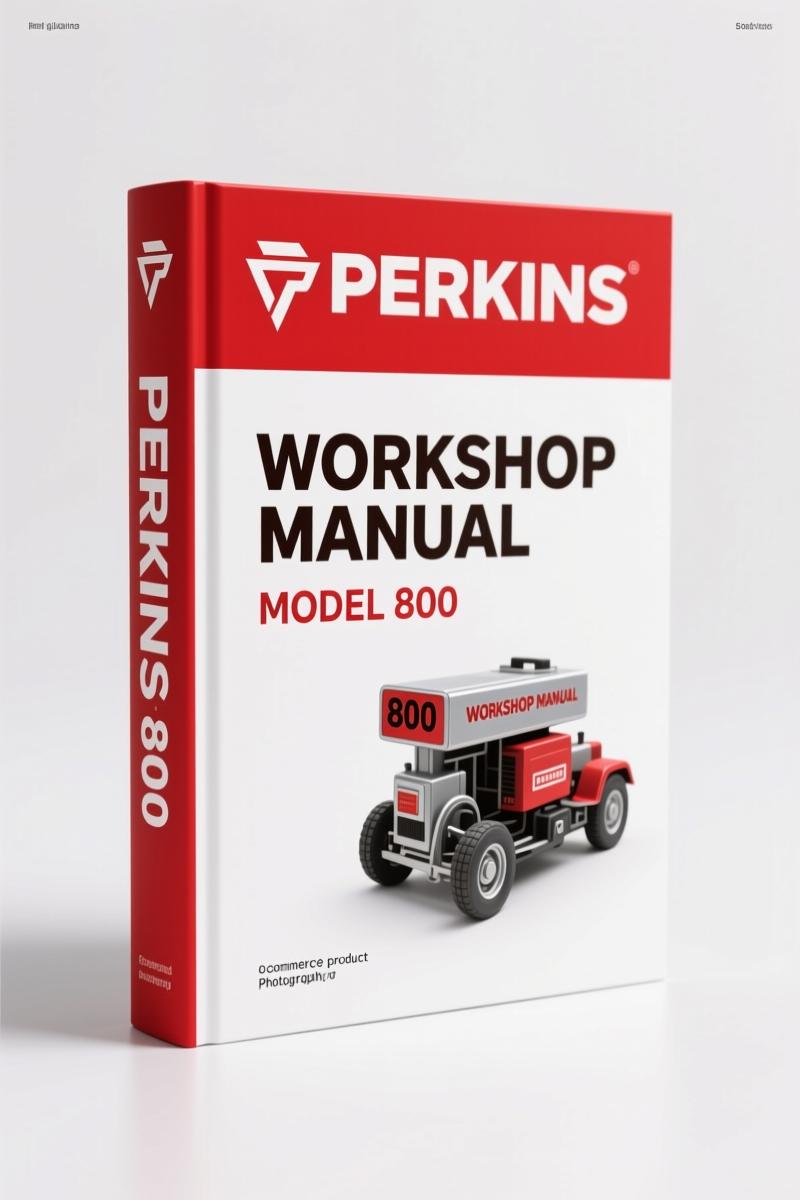
Perkins 800 2006 Workshop Manual – OEM Engine Service Data
Original price was: $64.80.$45.00Current price is: $45.00.
OEM workshop manual for Perkins 800 engine (2006). 80 pages covering fuel injection, turbocharger, valve train, oil system, and crankshaft seals.
Description
Perkins 800 2006 Workshop Manual – OEM Specs for the Industrial 800 Engine
You want to rebuild a Perkins 800 without the factory book? I’ve seen the results. Guys install a fuel pump using an aftermarket torque chart and snap the housing. Then they blame the part. The Perkins 800 2006 Workshop Manual is what you need on the bench – not some third‑party reprint that guesses clearances. This thing is 80 pages of factory procedure from Perkins, written for mechanics who don’t have time to second‑guess. I’ve been turning wrenches since before the 800 came out, and every time I open this manual I see something a generic PDF would have left out. The page count is tight – 80 pages – but every page has a purpose. You don’t get filler.
80 Pages of Original Factory Disassembly and Assembly
The manual’s title is Desarmado y Armado – Disassembly and Assembly – and that’s exactly what it covers. Fuel priming pump and filter base removal and installation starts on page 4. Turbocharger removal on page 10. Fuel injector removal and installation for both turbo and naturally aspirated versions on pages 11‑13. Exhaust manifold remove and install on page 14. Intake manifold on pages 15‑16. Valve spring removal with the cylinder head installed – page 16. I could go on: valve guides, seals, oil cooler, water pump, thermostat housing, flywheel, crankshaft seals, front cover, idler gear, breather, rocker shaft and push rods. That’s the kind of coverage you need when the engine is out and you’re staring at a pile of parts. Page 4 alone saves you a trip to the parts counter for a gasket set you didn’t know you needed.
One section every shop should study: “Bomba de cebado de combustible y base del filtro de combustible – Quitar e Instalar”. That priming pump is a common leak point. The manual shows the exact orientation of the o‑rings and the torque for the mounting bolts. No guesswork.
Fuel System: Pump, Injectors, and Lines – Factory Procedure
Three separate sections cover fuel injection piping for naturally aspirated and turbocharged engines. Perkins knows the line routing differs because of turbo heat shields and brackets. The manual lists the removal steps in order – don’t skip the fuel injection pump removal on page 9 unless you want to fight the timing later. Injection pump install procedure includes timing marks you won’t find in a generic scan. Injector removal for turbo engines on page 11 uses a specific puller that the manual references. If you don’t have that tool, the manual tells you the alternative method. It’s that precise.
Turbocharger and Valve Train – Removing without Breaking
Turbocharger removal is page 10, install on page 13. I’ve seen guys try to unbolt the turbo without removing the oil feed line first – bad idea. The manual steps you through the oil drain tube, the water lines (if equipped), and the correct sequence for mounting bolts. Valve spring removal with the cylinder head still on the block – page 16 – uses an adapter to compress the spring with the head installed. The manual lists the adapter part number. Without that, you risk bending a valve. Valve guide removal and installation on page 20 tells you the interference fit and the reamer size for the new guides. That’s information you cannot trust from a third‑party source.
Safety and Torque – What the Manual Emphasizes
Page 2 starts with safety warnings from Perkins: “La mayoría de los accidentes… se deben a que no se observan las precauciones y reglas básicas de seguridad.” Translation: most accidents come from ignoring basic safety rules. The manual is direct about that. Every procedure includes torque specs in N·m and lb‑ft where applicable. For instance, the oil filter base removal on page 23 has a specific torque for the mounting bolts. You don’t get that from a Haynes book. You get a range that might crack the casting. The factory manual gives you one number because Perkins tested it. That’s the difference.
Who Actually Needs This Manual?
Home garage enthusiasts who work on industrial engines. Small engine shops that see Perkins 800s in generators, pumps, or agricultural equipment. Beginners who want to do the job right the first time – not after buying a used engine because they broke something. The manual is in Spanish (original 2006 edition), but the drawings and torque charts are universal. If you can read a number, you can use this manual. For the procedures you need English text, run it through a translator – the step order is still factory.
Related manuals that cover other Perkins engines: Perkins 1100 Series 2002 Workshop Manual – Specs, Torque & Repair for the 1100 series, Perkins Peregrine, Serie 1300 1997 Workshop Manual – OEM Specs & Repair for the 1300 series, and Perkins 110T, 180TI, 210TI Workshop Manual – 174 Pages for the 110T/180TI/210TI models.
External reference for understanding manual transmissions: Manual Transmission. Also see Manual Transmission for additional context.
FAQ – Common Questions About This Manual
- Is this manual in English?
- It’s the original Spanish edition as published by Perkins in 2006.
- Can I use this manual for other Perkins models?
- This manual is specific to the Perkins 800 industrial engine. While some procedures may be similar to other models, torque specs, part numbers, and clearances differ. Using the wrong manual can cause engine damage. The table of contents covers only the 800 series. For other models, see Perkins 1100 Series 2002 Workshop Manual – Specs, Torque & Repair or Perkins Peregrine, Serie 1300 1997 Workshop Manual – OEM Specs & Repair. If you work on multiple Perkins engines, you need the specific manual for each series – no one book covers them all. The 800 has its own bore, stroke, and injection timing that don’t transfer. I’ve seen guys try to use a 1100 manual on an 800 and end up with a mistimed engine. Don’t be that guy.
You want to work on a Perkins 800 the way Perkins intended. That means having the factory book on the bench next to your torque wrench. 80 pages, 2006 original print, step‑by‑step disassembly and assembly, torque specs you can trust, safety warnings that keep you out of the hospital. Access the Factory Manual and get the right info the first time.
Additional information
| Brand | Perkins |
|---|---|
| Language | English |
4 reviews for Perkins 800 2006 Workshop Manual – OEM Engine Service Data
You may also like…
-
Sale!
Perkins 2300, 2800 2006 Training Manual – OEM Factory Diagnostics
Original price was: $79.20.$60.00Current price is: $60.00. -
Sale!
Perkins 1104C Service Manual – Factory Specs for Electronic Diesel Engines
Original price was: $79.20.$60.00Current price is: $60.00. -
Sale!
Perkins RE, RF, RG, RH, RJ 2002 Workshop Manual – OEM Service Data
Original price was: $94.25.$65.00Current price is: $65.00. -
Sale!
Perkins 1106D 2007 Service Manual – OEM Factory Diagnostics
Original price was: $94.90.$65.00Current price is: $65.00.
Related products
-
Sale!

1993 Operators Manual – International Bus 1000-3000 OEM Specs
Original price was: $12.30.$7.99Current price is: $7.99. -
Sale!
1993 Electrical Schematic – International 1000/3000/4000 Bus Chassis OEM Wiring Diagrams
Original price was: $29.26.$22.00Current price is: $22.00. -
Sale!
1994 Troubleshooting Manual – International 1000-4000 FBC
Original price was: $60.00.$50.00Current price is: $50.00. -
Sale!
1995 Operators Manual – International 1000-4000 Series | OEM Documentation
Original price was: $12.49.$9.99Current price is: $9.99.
James L. –
Perfect workshop guide. The text is searchable and easy to navigate. Every torque spec is included for Perkins 800. Saved my repair job! Thanks.
William H. –
This is exactly what I required. Instant access after payment. It assisted me to repair my Perkins 800 engine. Saved my repair job! Thank you.
Richard G. –
I am so happy with this transaction. The text is searchable and easy to navigate. Every spec sheet is included for Perkins 800. I will definitely buy again.
diy_master –
This is exactly what I was looking for. It is very easy to read on my iPad without blur. Contains clear bolt torque specs for Perkins. Worth every penny.