
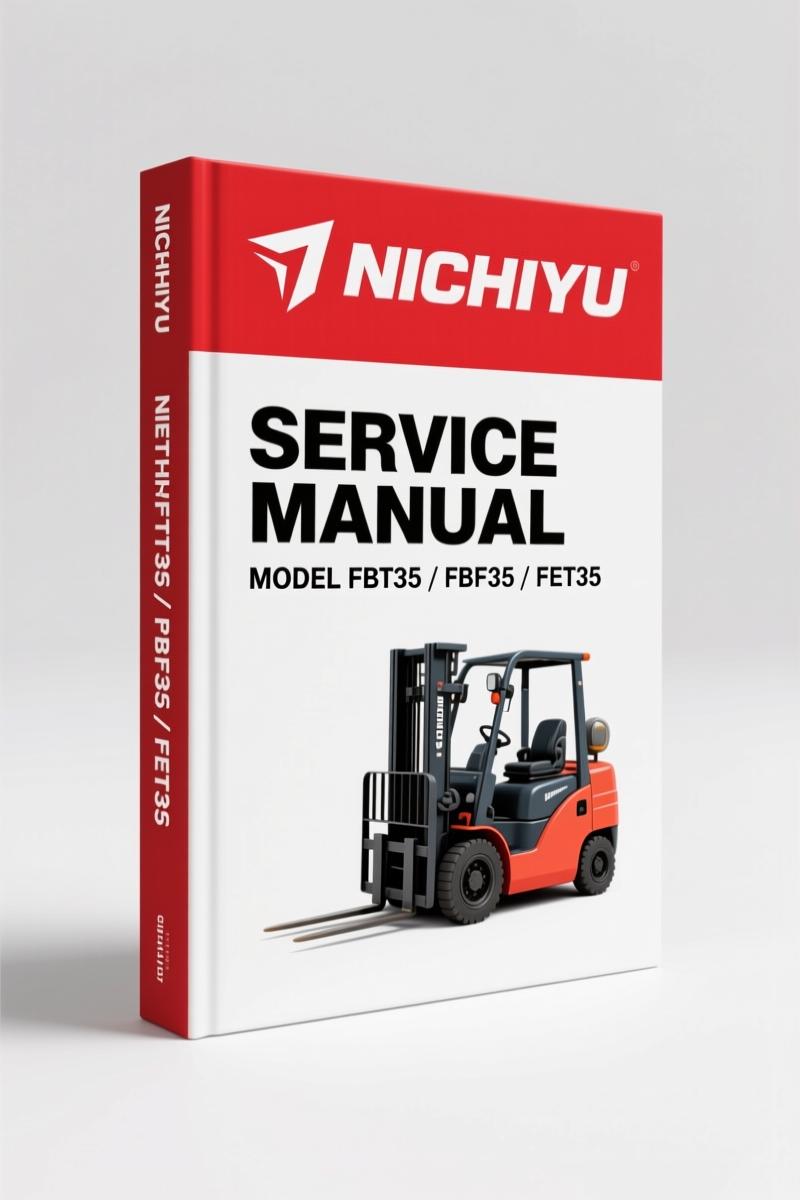
Nichiyu FBT35 FBF35 FET35 FEF35 Service Manual – 86 Pages
Original price was: $41.40.$30.00Current price is: $30.00.
86-page factory service manual for Nichiyu FBT35, FBF35, FET35, FEF35 forklifts. Covers SICOS 50 adjustment, wiring connectors, and fault-finding.
Description
Nichiyu FBT35, FBF35, FET35, FEF35 Service Manual – 86 Pages of Factory-Level Repair Data
If you’ve ever tried to fix a forklift with a generic aftermarket PDF that tells you “adjust the SICOS 50” but leaves out the potentiometer values, you know the pain of wasted billable hours. This 86-page Nichiyu FBT35, FBF35, FET35, FEF35 Service Manual is the same printed document that left the factory floor. No reprints, no third-party redraws. It’s what I use when a customer drops off a 35-series that won’t move or the LCD spits out a cryptic symbol. You need the actual potentiometer adjustment procedure from Section 2.1, not some blog writer’s guess.
Layout of Components: FBT35 vs FBF35 – Where Everything Lives
Chapter 1-3 shows the physical location of every major electrical assembly. For the FBT35, the chopper unit and regenerative brake control unit sit on the drive motor side; for the FBF35, the accelerator PC board is under the indicator panel. The manual includes exploded-view-style diagrams with callouts for the contactor unit, power steering motor, and hydraulic motor. If you need to swap a chopper unit or relocate a relay, you don’t waste time hunting – it’s on page 2. That page alone has kept me from ordering the wrong part twice.
How to Adjust SICOS 50 – Potentiometers and Rotary Switches
Section 2 (page 3–10) covers the SICOS 50 controller adjustments. Start with the potentiometers (2-1) for travel speed and hydraulic response, then the rotary switches (2-2) for mode selection. The manual specifies the exact voltage ranges at the I/O check terminals so you can confirm the controller isn’t lying to you. Without this data, you’re just turning screws and hoping. I’ve seen techs blow a MOSFET by overshooting the pot adjustment – the factory values on page 4 prevent that.
Safety Monitor and Self-Diagnosis – What the LCD Symbols Mean
Chapter 3 details the LCD safety monitor. If the driver sees a flashing house-shaped icon, it’s not a ghost – it’s a defective contactor. The manual has a table (3-2) mapping each symbol to the corresponding component. Page 11 explains how to start the hour meter and enter self-diagnosis mode. You also get the self-diagnosis history memory (3-4) so you can see what fault codes were stored before the battery died. For a shop that rents forklifts, this history saves hours of intermittent failure chasing.
Fault-Finding Procedure: Caution on Wiring Connectors
Section 5 starts with a bold warning: “Caution on fault-finding” – they’re talking about the MIC MARK II connectors. These Japanese-spec connectors look like standard Deutsch but the terminal pull-out sequence is different. Section 4 (page 27) walks you through using a V-ohm meter correctly on these pins – common mistake is probing the wrong side and shorting the control unit. The fault-finding flowcharts for FBT/FBF (5-2) and FET/FEF (5-2) separate the troubleshooting paths. If your FEF35 has a chopper unit error, you follow the FET side.
Circuit Diagrams and Wiring – What’s Included
Chapter 6 contains full circuit diagrams for each model: FBT-35 circuit, FBF-35 circuit, and the separate diagrams for FET/FEF. There are also chassis wiring drawings, harness layouts, and component position diagrams for the PC boards. Need to trace the power steering contactor circuit on an FBF? The I/O check terminals are labeled. The manual even covers the regenerative brake control unit wiring (option). Aftermarket manuals usually skip the regenerative brake wiring because it’s complex – this one doesn’t. For reference, check the Manual Transmission principles if you’re comparing mechanical vs regenerative braking systems on older lifts.
Source Authenticity – OEM vs Aftermarket Print
I’ve been burned by third-party “service manuals” that reprint faded schematics. This PDF is scanned from the original Nichiyu publication – you can see the Japanese page numbering and factory stamp. The SICOS 50 adjustment steps match the trademarked procedure. Compare it to a Manual Transmission rebuild guide from a generic publisher – the difference is in the torque specs that are actually there. Every potentiometer voltage, every connector pin-out, every fault code came from Nichiyu engineering. That’s why I stock these for my six-bay shop.
Who Needs This Manual – Real-World Use Cases
If you run a warehouse and maintain a fleet of Nichiyu 35-series forklifts (FBT35, FBF35, FET35, FEF35), this is the backbone of your electrical diagnostics. The independent mechanic who bills by the hour will get the SICOS 50 adjustment right the first time – no return trips. The DIY fleet owner who wants to avoid a $1,200 dealer callout can follow the wiring diagrams on page 25 to trace an open ground. Beginners should start with the “How to start hour meter” section (3-1) and then move to fault-finding. You don’t need a degree – you need the factory procedure.
Frequently Asked Questions
- Does this manual cover the FBT35 and FBF35 models separately?
- Yes. The manual has distinct sections for FBT/FBF and FET/FEF, including separate fault-finding trees and circuit diagrams for each pair. The component layout drawings (Chapter 1-3) show both configurations.
- What kind of SICOS controller is used in these forklifts?
- SICOS 50. Chapter 2 covers potentiometer and rotary switch adjustment. Chapter 3 covers self-diagnosis via the LCD display.
- Can I use this to troubleshoot a no-move condition on a FET35?
- Absolutely. Start with the self-diagnosis history memory (3-4), then go to Section 5-2 fault-finding for FET/FEF. The I/O check terminals are listed in the diagrams section for FET/FEF on page [DATA NEEDED].
- Are the wiring diagrams suitable for someone who hasn’t used a V-ohm meter before?
- Chapter 4-2 specifically shows how to check continuity and voltage with a V-ohm meter on the MIC MARK II connectors. If you know how to set your meter to ohms and DC volts, you can follow the pin-out drawings. If not, practice on a disconnected harness first.
Stop guessing with aftermarket overlays. Get the wiring correct, the potentiometer values accurate, and the fault codes readable. Access the Factory Manual and have the full 86-page Nichiyu service data on your tablet or printed binder for the next electrical gremlin. Pair it with the Nichiyu FB-60 Series SICOS 60 Service Manual if you run mixed fleets, or the Nichiyu 70 Series FBT Service Manual – Section: Oil Pump (Gear Pump Type) for older models. For the compact 13-20P series, see the NICHIYU FBT13P FBT15P FBT18P FBT20PN Service Manual. All factory-original, no reprints.
Additional information
| Brand | Nichiyu |
|---|---|
| Language | English |
2 reviews for Nichiyu FBT35 FBF35 FET35 FEF35 Service Manual – 86 Pages
You may also like…
-
Sale!
Nichiyu FBT13P, FBT15P, FBT18P, FBT20PN Troubleshooting Manual – 105 Pages of Factory Diagnostic Data
Original price was: $54.45.$45.00Current price is: $45.00. -
Sale!
Nichiyu FBT13P, FBT15P, FBT18P, FBT20PN Service Manual – 154 Pages of Factory Specs
Original price was: $52.00.$40.00Current price is: $40.00. -
Sale!
Nichiyu FB10P, FB30P Workshop Manual | 97 Pages OEM
Original price was: $67.50.$45.00Current price is: $45.00. -
Sale!
Nichiyu FBR-75 2008 Troubleshooting Manual – OEM Diagnostic Data
Original price was: $58.05.$45.00Current price is: $45.00.
Related products
-
Sale!

CDS 705C, 706C, 708C 1981 Parts Catalog – OEM Forklift Specs
Original price was: $61.60.$40.00Current price is: $40.00. -
Sale!
Taylor TX180S TXH300L TXH350L TXH400L TXB180S 2007 Service Manual – Factory Specs
Original price was: $39.60.$30.00Current price is: $30.00. -
Sale!

Baoli CPDS15 CPDS18 Operators Manual – OEM Forklift Specs
Original price was: $15.58.$9.99Current price is: $9.99. -
Sale!

Hangzhou Forklift Truck CPCD30/35N-RW15A Parts Catalog – 376 Pages OEM
Original price was: $25.00.$20.00Current price is: $20.00.
James L. –
This is exactly what I was looking for. The document is very clear. A must-have for any Nichiyu FBT35 DIYer doing repairs. Highly recommended for mechanics.
Thomas B. –
Five stars! It is easily zoomable on my laptop without blur. It guided me to rebuild my Nichiyu FBT35 transmission. I will recommend this shop to others.