
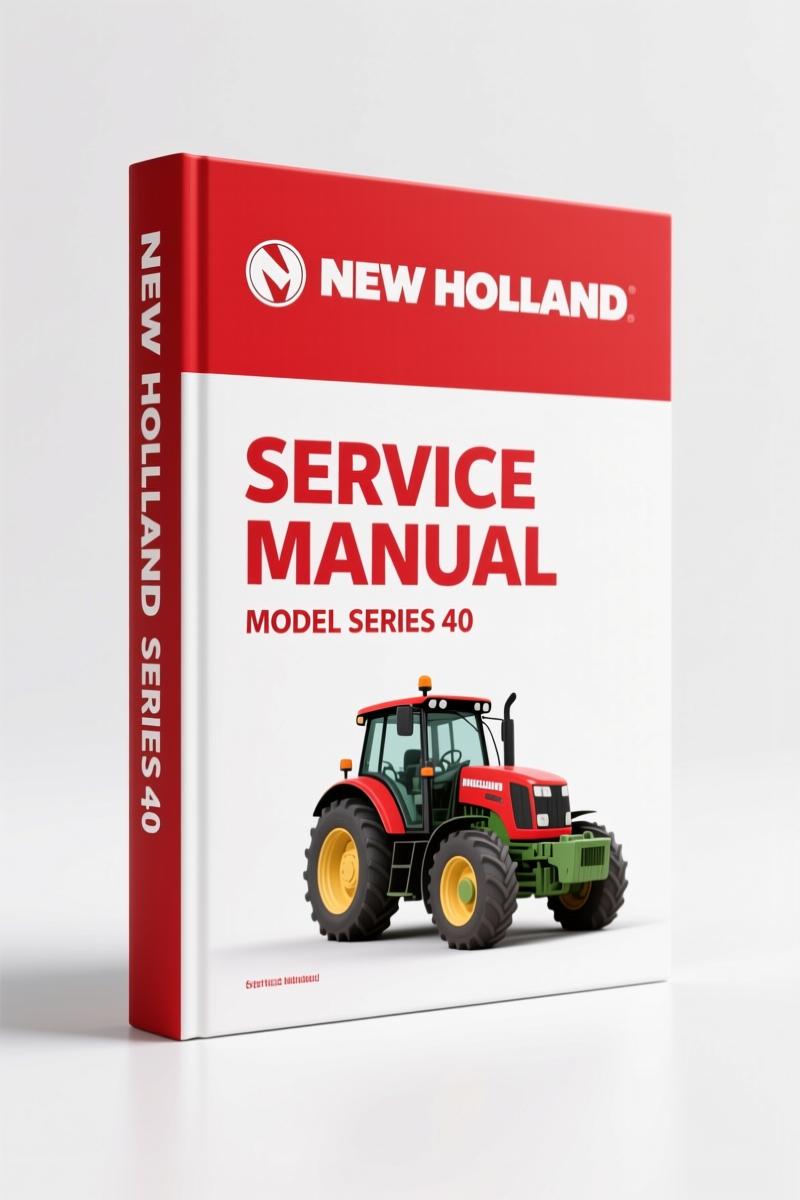
New Holland Series 40 Service Manual – 1492 Pages Factory Diagnostics
Original price was: $50.40.$40.00Current price is: $40.00.
Factory-certified New Holland Series 40 service manual. 1492 pages covering engine, fuel, electrical, wiring, and transmission systems.
Description
New Holland Series 40 Service Manual
You buying a manual for a Series 40 tractor? Let me guess – you grabbed some aftermarket PDF off a forum and spent an afternoon chasing a cooling system leak, only to find the torque values were off by 10 ft-lbs. I’ve seen that happen. Costs you a head gasket and a weekend. That’s why I tell every tech I train: New Holland Series 40 Service Manual is the only thing you trust when the real chassis rolls into the bay. 1492 pages of what the factory wrote, not some third-party cheat sheet.
Engine Systems and Cooling – Chapter 1
Engine section starts on a familiar note: disassembly sequence, clearances, and the torque sequence for cylinder head bolts. But what separates this from a cheap copy is the note on page 3 – that page tells you the manual covers both Series 40 and Series S, but with transmission code transpositions. If you’re working on a 7740 with 16×16 transmission, you need to read SLE, not S. Miss that and you’ll be pulling the wrong injector timing. Cooling chapter covers fan drive tension, thermostat testing, and flow rates. No guesswork.
Fuel Systems: Injectors and Pump – Part 2
Injectors are the heart of any diesel. Part 2 goes through the fuel system general, dry and wet air cleaners, injectors, fuel pump, turbocharger. Every component with OEM part numbers and adjustments. I’ve had guys ask me: “Can I just clean the injector nozzles?” – manual says no. It lists the replacement interval and the pop pressure specification. If you’re rebuilding a fuel pump, the manual includes calibration data. You need that data, especially on a Series 40 with a rotary pump. Don’t trust aftermarket reman specs.
Wiring Diagrams and Electrical Fault Finding – Part 3
Electrical systems can sink your whole day. Part 3 has wiring diagrams that actually match the harness. There’s a chapter on EIC fault finding for post-November 1995 models. That’s a common failure point – the instrument cluster goes dead. The manual gives you the pinout and diagnostic flow. Also covers alternators, starter motors, batteries. If you’re chasing a parasitic draw, the ‘Electrics – General’ chapter shows the proper test sequence. You won’t find that in a Chilton manual.
One more thing about the wiring – the manual includes Electrical Connector ID & Schematics at the back. That saved me two hours on a 7740 that had a corroded harness. Without it, you’re cutting into wires blind.
Transmission Options: 16×16, 12×12, 8×2 – Part 5
Manual Transmission fans will appreciate the depth here. Part 5 covers 16×16 Quad Mod, 12×12, 8×2 transmissions, plus the dual power assembly and reduction gearbox. Each one gets its own chapter with exploded views and shift linkage adjustments. The 8×2 Dual Power Assembly can be tricky – the manual walks you through the clutch pack clearance and the valve body pressures. If you’re dealing with a transmission that won’t shift into range, the fault finding section (post November 1995) gives you error code tables. I’ve seen shops replace a whole transmission because they didn’t have this data.
Also in Part 5: fault finding and calibrations. That’s where you find the learning procedure for the electronic shift controller. You need to perform a calibration after replacing the ECU or the solenoids. Skip it and the transmission hunts for gears.
Hydraulic Systems: Closed Centre Load Sensing – Part 8
Hydraulics are where you lose the most time if you’re guessing. Part 8 has an entire chapter on the Closed Centre Load Sensing (CCLS) pump. That pump is used on most Series 40 tractors with electronic draft control (Electrolink). The manual breaks down the pump flow rates, pressure settings, and the test port locations. There’s also a chapter on Electrolink fault finding with calibration steps. If your three-point hitch drifts down overnight, you check the lift cylinder seals – but the manual tells you to check the spool valve first. That’s the kind of sequence that saves you from replacing parts you don’t need.
For the older fixed displacement pump tractors, there’s a separate chapter. Hydraulic trailer brakes, remote control valves, assist rams – all covered. The torque specs for the hydraulic line fittings are listed in the beginning. Aftermarket manuals usually skip that detail.
Audience Fit – Who Needs This Manual?
If you own a Series 40 tractor – 6640, 7740, or any variant with 8×2, 12×12, 16×16 transmission – you’re the audience. Also the Series S equivalents (S90, S100). DIY farmers who do their own maintenance will get the most out of it. Shops that work on these tractors regularly should have a copy on the bench. If you’re a beginner, this manual is not a “how to be a mechanic” book – it’s the actual service manual. You need at least basic mechanical understanding, but the steps are detailed enough that you can follow them with a torque wrench and a multimeter.
Source Validity – OEM vs Aftermarket
I don’t trust aftermarket documentation. I’ve seen them print the wrong firing order for a 4-cylinder engine. This is a factory Manual Transmission repair manual printed by New Holland. The note on page 3 confirms it covers both Series 40 and Series S with the proper cross-reference. Every torque value, every electrical diagram, every hydraulic pressure spec came from the OEM engineering department. You’re not guessing. You’re following what the design engineers wrote. That’s the difference between a fix that lasts and a fix that fails in the field.
- How does the manual handle the transmission differences between models?
- It lists each transmission variant separately in Part 5, including the 16×16 Quad Mod and the 8×2 Dual Power. The fault finding section at the end (chapter 8) applies to post-November 1995 models and includes calibration procedures. You will need to know your tractor’s build date to use the right section.
- Can I use this manual for a Series S tractor?
- Yes. The note on page 3 tells you to transpose model numbers: for Series 40 read 6640/7740, for Series S read S90/S100. Transmission codes also transpose – S means 8×2, SL means 12×12, SLE means 16×16. Follow the table and you’ll be fine.
Don’t waste another weekend chasing ghosts with a ripped PDF. Access the Factory Manual – the 1492-page OEM New Holland Series 40 Service Manual – and get the real specs.
Related Manuals
- Sperry New Holland 31 33 36 Service Manual – OEM Factory Specs
- New Holland T7510-T7550 2013 Service Manual – Factory Specs
- New Holland T5.95, T5.105, T5.115 2013 Service Manual – 2173 Pages
Additional information
| Brand | New Holland |
|---|---|
| Language | English |
3 reviews for New Holland Series 40 Service Manual – 1492 Pages Factory Diagnostics
You may also like…
-
Sale!
New Holland H8040 2013 Service Manual – Factory Specifications
Original price was: $87.50.$70.00Current price is: $70.00. -
Sale!
New Holland E385B 2007 Workshop Manual – 1061 Pages of Factory Service Data
Original price was: $84.00.$70.00Current price is: $70.00. -
Sale!
New Holland D350 Service Manual – 354-Page OEM Factory Specs
Original price was: $100.10.$65.00Current price is: $65.00. -
Sale!
New Holland D255 Service Manual – 338 Pages OEM Factory Specs
Original price was: $91.00.$65.00Current price is: $65.00.
Related products
-
Sale!

1989 Service Manual – International 2000-8000 Electrical Systems
Original price was: $72.00.$50.00Current price is: $50.00. -
Sale!

Service Manual – International HS 2.8L Engine – 130 Pages of Factory Specs
Original price was: $56.40.$40.00Current price is: $40.00. -
Sale!

International 1000-3000 Series Operators Manual – 132 Pages of OEM Specs
Original price was: $14.40.$10.99Current price is: $10.99. -
Sale!
1993 Electrical Schematic – International 1000/3000/4000 Bus Chassis OEM Wiring Diagrams
Original price was: $29.26.$22.00Current price is: $22.00.
Thomas B. –
This is just what I needed. The file is very clear. A must-have for any New Holland Holland owner doing repairs. I will definitely buy again.
Charles W. –
This is just what I required. The document is very clear. A must-have for any New Holland Holland owner doing repairs. I will recommend this shop to others.
David K. –
Excellent quality! Quick access after payment. Contains detailed bolt torque specs for New Holland. I will recommend this shop to others.