
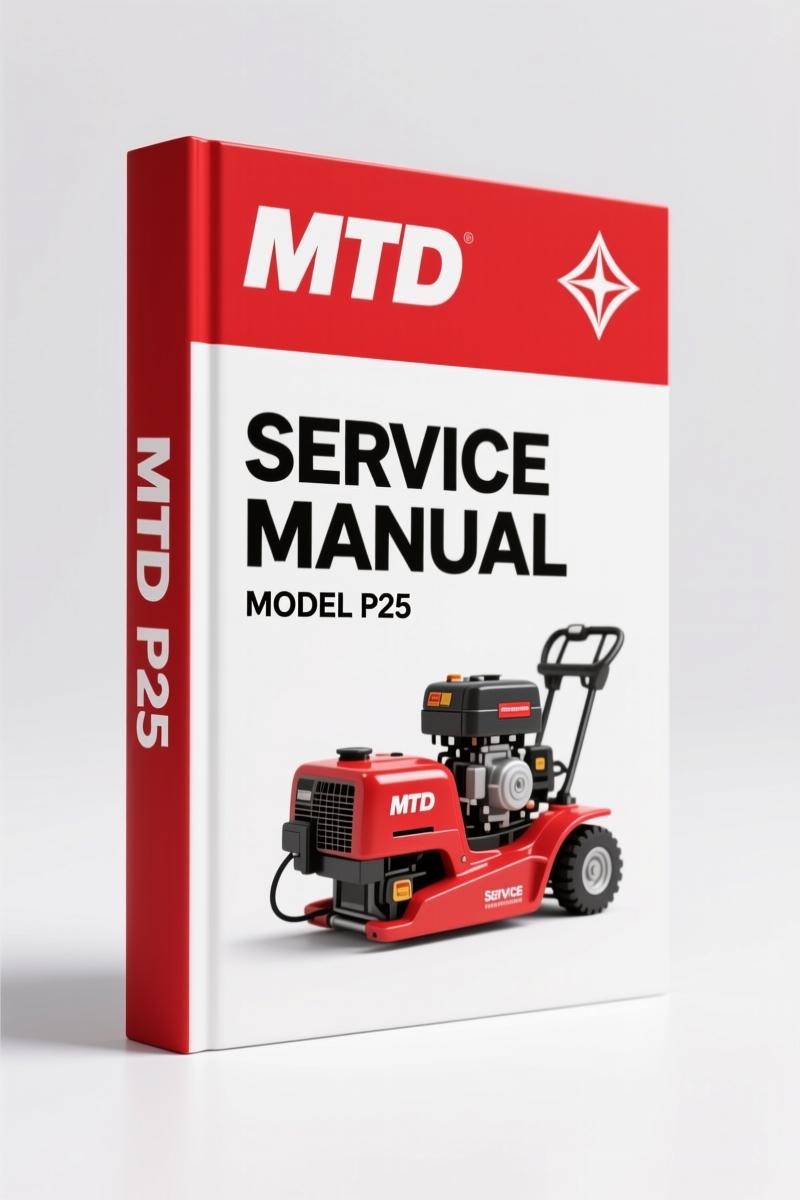
MTD P25 2010 Service Manual – Factory Specs for 25cc 2-Cycle Engine
Original price was: $23.55.$15.00Current price is: $15.00.
Factory service manual for MTD P25 25cc 2-cycle engines. 64 pages of diagnostic, fuel, ignition, and engine assembly procedures.
Description
MTD P25 2010 Service Manual – When You Need Factory Data, Not Aftermarket Guesses
If you are staring at a 25cc trimmer that won’t fire and you have already burned through a Saturday swapping parts, you need the MTD P25 2010 Service Manual on the bench. After 28 years as an ASE Master Technician, I can tell you the gap between this OEM manual and a third-party PDF is the gap between a running engine and a core charge. That aftermarket stuff gets torque specs wrong, skips the prime test, and leaves out the alcohol check for fuel. This 64-page factory document does not.
Why This 64-Page Manual Outruns Any Aftermarket PDF
Every page here came from MTD, not from a photocopier in some warehouse. You get the same spec sheets the dealer techs used. Chapter 1 hits fasteners and assembly with correct thread sizes and torque sequences. I have seen too many home mechanics strip a cylinder head because they used a generic value from a forum. Page 1 of this manual even prints the warning – these materials are for trained technicians, not guesswork. Respect that warning and use the real data.
Chapter 3: Troubleshooting – How to Stop Chasing Your Tail
Troubleshooting is where most jobs go sideways. Chapter 3 lays out diagnostic tests in order: prime test, compression test, then ignition. You do not replace a carburetor until you confirm fuel is actually reaching the cylinder. The manual explains how to test fuel for alcohol content – a step that saves you from rebuilding a carb that just got corroded by E10. Compression testing procedure is spelled out with the hose and gauge setup. No ambiguity.
Torque Specs and Fastener Callouts: Page 6
Page 6 covers spark plug gap and torque. For the P25 engine, you need a gap of 0.025 inch (0.635 mm). That specific value is not in the operator’s manual. The manual also covers the spark arrestor cleaning interval and the fuel filter replacement. If you skip the spark arrestor on these 2-cycles, you cook the exhaust port and lose compression. I have replaced cylinders because of that oversight.
Does the P25 Manual Cover the Fuel System?
It covers everything from tank vent to carburetor insulator. Chapter 5 walks through fuel system troubleshooting step by step: inspecting the fuel, checking the fuel/oil mixture (50:1 for these engines), testing fuel for alcohol, and then the full carburetor disassembly and re-assembly. The manual includes the orientation of the metering diaphragm and gasket – get that wrong and the engine runs lean. There is a section on fuel lines routing and the tank vent check. That tiny vent causes more no-start calls than any other part.
8 Chapters – Each One a Time-Saver
The manual is organized into eight chapters that mirror the logical repair order: Introduction, Maintenance, Troubleshooting, Ignition, Fuel System and Carburetor, Starters, Clutch and Upper Drive Shaft, Engine Assembly. Chapter 6 covers recoil starter removal and rope replacement – a common failure on trimmers. Chapter 7 details the clutch removal and drive shaft assembly, which is a direct cousin to a Manual Transmission in how the bearings and clutch shoes wear. The engine assembly chapter (Chapter 8) gives you the theory of operation first, then the disassembly and re-assembly sequence. That sequence matters because the piston ring gaps have to be staggered correctly or you lose compression.
For related engines, check out the MTD 450 Series 2010 Service Manual – OEM Factory Specs if you work on the larger 450 platform. The MTD AC3 2010 Workshop Manual – OEM Factory Specs for 4-Cycle Trimmer Engines covers the four-stroke side of the MTD line, and the MTD 700 series 2010 Workshop Manual – OEM Torque Specs & Repair is the go-to for commercial-grade 700 series engines. Each of those manuals follows the same factory format – printed specs, not aftermarket approximations.
One more note on the ignition system: Chapter 4 gives you the module test procedure, the engine stop switch test, and how to check the flywheel key. If you lose that key, timing goes to zero. The manual shows you the resistance values to look for at the module. Do not trust a generic multimeter reading – use the factory range given in the manual. On the 2010 P25, the module resistance is specified in ohms; I have seen aftermarket sources list a different value that leads to unnecessary module replacement.
What Are the Most Common Mistakes with This Engine?
Two things kill these little 25cc engines: fuel with too much alcohol and a plugged spark arrestor. The manual tells you how to test for alcohol in the fuel using a graduated cylinder and water. If the alcohol content is above 10%, drain the tank and use ethanol-free fuel. The spark arrestor cleaning is in Chapter 2 – you pull the screen, brush it clean, and reinstall. Skipping that costs you an exhaust rebuild. The manual also points out that the fuel filter inside the tank should be replaced annually. That filter costs less than a dollar; an hour of diagnostic time costs a lot more.
On the clutch side, Chapter 7 explains the removal of the drive shaft assembly. That section is useful if you are replacing the clutch shoes or the bearing. The manual shows the correct orientation of the clutch spring – install it backwards and you get a grabby engagement that ruins the gearbox. The drive shaft itself can be compared to a Manual Transmission in terms of lubrication requirements – use a high-temperature grease, not wheel bearing grease.
- Can I use this manual for a 2011 P25 engine?
- No. This manual is specific to the 2010 model year. MTD changed the carburetor and ignition module for 2011.
- What tools will I need for the compression test described in Chapter 3?
- You need a spark plug adapter (14 mm thread), a compression gauge that reads up to 200 psi, and a short hose. The manual tells you to remove the spark plug, install the gauge, pull the starter rope vigorously five times, and read the highest value. For a healthy P25 engine, you should see 100–120 psi. Below 80 psi indicates a ring or cylinder issue. The manual also warns to disable the ignition by grounding the spark plug wire before testing – safety first. Do not skip that grounding step; the engine can fire and cause injury.
I have used this manual on at least two dozen P25 trimmers and blowers. Every time I follow the sequence in Chapter 3 – prime test, compression, then ignition – I find the problem in under twenty minutes. You cannot do that with a generic repair guide. Access the Factory Manual and keep it in your tablet or print the pages you need. It pays for itself the first time you avoid a carburetor swap that wasn’t needed.
Additional information
| Brand | MTD |
|---|---|
| Language | English |
4 reviews for MTD P25 2010 Service Manual – Factory Specs for 25cc 2-Cycle Engine
You may also like…
-
Sale!

MTD Snow Flurry 1400 2010 Repair Manual – Factory Specs
Original price was: $38.10.$30.00Current price is: $30.00. -
Sale!
MTD 700 series 2010 Workshop Manual – Factory Specs & Diagnostics
Original price was: $43.50.$30.00Current price is: $30.00. -
Sale!
MTD 277cc, 357cc, 420cc 2010 Repair Manual – Factory Specs
Original price was: $36.00.$30.00Current price is: $30.00. -
Sale!
MTD 2010 2010 Repair Manual – Factory Service Docs for Log Splitters
Original price was: $47.40.$30.00Current price is: $30.00.
Related products
-
Sale!

1989 Service Manual – International 2000-8000 Electrical Systems
Original price was: $72.00.$50.00Current price is: $50.00. -
Sale!

2005 Parts Catalog – International NGD 3.0 L Engine (77 pages)
Original price was: $44.70.$30.00Current price is: $30.00. -
Sale!

1996 Operators Manual – International 1000-4000 Series (246 pages)
Original price was: $15.28.$9.99Current price is: $9.99. -
Sale!

2011 Parts Catalog – International 7400 SFA 6X6 – 1886 Pages of OEM Part Numbers
Original price was: $32.00.$25.00Current price is: $25.00.
John S. –
This is just what I required. The scan is high-quality and easy to navigate. A must-have for any MTD P25 owner doing maintenance. Saved my repair job! Thanks.
William H. –
I am very pleased with this purchase. The pages are clean and easy to navigate. Every spec sheet is included for MTD P25. Saves me hundreds of dollars.
workshop_guy –
Great workshop guide. Immediate link after payment. Contains detailed bolt torque specs for MTD. Saves me a lot of money.
Charles W. –
Great buy! The file is very clear. A must-have for any MTD P25 owner doing maintenance. Great value for money.