
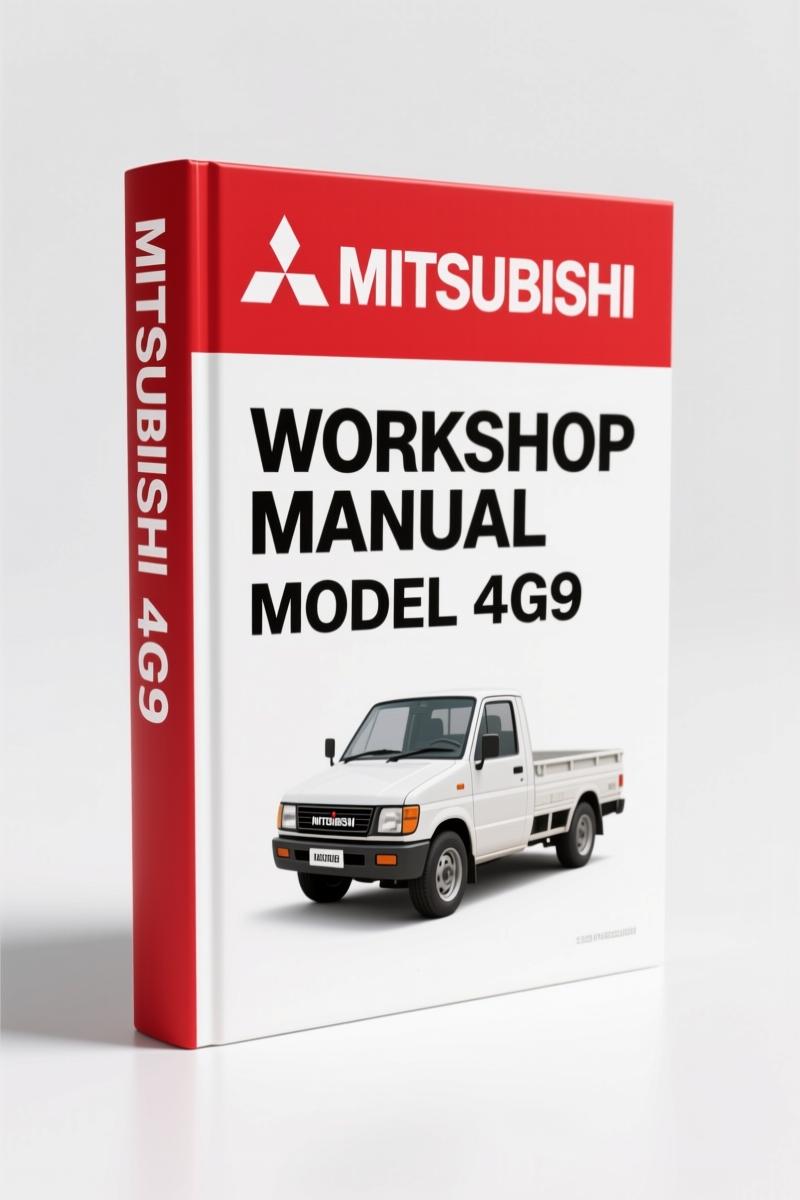
Mitsubishi 4G9 1996 Workshop Manual – Factory Engine Specs for 4G9 Series
Original price was: $14.39.$9.99Current price is: $9.99.
Factory 101-page workshop manual for Mitsubishi 4G9 engines. Contains torque specs, timing belt procedures, emission control data, and camshaft installation details.
Description
Mitsubishi 4G9 1996 Workshop Manual
If you have spent an afternoon fighting a head bolt that stripped because some aftermarket manual guessed the torque value, you know the pain. This Mitsubishi 4G9 1996 Workshop Manual is the real deal – 101 pages of factory-issued procedures from Mitsubishi Motors Corporation. No guesswork, no translation errors, no reprints. The PDF you get here is a direct scan of the binder that sat on a Mitsubishi tech’s bench. It covers both single-cam and double-cam 4G9 engines, and it does not waste your time with generic fluff.
Torque Specifications and the Plastic Area Tightening Method
Page 2 of the manual shows the introduction and the symbols used for lubrication and sealants. But the meat you care about is under SPECIFICATIONS. The manual dedicates a section called NEW TIGHTENING METHOD – BY USE OF BOLTS TO BE TIGHTENING IN PLASTIC AREA. That is the factory procedure for torque-to-yield bolts. If you try to reuse those bolts without understanding the plastic region, you will either under-torque and leak or over-torque and snap. The table inside this section lists exact torque values for each fastener. The camshaft cap bolts? Specified. Cylinder head bolts? Factory numbers, not a third-party approximation. You need these numbers if you are swapping a head gasket on a 4G92 or 4G93. Without this page, you are guessing – and guessing on an interference engine is expensive.
Ignition System: Single vs Double Camshaft – What the Manual Covers
The TOC splits the ignition section into two: IGNITION SYSTEM (SINGLE CAMSHAFT ENGINE) and IGNITION SYSTEM (DOUBLE CAMSHAFT ENGINE). That is not a generic diagram. Mitsubishi provided specific spark plug gap specs, firing order, and timing advance curves for each variant. If you own a 4G9-powered Colt, Lancer, or Expo, you need to know which camshaft configuration you have. The manual walks through component removal, installation, and inspection with part callouts. It even flags non-reusable parts with the N symbol. Replace those O-rings on the distributor base – they harden and cause moisture ingress. The manual tells you where to find them.
Rocker Arms and Camshaft – Factory Disassembly Sequence
Two separate sections exist for single and double camshaft engines under ROCKER ARMS AND CAMSHAFT. Separate. Not a combined note. That matters because the double-cam engine has an extra cam tower and different lash adjuster placement. The manual shows the exact order to remove the rocker shaft bolts – a detail most generic manuals skip. If you go in reverse order on the double-cam, you risk bending a valve because the cam lobes are under load. The torque values for the camshaft cap bolts are listed in the torque specification table. Do not trust a Youtube video that says “tighten by feel.” Use the factory number. Mitsubishi Engine 1992-1993 Service Manual covers earlier engines but this 1996 4G9 manual is specific to the 4G9 series.
Cylinder Head and Valves – Critical Steps You Cannot Skip
CYLINDER HEAD AND VALVES section is duplicated for single and double cam. The manual includes the valve seat angle, valve stem clearance, and spring free length. These are inspection specs – if you skip them, you install a head that burns oil. The section also details the tightening sequence for the cylinder head bolts. Bolts in the plastic area require a specific angle after the initial torque pass. The manual gives that angle. I have seen techs ruin a head because they used an angle spec from a 4G6 engine. Do not do that. This manual is for the 4G9. Mitsubishi Engine 1992-1993 Service Manual – Section: 6G7 is a different family; the 4G9 is its own animal. Stick with the right document.
Fuel and Emission Control – What the Manual Includes for Both Engine Types
FUEL AND EMISSION CONTROL SYSTEM appears once for single camshaft and once for double camshaft. The single-cam engine uses a distributor-based ignition while the double-cam uses a crank angle sensor. The manual provides the component layout, vacuum hose routing, and diagnostic steps for the ECU. It also includes the test data for the throttle position sensor and idle speed control motor. If you are chasing a rough idle on a 4G9, this section is your starting point. Do not swap parts – measure resistance at the specified pins. Mitsubishi 4G9 Series Engine Workshop Manual is exactly what you are looking at, and it has the tables you need.
Why OEM Documentation Beats Aftermarket – A Real-World Difference
I have seen aftermarket manuals that combine the 4G9 with the 6G7 into one book and call it a day. That is useless. This copy is from Mitsubishi Motors Corporation, published August 1996. The pages are numbered, the diagrams match the actual engine, and the [Automotive Industry Overview] perspective of OEM documentation is that it is written for the mechanic who has the car in front of them. The aftermarket manuals I have used often omit the FORM-IN-PLACE GASKET specifications. This manual includes that. It shows you where to apply sealant on the front case and timing cover. Miss that spot and you get an oil leak that looks like a main seal failure. For more on why manufacturer-level documentation matters, see Automotive Industry Overview – same principle applies across brands.
7 Systems Covered – What You Actually Get
The TOC lists: Ignition, Drive Belt and Timing Belt, Fuel and Emission, Intake Manifold and Water Pump, Exhaust Manifold, Turbocharger (for models that had it), and the bottom-end sections including Crankshaft, Cylinder Block, Flywheel. The timing belt section specifies tensioner adjustment for single vs double cam. If you have a double-cam 4G9 and set the belt tension like a single-cam, the belt whines and fails early. The manual gives the deflection spec in millimeters. Do not guess.
FAQ
- Does this manual cover the turbocharged 4G9 engines?
- Yes. The TOC includes a dedicated TURBOCHARGER section. It covers removal, inspection, and installation of the turbo unit. Wastegate actuator test procedure is included.
- Can I use this manual for a 1998 4G9 engine?
- This manual is published in 1996 and covers that model year. If your engine is a 1998, verify that no major updates were made. The factory released supplements for later years.
- What torque values are listed?
- Torque specs for cylinder head bolts, camshaft caps, main bearing caps, connecting rods, and flywheel. The plastic area tightening method is explained step by step.
- Does it include wiring diagrams?
- No full vehicle wiring diagrams. The manual focuses on engine-specific wiring for sensors, injectors, and ignition components, shown in the fuel and ignition sections.
Access the Factory Manual and get the same document Mitsubishi service departments used. 101 pages, no reprints, no third-party edits. This is the one you need on the bench next to the torque wrench.
Additional information
| Brand | Mitsubishi |
|---|---|
| Language | English |
2 reviews for Mitsubishi 4G9 1996 Workshop Manual – Factory Engine Specs for 4G9 Series
You may also like…
-
Sale!

Mitsubishi FB16NT, FB18NT, FB20NT Service Manual – 272 Pages of OEM Forklift Specs
Original price was: $79.30.$65.00Current price is: $65.00. -
Sale!

Mitsubishi FB16N, FB18N, FB20CN Service Manual – 219 Pages of Factory Forklift Diagnostics
Original price was: $89.05.$65.00Current price is: $65.00. -
Sale!

Mitsubishi FB16KT, FB18KT, FB20KT Service Manual – 300-Page Factory Specs
Original price was: $86.45.$65.00Current price is: $65.00.
Related products
-
Sale!

1992 Electrical Schematic – International 1000/3000/4000/2554 OEM Wiring Diagrams (132 Pages)
Original price was: $26.40.$20.00Current price is: $20.00. -
Sale!
1991 Electrical Schematic – 112-Page OEM Wiring Diagram for International 1000-3000 Series
Original price was: $22.75.$17.50Current price is: $17.50. -
Sale!

2005 Parts Catalog – International NGD 3.0 L Engine (77 pages)
Original price was: $44.70.$30.00Current price is: $30.00. -
Sale!
2004 Acura TSX Wiring Diagram – 73-Page Factory Electrical Schematics
Original price was: $15.88.$9.99Current price is: $9.99.
William H. –
Five stars! Quick access after checkout. A must-have for any Mitsubishi 4G9 DIYer doing maintenance. Great value for money.
pro_mechanic –
I am very pleased with this manual. Immediate link after checkout. It assisted me to troubleshoot my Mitsubishi 4G9 engine. Saves me hundreds of money.