
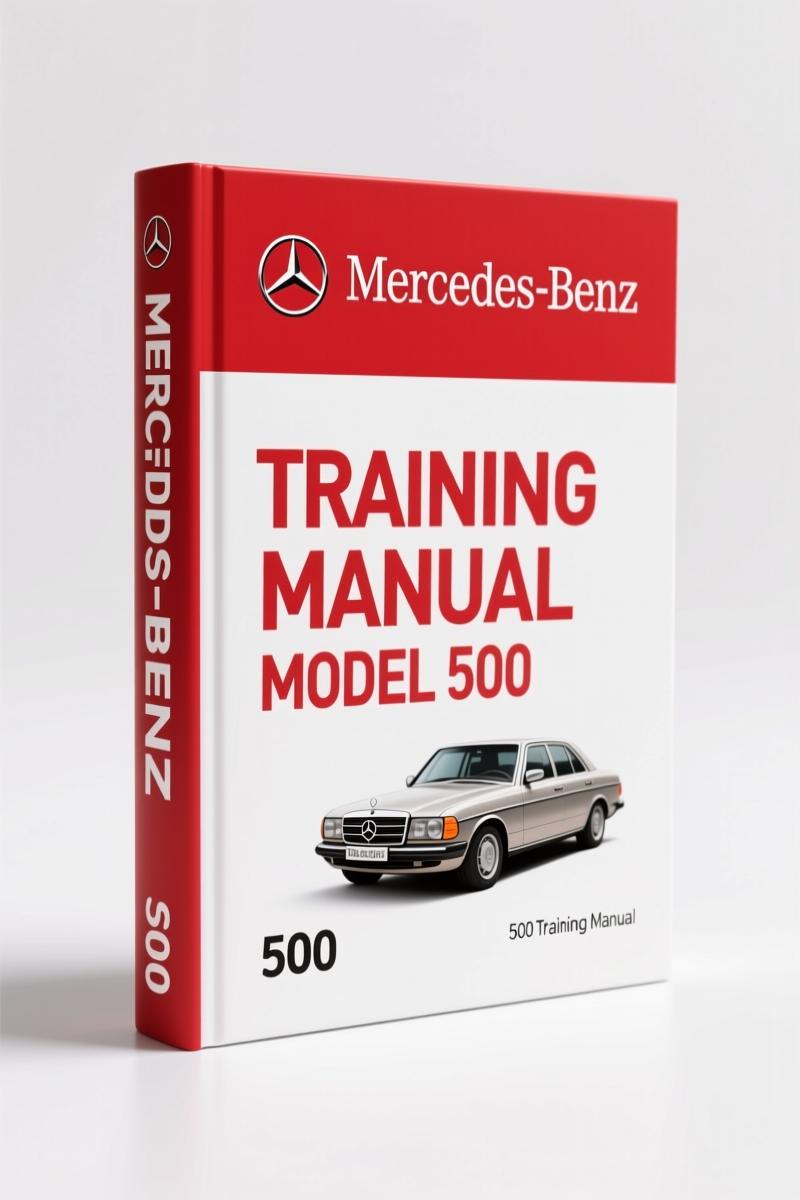
Mercedes-benz 500, 900 2003 Training Manual – Engine Mechanics
Original price was: $28.81.$21.99Current price is: $21.99.
Factory training manual for Mercedes-benz 500/900 series engines (2003). 140 pages of EURO 3 specs, cylinder head, fuel system diagnostics.
Description
Mercedes-benz 500, 900 2003 Training Manual – What You Get on the Bench
You are dealing with a Mercedes-benz 500, 900 2003 Training Manual that came straight from DaimlerChrysler Global Training. 140 pages of engine mechanics, not a reprint from some third-party that copies blurry scans. If you have ever torqued a cylinder head on a Series 500 and wondered whether the angle is 90° or 120° after the initial pass, this is the book that settles it. I have seen aftermarket manuals round torque values to the nearest 5 Nm – that strips threads or blows gaskets. This original German training document gives you the exact assignment of galleries in the cylinder head gasket, the sealing surface specs, and the nozzle protective sleeve installation procedure. No guesswork, no shortcuts.
Concept of EURO 3 for Series 500 and Series 900
The manual opens with the EURO 3 emissions strategy behind these engines. If you are working on a 900-series truck that has to pass a North American smoke test, you need to understand the charge air combination sensor and the modified MR characteristic curve. Page references in the TOC walk you through the exhaust plenum chamber and dual pipes to the turbocharger. This is not theory – it is the actual training material DaimlerChrysler used to teach dealership techs how to keep these engines within compliance without throwing parts at them.
7 Systems Covered – From Cylinder Liner to Fuel Circuit
Look at the content density: cylinder heads Euro 2 and Euro 3, valve gear modifications, valve seat rings, fuel prefilter with heated water separator (code K81), modified charge air combination sensor, electromagnetic fan drive (Linnig clutch) for engines 541 and 542 with CODE MZ5, and the entire fuel circuit in the crankcase. Each section names the specific part numbers and revision levels. The oil cooler and oil filter case, priming of the lubrication system BR 500 – all here. I count 7 major system groups in the first five pages of the TOC alone. If you need to reseal a unit pump solenoid on a Series 500, the procedure starts at section 52.
Does This Manual Cover the Fuel System?
Yes, and it goes deeper than any aftermarket book I have seen. The symbolical fuel circuit (page 73 in the PDF) is a full schematic with test points. There is a dedicated fuel pressure test procedure, a list of possible symptoms at the fuel circuit, instructions for replacing fuel filter and fuel prefilter, and a section on poor fuel quality. If a customer brings in a 900 with a constant throttle fault, the manual includes fault symptoms for constant throttle and a specific analysis of the charge pressure tolerance band. You will not find that in a Chilton.
Torque Specs and Valve Clearance – OEM Data Only
For the cylinder head attachment sequence on the Series 500, the manual gives the exact tightening steps, including the sealing surface preparation. The valve clearance is covered in its own section – no rounded numbers. Crankshaft bearing and assembly, connecting rod specs, flywheel repair procedures – all with factory tolerances. The valve lift checking procedure on page 65 tells you the dial indicator setup and the expected lift curve. This is the kind of data you use when a head gasket fails and you need to know the piston projection before assembling. I have seen guys skip the piston projection check and then wonder why the valve hits the piston at 2000 rpm.
Source Validity – Why OEM Beats Aftermarket
This is a DaimlerChrysler copyrighted training document, printed in Germany, 2nd edition modified 04.03. The copyright notice explicitly forbids reproduction without written consent – meaning this is not a free scan floating around. The binding contains the Global Training watermark. Every torque value, every clearance, every diagnostic step was written by the engineers who designed these engines. Aftermarket manuals often take the EURO 2 data and apply it to EURO 3 builds, which gets you a blown charge air cooler hose or a misdiagnosed fuel pressure reading. This manual gives you the exact EURO 3 changes. If you want to understand the assignment of galleries in the cylinder head gasket for a Series 500, you need the OEM version.
Who Needs This Manual
If you own a shop that sees Mercedes diesel trucks – especially the 500 and 900 series from the early 2000s – this is your diagnostic cheat-sheet. DIYers with a garage full of tools and a willingness to follow a 20-step cylinder head removal procedure will also benefit, but only if you already know how to use a dial indicator and a torque wrench. This manual does not hold your hand through basic tool use; it expects you to know what a feeler gauge is. Beginners should pair it with a solid fundamentals guide like this Manual Transmission overview if you are also dealing with drivetrain work. For suspension and brake systems on the same chassis, check the Mercedes-Benz Truck 2010 Training Manual – Air Brake & Suspension. If you are moving into the 327 platform, the Mercedes-benz 327 2004 Training Manual – Brake Assist System has the ABS diagnostics. And for a full electrical architecture reference, the Mercedes-benz 212 2009 Training Manual – Factory Systems Guide covers CAN bus and wiring.
Frequently Asked Questions
- Does this manual cover the 900 series?
- Yes. The EURO 3 concept covers both Series 500 and Series 900.
- Why is the charge pressure tolerance band important?
- The manual includes a full analysis of the charge pressure tolerance band on page 96 – this is critical for diagnosing turbocharger performance. If you rely on generic boost pressure specs, you will misread a 0.2 bar deviation that indicates a failing wastegate or a blocked charge air cooler. The factory band tells you the exact allowable spread for each engine variant under load and idle. I have seen a shop replace a turbo on a 900 series because the boost was 0.3 bar low, only to find the real issue was a split hose in the charge air circuit. This manual would have saved them three hours of labor and the cost of a turbo. The section also covers inspecting the charge air cooler and hoses for leaks, which is a step most techs skip until the symptom is already there.
You need the factory data to do the job once. Access the Factory Manual and put it on your shop tablet. Print the valve clearance page and tape it to your toolbox. When a customer asks why you charged four hours for a head gasket, you can show them the 20-step attachment procedure with 12 torque stages. That is real value.
Additional information
| Brand | Mercedes-benz |
|---|---|
| Language | English |
3 reviews for Mercedes-benz 500, 900 2003 Training Manual – Engine Mechanics
You may also like…
-
Sale!
Mercedes-benz 201 Wiring Diagram – 290-Page Factory Electrical Data
Original price was: $63.00.$45.00Current price is: $45.00. -
Sale!
Mercedes-benz Actros 2011 Service Manual – 165 Pages
Original price was: $70.65.$45.00Current price is: $45.00. -
Sale!
Mercedes-benz 380 SL Service Manual – 327 Pages OEM Specs
Original price was: $69.30.$45.00Current price is: $45.00. -
Sale!
Mercedes-Benz Actros Training Manual – Factory FR Module & Vehicle Control
Original price was: $84.70.$55.00Current price is: $55.00.
Related products
-
Sale!

2006 Service Manual – International DT 466E, 530E Diesel Engine
Original price was: $67.50.$50.00Current price is: $50.00. -
Sale!

1994 Troubleshooting Manual – International 1000-4000 FBC
Original price was: $60.00.$50.00Current price is: $50.00. -
Sale!
Acura NSX 1991 Service Manual – 1420 Pages OEM
Original price was: $102.05.$65.00Current price is: $65.00. -
Sale!

Acura Integra 1998 Service Manual – 1891 Pages Factory OEM Documentation
Original price was: $31.75.$25.00Current price is: $25.00.
workshop_guy –
Superb resource! It is easily zoomable on my phone without losing quality. It helped me to rebuild my Mercedes-benz 500, electrical system. Saves me a lot of dollars.
gearhead88 –
I am very pleased with this purchase. The scan is high-quality and easy to navigate. Contains detailed schematics for Mercedes-benz. Saves me so much time.
Richard G. –
Superb resource! The document looks clean. Contains clear schematics for Mercedes-benz. Saves me hundreds of money.