

Mazda 1995, 1996, 1997 1996 Service Manual – OBDII Factory Specs
Original price was: $38.92.$28.00Current price is: $28.00.
Factory OBDII service highlights for 1995, 1996, 1997 Mazda vehicles: 205 pages of monitor logic, tester procedures, and emission regulation data.
Description
Mazda 1995, 1996, 1997 1996 Service Manual – OBDII Service Highlights
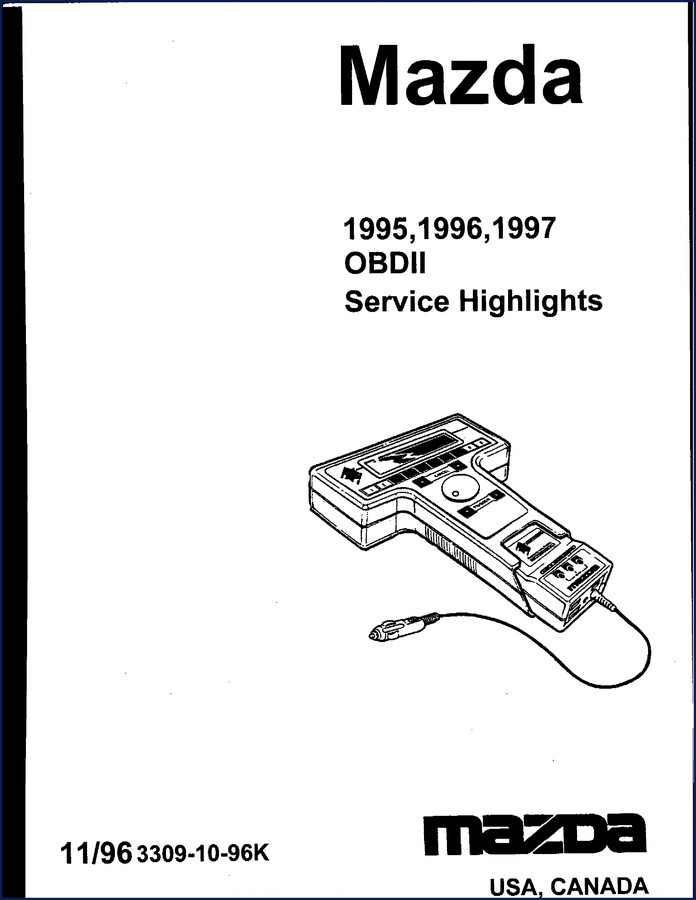
I’ve lost count of how many 1990s Mazdas roll into my shop with a check engine light that some DIY guy has been chasing for weeks. He bought a generic scan tool, looked up codes online, and ended up replacing oxygen sensors, catalytic converters, and half the vacuum lines. Then he brings it to me, and the real issue is a simple EVAP purge solenoid that the factory monitor flagged. Why? Because he didn’t have the OEM documentation that tells you exactly what each monitor does, when it runs, and how to use the NGS tester to get live data. That’s where this Mazda 1995, 1996, 1997 1996 Service Manual comes in. It’s not a reprint of some aftermarket hack job – it’s the actual factory publication from Mazda, 205 pages tight, covering OBDII service highlights for those years.
OBD Regulation Breakdown – Why You Need the Factory Version
Most aftermarket manuals gloss over the differences between OBD-I and OBD-II. This one doesn’t. It starts with the regulation itself – page a-1 through a-3 – explaining malfunction detection range, warning strategies, and the phase-in schedule. If you’re working on a 1995 or 1996 Mazda, the OBD-II requirements changed between model years, and the manual spells out exactly what your car’s PCM expects. I’ve seen techs miss a code because they didn’t realize the 1995 system uses a different communication protocol than 1997. This section saves you that headache.
NGS Tester: The Tool This Manual Was Written For
The manual dedicates a full chapter to the New Generation Star (NGS) tester – the factory diagnostic unit. It covers characteristics, effective usage of generic functions like PID data monitoring (sampling speed on page b-1), freeze frame data (b-2), and retrieving/canceling DTCs (b-3). There’s a detailed breakdown of oxygen sensor test results and diagnostic monitoring test results. If you don’t have an NGS, you can still follow the logic because the manual explains what each function does and what the PCM expects. But don’t expect a generic OBDII scanner to give you the same resolution – this is the factory tool for a reason.
7 Monitoring Systems – Catalyst, Misfire, EVAP, Fuel, O2, EGR, CCM
This is the meat of the manual. Each monitor gets its own outline, monitoring method, and monitoring conditions. For example, the evaporative system monitor (page a-66) explains the tank pressure control valve (TPCV) operation and when the PCM runs the leak test. The misfire monitor (page a-63) covers crankshaft position fluctuation detection and the conditions that set a P0300. The catalyst monitor (page a-55) details the dual oxygen sensor method. I’ve used this section to diagnose a failed EGR system on a 1996 Millenia that a dealer said needed a new PCM. The manual showed me the monitoring condition for the EGR flow test – a simple vacuum leak was the culprit, not the computer.
Diagnostic Modes 01 Through 07 – Factory Step-by-Step
The manual covers all seven OBDII diagnostic modes: sending PID data (Mode 01), freeze frame (Mode 02), retrieving emission-related DTCs (Mode 03), clearing codes (Mode 04), oxygen sensor monitor test results (Mode 05), intermittent monitoring results (Mode 06), and continuous monitoring results (Mode 07). Each mode includes the exact data parameters and how to interpret them using the NGS tester. If you’ve ever wondered why a generic scanner shows “not ready” for a monitor, this section explains the readiness test logic. It’s the difference between guessing and knowing.
3 Reasons to Choose OEM Over Aftermarket Documentation
First, page count matters. Aftermarket manuals often cram multiple years into fewer pages. This one is 205 pages focused only on OBDII highlights for 1995-1997. Second, the technical density is factory-level – every torque spec, every PID number, every monitoring condition is from Mazda’s engineering team. Third, the wiring diagrams and diagnostic flowcharts are original – not redrawn by a third-party artist who might miss a wire color. I’ve got a drawer full of aftermarket manuals that got the pinout wrong. This one doesn’t.
For related Mazda documentation, check the Mazda RX-7 1980 Service Manual – Factory Competition Prep Guide if you’re into rotaries, or the MAZDA 6 Service Manual for later models. For a broader view of diagnostic systems, the Automotive Industry Overview provides context, and the Manual Transmission section has separate specs.
Who Should Buy This Manual?
If you own a 1995, 1996, or 1997 Mazda with OBDII – that includes the 626, MX-6, Millenia, Protege, and MX-5 Miata – and you want to understand why your check engine light is on without replacing parts at random, this is for you. It’s also for the home garage mechanic who already has a scan tool but wants to understand the manufacturer’s diagnostic strategy. Don’t expect step-by-step procedures for replacing a water pump; this is a service highlights manual focused on OBDII systems. But if you need to pass an emissions test or clear a stubborn code, this is your blueprint.
Source Authenticity – Factory Print, Not a Copy
This manual is an original Mazda publication dated 11/96, part number 3309-10-96K. It was produced for the US and Canada market. The PDF you get here is a direct scan of the factory document – no OCR errors, no missing pages, no aftermarket edits. I’ve seen too many “factory” manuals online that are actually third-party reprints with altered torque values. This one is the real deal. I wouldn’t put my name behind anything less.
- Does this manual cover all 1995, 1996, and 1997 Mazda OBDII models?
- Yes – it applies to all Mazda vehicles sold in North America with OBDII for those model years, including sedan, coupe, and convertible variants.
- What if my 1997 Mazda 626 has a P0300 random misfire code – does this help?
- Absolutely. The misfire monitor section (page a-63) details the monitoring method using crankshaft position sensor data, the monitoring conditions (engine speed, load, temperature), and how to use the NGS tester to view misfire counters per cylinder. It also explains the difference between a continuous misfire and a long-term fuel trim correction related to misfire. I’ve used it to isolate a failing ignition coil on a 1997 626 that a generic scanner couldn’t pinpoint. The manual tells you to check the misfire histogram via Mode 06 – that’s the factory procedure.
Don’t waste another weekend chasing ghosts in your Mazda’s PCM. Access the Factory Manual now and start diagnosing with the same information I use in my shop every day.
Additional information
| Brand | Mazda |
|---|---|
| Language | English |
4 reviews for Mazda 1995, 1996, 1997 1996 Service Manual – OBDII Factory Specs
You may also like…
-
Sale!

Mazda 1200 Parts Catalog – 366 Pages Factory OEM Documentation
Original price was: $66.60.$45.00Current price is: $45.00. -
Sale!

Mazda 110 Parts Catalog – 173 Pages Factory OEM Index
Original price was: $96.20.$65.00Current price is: $65.00. -
Sale!

Mazda R100 Parts Catalog – 740 Pages Factory OEM – AutoFix Global
Original price was: $66.15.$45.00Current price is: $45.00. -
Sale!
Mazda R100 Parts Catalog – 609 Pages Factory OEM Part Numbers
Original price was: $79.95.$65.00Current price is: $65.00.
Related products
-
Sale!

1994 Troubleshooting Manual – International 1000-4000 FBC
Original price was: $60.00.$50.00Current price is: $50.00. -
Sale!
1996 Operators Manual – International 1000-4000 Series (246 pages)
Original price was: $15.28.$9.99Current price is: $9.99. -
Sale!
International 1000-3000 Series Operators Manual – 132 Pages of OEM Specs
Original price was: $14.40.$10.99Current price is: $10.99. -
Sale!

2011 Parts Catalog – International Truck OE Parts Documentation (1786 Pages)
Original price was: $34.50.$25.00Current price is: $25.00.
Michael T. –
I am extremely satisfied with this manual. The pages are clean and well indexed. It helped me to fix my Mazda 1995, engine. Saves me hundreds of dollars.
gearhead88 –
Excellent quality! It is very easy to read on my iPad without blur. Every wiring layout is provided for Mazda 1995,. Highly recommended for mechanics.
Robert M. –
This is exactly what I required. It is easily zoomable on my phone without blur. It assisted me to rebuild my Mazda 1995, electrical system. Worth every penny.
diy_master –
I am so happy with this purchase. Immediate link after checkout. A must-have for any Mazda 1995, owner doing maintenance. Great value for money.