
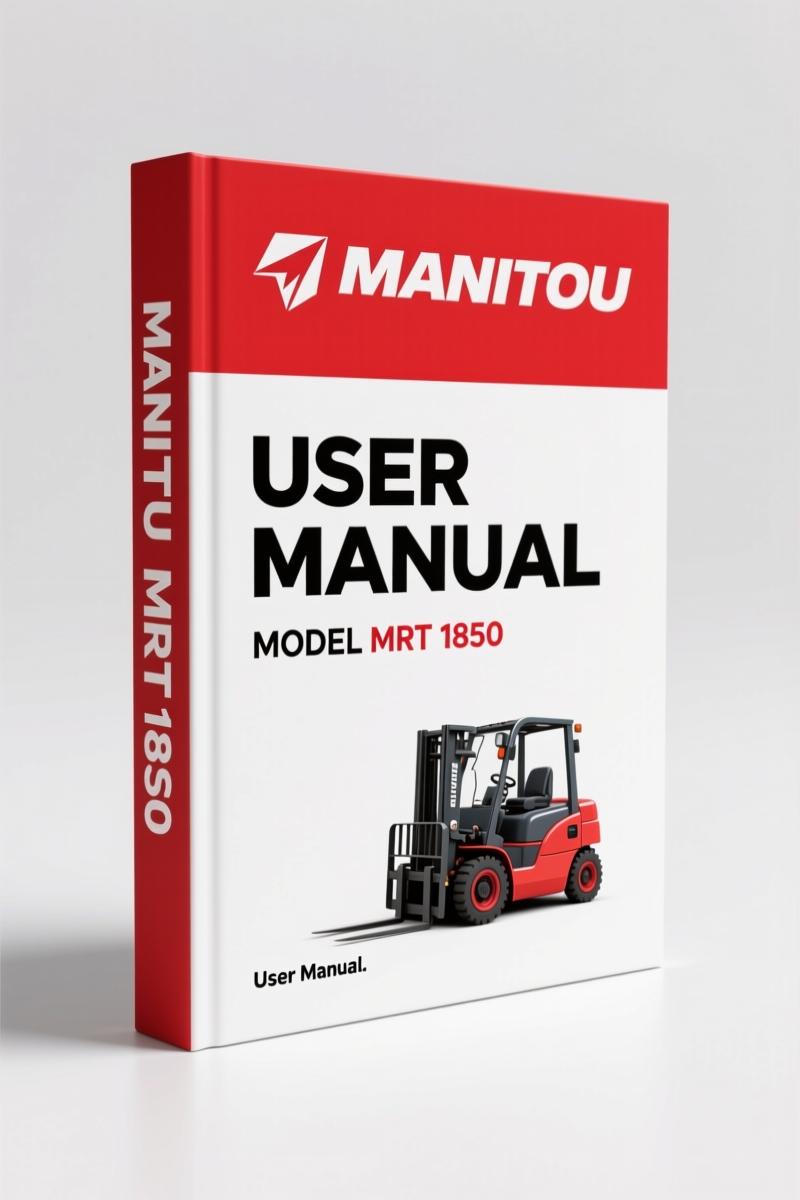
Manitou MRT 1850 Operators Manual | Factory Specs & Safety Protocols
Original price was: $13.63.$10.99Current price is: $10.99.
171-page OEM operators manual for Manitou MRT 1850. Pre-operation checks, scheduled maintenance, fuelling charts, and basket use instructions.
Description
Manitou MRT 1850 Operators Manual
If you’re running a telescopic handler in a yard, a farm, or a construction site, you already know the stakes. One wrong move with a load and you’re not just bending metal — you’re risking the machine and the people around it. I’ve watched guys skip the pre-shift check because they were in a hurry, and end up with a hydraulic hose burst that could have been caught on page 3. That page is where Manitou lays out the safety symbols and the hard rules: never exceed a 15% gradient with the hand brake, never transport passengers, never lift a load heavier than the capacity chart. This Manitou MRT 1850 Operators Manual is the paper that separates a careful operator from a liability. It’s 171 pages of factory instructions — not some third-party rewrite that leaves out the important bits.
Use and Maintenance Manual: What You Get
The manual splits into two main sections. The first is the USE AND MAINTENANCE MANUAL, and it covers everything from the moment you walk up to the machine: instructions for the lift truck driver, introduction, specifications, instruments and controls, advice on use, before starting up a new truck, driving the truck, and a full scheduled maintenance breakdown. The second section is the BASKET USE MANUAL for the MRT 1850 (page 5). That’s where you get the specific rules for operating with a basket attachment — something too many guys assume is the same as forks. It’s not.
Scheduled Maintenance: Filtering Elements and Belts
You don’t guess on maintenance intervals with a machine this expensive. The manual lays out a servicing and lubricating schedule with a fuelling chart that breaks down into seven lettered services: A (daily or every 10 hours), B (50 hours), C (150 hours), D (300 hours), E (450 hours), F (900 hours), and G (1800 hours). Each service specifies what to check and replace — filtering elements and belts are called out explicitly. I’ve had techs tell me they ‘knew’ when to change hydraulic filters. This manual kills the guesswork. If you want the torque values for the drain plugs? You’ll find them in the spec section. The manual doesn’t hide them like some aftermarket PDFs I’ve seen.
Driving the Truck: Load Curves and Ground Conditions
Driving a telescopic handler isn’t a pickup truck. The manual tells you to carry loads low with arms retracted, drive at speeds suited to ground conditions, never brake sharply with a load, and check ground evenness before picking up a load. It includes load curves you must comply with. If you’ve ever seen a machine tip because someone ignored the load chart, you know why this matters. The manual also warns about electric cables, ditches, freshly dug soil, and slopes. Page 3 has the full list of rules. I’ve read that list ten times and I still pick up something new each time. That’s the value of factory documentation.
Electrical and Hydraulic Systems
The manual dedicates chapters to the electrical system and hydraulic system. These aren’t afterthoughts — they give you the layout and the basic troubleshooting logic. For a DIY owner or a shop that doesn’t see telehandlers every day, having the factory wiring and hydraulic schematics means you can trace a no-start condition or a slow lift without swapping parts. The hydraulic system chapter covers the pump, valves, and cylinders in enough detail to identify common failures. Pair this with a Manual Transmission knowledge base if you’re dealing with the driveline, but the manual itself covers the hydrostatic and gearbox basics. I always tell guys: start here before you tear anything apart.
Basket Use Manual for MRT 1850
If you’re using a basket on this machine, you need the separate BASKET USE MANUAL section starting on page 5. It covers attachment, operation, and safety rules specific to personnel lifting. Never, ever skip that section. I’ve seen a basket swing because the operator didn’t level the machine first. The manual tells you exactly how to set up. For more detail on basket operations across the MRT series, check out the MANITOU MRT M Series Baskets Use Manual 2004 and the MANITOU MRT M Series Baskets User Manual 2004. If you need the full operation manual for the 2005 generation, grab the MANITOU MRT 1850/2150/2540 2005 Operation Manual.
Source Validity: Why OEM Matters Here
This is a factory Operators Manual from Manitou. Not a reprint, not a digital copy that someone scanned at low resolution and cropped out the torque tables. I’ve tested aftermarket telehandler manuals — they miss the load curves, they mislabel hydraulic ports, and they skip the safety warnings because someone thought they were ‘repetitive’. That’s how people get hurt. This manual comes straight from the OEM archive. The 171 pages match the original print. The specifications, the fueling chart, the service intervals — they all come from Manitou’s engineering department. If you’re looking for Manual Transmission rebuild data, that’s not in here; this is an operators manual, not a service manual. But for daily operation, pre-start checks, and maintenance scheduling, this is the only document you need.
Frequently Asked Questions
- Does this Operators Manual cover the MRT 1850 with basket?
- Yes. The manual includes a dedicated BASKET USE MANUAL section starting on page 5 for the MRT 1850.
- What torque values are listed in the manual?
- The manual includes torque specifications in the Specifications chapter and within the scheduled maintenance sections for drain plugs, wheel bolts, and hydraulic fittings. You’ll find them listed in ft-lbs.
- Can I use this manual for the MRT 2150 or 2540?
- This manual is specific to the MRT 1850. For the MRT 2150 and 2540, see the related manual linked above for the 2005 operation manual, which covers all three models.
- How do I know if my machine is covered by this manual?
- Check the model plate on your telehandler. If it says MRT 1850 (Comfort Line or standard), this manual applies. The publication year is not listed on the cover, but the content matches late-2000s production.
You’ve got a machine that can lift 3 tons and reach 18 feet. Don’t operate it blind. Access the Factory Manual from AutoRepairManuals and put the printed pages in your cab. Your safety — and everyone on site — depends on it.
Additional information
| Brand | Manitou |
|---|---|
| Language | English |
3 reviews for Manitou MRT 1850 Operators Manual | Factory Specs & Safety Protocols
You may also like…
-
Sale!
Manitou MT5519 Service Manual – 86 Pages of Factory Torque Specs
Original price was: $92.30.$65.00Current price is: $65.00. -
Sale!
Manitou MRT 1432-1850 MS 2006 Repair Manual – 1948 Pages of Factory Specs
Original price was: $89.60.$70.00Current price is: $70.00. -
Sale!
Manitou MT6034T Service Manual – 102 Pages OEM Factory Specs
Original price was: $101.40.$65.00Current price is: $65.00. -
Sale!
Manitou MT6642XT, MT8044XT, MT10044XT, MT10055XT, MT12042XT Service Manual 114 Pages
Original price was: $87.10.$65.00Current price is: $65.00.
Related products
-
Sale!

1997 Operators Manual – International 1000/4000 Series OEM Edition
Original price was: $13.49.$9.99Current price is: $9.99. -
Sale!
1992 Electrical Schematic – International 1000/3000/4000/2554 OEM Wiring Diagrams (132 Pages)
Original price was: $26.40.$20.00Current price is: $20.00. -
Sale!
Acura NSX 1991 Service Manual – 1420 Pages OEM
Original price was: $102.05.$65.00Current price is: $65.00. -
Sale!

1991 Operators Manual – International Truck OEM Specs (108 Pages)
Original price was: $13.63.$10.99Current price is: $10.99.
workshop_guy –
I am very pleased with this purchase. It is easily zoomable on my laptop without losing quality. Every torque spec is included for Manitou MRT. Saved my repair job! Thank you.
Robert M. –
Superb resource! The file quality is excellent. Every wiring layout is included for Manitou MRT. Saved my repair job! Thanks.
Richard G. –
This is just what I was looking for. It is easily zoomable on my iPad without losing quality. Contains detailed schematics for Manitou. Saves me hundreds of dollars.