
Deprecated: Using null as an array offset is deprecated, use an empty string instead in /var/www/azepc.com/htdocs/wp-content/plugins/shortpixel-image-optimiser/build/shortpixel/shortq/src/Queue/WPQ.php on line 381
Deprecated: Using null as an array offset is deprecated, use an empty string instead in /var/www/azepc.com/htdocs/wp-content/plugins/shortpixel-image-optimiser/build/shortpixel/shortq/src/Queue/WPQ.php on line 381
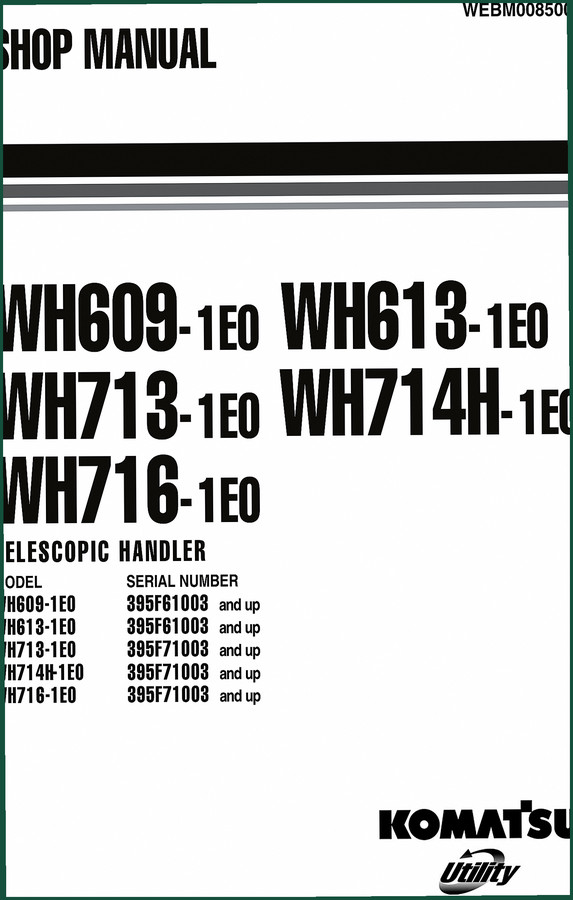
Komatsu WH609-1E0–WH716-1E0 Operators Manual, 272 pages
Original price was: $17.87.$11.99Current price is: $11.99.
Factory Komatsu operators manual for 5 telescopic handler models. 272 pages covering safety, controls, load charts, and routine checks.
Description
Komatsu WH609-1E0, WH613-1E0, WH713-1E0, WH714H-1E0, WH716-1E0 Operators Manual
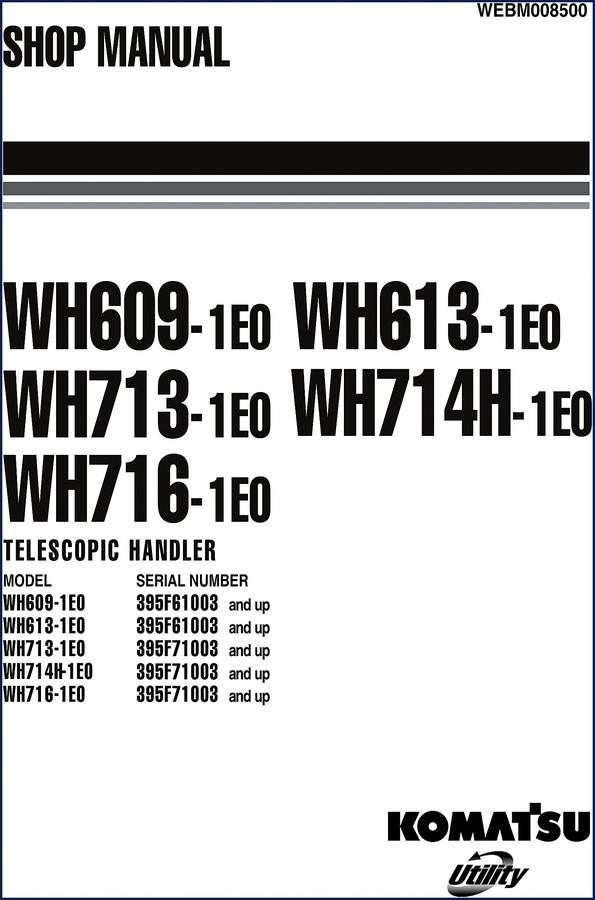
You’ve got a Komatsu telescopic handler on the lot or on a job site, and the operator says he knows what he’s doing. Until he doesn’t. Then you’re pulling a transmission because he ran it with no oil, or you’re replacing a boom cylinder because he overloaded it on a slope. That’s where this Komatsu WH609-1E0, WH613-1E0, WH713-1E0, WH714H-1E0, WH716-1E0 Operators Manual earns its keep. It’s not a repair manual—that’s the companion shop manual you should own too—but it’s the document that keeps operators from breaking things in the first place. 272 pages of factory-original procedure, safety requirements, and maintenance schedules that Komatsu printed for these machines. If you’re a shop owner or a fleet manager, you want this in the cab, not floating around the internet as a blurry scan.
Safety Precautions: Not a Suggestion
Section 2 of this manual runs 40-something pages of safety, noise, and vibration plates, pictograms, general precautions, and specific do-not-do lists. I’ve seen guys skip reading this and then wonder why the machine tipped. Page references for your shop use: the position of safety plates is documented in section 2.1.1—find them on the machine, match them to the pictogram meanings in 2.1.2. That’s your first step every time a new operator sits in the seat. The manual also covers unauthorized modifications (2.2.4), leaving the operator’s seat (2.2.5), and getting on and off the machine (2.2.6). If you think those are common sense, you’ve never seen a mechanic take a shortcut and slip off wet steps. This section is mandatory reading for anyone who touches the controls.
Product Identification: Know What You’re Working With
Every machine has its own serial numbers—engine, transmission, front axle, rear axle, cab—and this manual tells you exactly where to find each one. The WH609-1E0 starts at serial 395F61003 and up; the WH713-1E0 and larger models start at 395F71003. You need those numbers to order the right parts, and the manual shows you the standard identification plate (section 1.4.2.1) and the engine serial number location (1.4.3). Write the dealer’s address on the page in 1.4.8 and keep it handy. This is the kind of detail you don’t get from aftermarket “universal” guides.
Running-In Procedure: Why It Matters
Section 1.3.4 covers running-in: the first 100 hours or so where you treat the engine and transmission gently. Too many operators ignore this and then complain about oil consumption or gear whine. The manual specifies load limits, speed restrictions, and oil change intervals during break-in. Follow it. I’ve seen transmissions fail at 500 hours because someone ran the machine at full load from hour one. This section alone can save you a rebuild.
Instruments and Controls: Understand the Dashboard
Section 3.2 diagrams every gauge, warning light, switch, and control in the cab. You’ll find the electric accessories (3.2.4) and machine controls (3.2.5) with factory descriptions. If a warning light comes on and the operator doesn’t know what it means, you lose time. This manual puts the meaning right in front of them. Combine it with the related Komatsu WH609-1E0 – WH716-1E0 Shop Manual for deeper diagnostic work, but the operator manual covers what to do when a light flashes.
Lifting Loads: Reading Load Charts Correctly
Section 3.3 teaches how to read the load charts—full description in 3.3.1.1 and usage in 3.3.1.2. Telescopic handlers are not forklifts; you can’t just grab a load and lift. The charts consider boom angle, extension, and stabilizer position. Operators who ignore these charts bend booms and break axles. The manual explains it step by step. If your operator can’t read a load chart, this section is your training material.
Maintenance Precautions: Keep the Machine Safe
Section 2.8 runs from warning plates to high-pressure hose precautions. Specifics: tools required (2.8.2), working under the machine (2.8.5), periodical change of safety-critical parts (2.8.8), and synthetic biodegradable oil type HEES (2.8.22). That last one matters if you’re in environmentally sensitive areas. The manual also covers battery safety (2.6), booster cable starting (2.6.2), and emergency recovery (2.7). These are not generic warnings—they are Komatsu-specific procedures. For engine-specific repair information, see the KOMATSU S4D104E Series Diesel Engine Workshop Manual.
Does This Manual Cover the Engine and Transmission?
Yes, but as an operator manual, it focuses on daily operation and preventive maintenance, not overhaul. You’ll find the engine serial number location, exhaust gas emission plate (1.4.3), and transmission serial number location (1.4.6). The manual instructs you on checking oil levels, coolant, and basic service. For a full teardown or rebuild of either the engine or the Manual Transmission, you need the shop manual. But for daily operation, this is your guide. The Automotive Industry Overview of heavy equipment manuals shows that OEM documentation consistently beats aftermarket for accuracy—this manual proves it.
Source Validity: OEM, Not Aftermarket
This is an original Komatsu publication, file name KOMATSU_WH609-1E0-WH613-1E0-WH713-1E0-WH714H-1E0-WH716-1E0_Operators_Manual_en-35331020366.pdf. That’s not a reprint or a generic compilation—it’s the exact manual you’d get from a Komatsu dealer. Aftermarket manuals often drop sections like the running-in procedure or the safety plate locations. This one doesn’t. Every page is from the factory. If you want to confirm the transmission serial number format or the load chart for your specific model, you trust this document.
Related manuals you should consider for a complete library: Komatsu WD900-3 Wheel Dozer Operation & Maintenance Manual if you run other Komatsu equipment, and the shop manual I mentioned earlier.
- Why do I need this if I have a shop manual?
- The shop manual tells you how to fix it. The operator manual tells you how to not break it. Different purpose. This one belongs in the cab, not on the bench.
- Does it include torque specs for wheel lugs or engine bolts?
- No. This is an operation and maintenance manual, not a repair manual. It covers daily checks, fluid capacities, load charts, and safety. For torque values, you need the workshop manual for your specific model. That said, it does reference the correct oil types and coolant specifications, which are critical before you put a wrench on anything.
You’ve got a machine that costs six figures. The operator’s manual costs a fraction of one hour of downtime. Access the Factory Manual and put it in the cab. Then make sure everyone reads section 2 before they turn the key.
Additional information
| Brand | Komatsu |
|---|---|
| Language | English |
4 reviews for Komatsu WH609-1E0–WH716-1E0 Operators Manual, 272 pages
You may also like…
-
Sale!
Komatsu D65EX, D65PX, D65WX Workshop Manual – 2820 Pages
Original price was: $108.75.$75.00Current price is: $75.00. -
Sale!
Komatsu PC5500E-6 Workshop Manual – 1378 Pages
Original price was: $150.00.$100.00Current price is: $100.00. -
Sale!
Komatsu HD1200 1980 Workshop Manual – Factory Specs & Procedures
Original price was: $91.50.$75.00Current price is: $75.00. -
Sale!
Komatsu PC600LC-6 Workshop Manual – Factory Service Data for 732-Page Excavator Guide
Original price was: $112.80.$80.00Current price is: $80.00.
Related products
-
Sale!

2006 Service Manual – International DT 466E, 530E Diesel Engine
Original price was: $67.50.$50.00Current price is: $50.00. -
Sale!

1992 Electrical Schematic – OEM Wiring Diagrams for International 1000-3800
Original price was: $24.48.$18.00Current price is: $18.00. -
Sale!
1993 Operators Manual – International Bus 1000-3000 OEM Specs
Original price was: $12.30.$7.99Current price is: $7.99. -
Sale!
Acura NSX 1991 Service Manual – 1420 Pages OEM
Original price was: $102.05.$65.00Current price is: $65.00.
diy_master –
I am extremely satisfied with this transaction. The PDF is high resolution. A must-have for any Komatsu WH6091E0WH7161E0 mechanic doing maintenance. Worth every penny.
workshop_guy –
Five stars! The pages are clean and easy to navigate. Every wiring layout is provided for Komatsu WH6091E0WH7161E0. Saves me so much time.
Charles W. –
This is exactly what I needed. The scan is high-quality and well indexed. A must-have for any Komatsu WH6091E0WH7161E0 mechanic doing repairs. Saves me a lot of dollars.
Richard G. –
Perfect factory service manual. The PDF is high resolution. Every wiring layout is provided for Komatsu WH6091E0WH7161E0. Saved my weekend project! Thanks.