
Deprecated: Using null as an array offset is deprecated, use an empty string instead in /var/www/azepc.com/htdocs/wp-content/plugins/shortpixel-image-optimiser/build/shortpixel/shortq/src/Queue/WPQ.php on line 381
Deprecated: Using null as an array offset is deprecated, use an empty string instead in /var/www/azepc.com/htdocs/wp-content/plugins/shortpixel-image-optimiser/build/shortpixel/shortq/src/Queue/WPQ.php on line 381
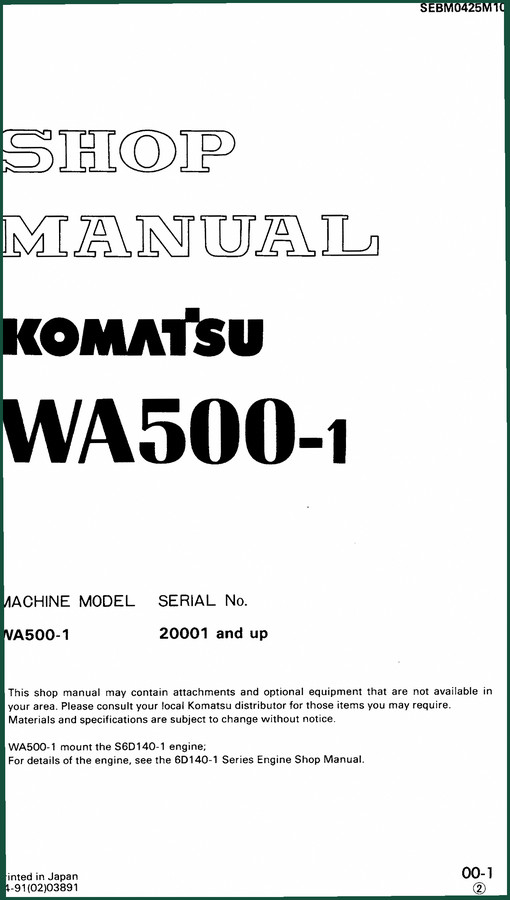
Komatsu WA500-1 Workshop Manual: 792 Pages of Factory Specs for Power Train & Brake Systems
Original price was: $45.00.$30.00Current price is: $30.00.
OEM workshop manual for the WA500-1. 792 pages of testing, adjusting, and disassembly procedures from Komatsu.
Description
Komatsu WA500-1 Workshop Manual – Factory OEM, 792 Pages
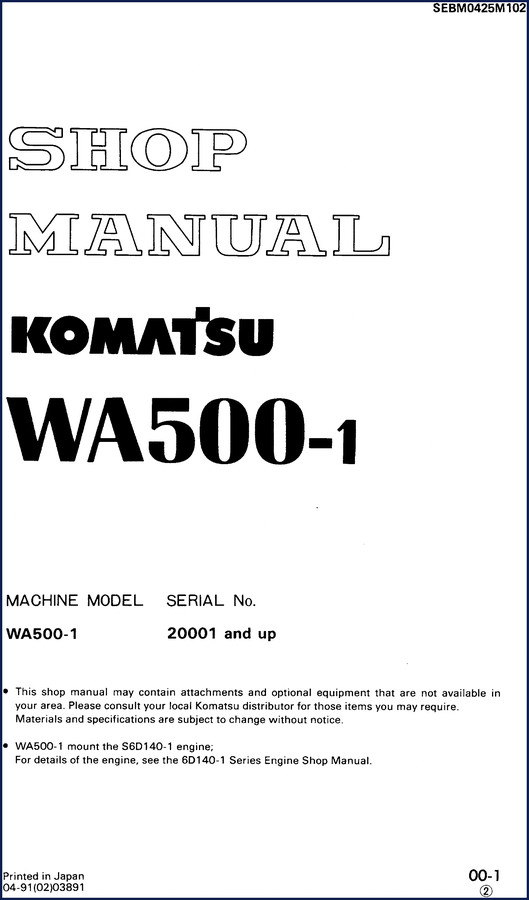
I’ve torqued more head bolts than most people have had hot meals, and I’ll tell you right now: if you’re working on a Komatsu WA500-1, you want the factory book. This is a Workshop Manual, not some aftermarket rewrite from a guy who’s never seen a wheel loader. It’s 792 pages of Komatsu-published procedures, wiring diagrams, and torque callouts. No guesswork, no third-party nonsense. If you’re a DIY mechanic running a home shop or a guy who just bought a used WA500-1 and needs to keep it running, this is the baseline document.
You’re going to find that this manual doesn’t waste time with theory. It dives straight into the STRUCTURE AND FUNCTION section (page 10-1) where it breaks down every major system: the radiator and oil cooler, damper, torque converter and transmission piping, and the hydraulic circuit for the power train. If you’ve ever tried to diagnose a transmission slippage using a generic write-up, you know the frustration. This manual gives you the exact hydraulic circuit diagram for the power train. No guessing which line goes where.
792 Pages of Factory-Authorized Procedures
Three major sections make up this book: STRUCTURE AND FUNCTION, TESTING AND ADJUSTING, and DISASSEMBLY AND ASSEMBLY. The Structure section is where you learn how the transmission control valve works, how the torque converter feeds oil to the PTO, and where the pilot oil filter lives. You get exploded views with part numbers, so when you order a replacement valve body, you know exactly which one fits. The Testing section (starting page 20-1) includes standard value tables for engine, chassis, and electrical system. Need the compression pressure spec? It’s there. Need the valve clearance adjustment procedure? That’s covered under “ADJUSTING VALVE CLEARANCE” in the testing section.
Aftermarket manuals often skip the tool list. This one has a TOOL LIST FOR TESTING AND ADJUSTING. You see exactly what you need before you start. If you’ve ever spent an hour hunting for a special socket halfway through a job, you know why that matters.
Transmission and Torque Converter: What’s Inside
Under the TORQUE CONVERTER AND TRANSMISSION PIPING subsection, the manual walks you through the hydraulic circuit for the power train. It shows the flow from the converter through the transmission control valve and into the clutches. There’s also a dedicated section on the TRANSMISSION SOLENOID VALVE. If the machine isn’t shifting right, you can go straight to that chapter and check solenoid operation per the factory procedure. The troubleshooting chart (starting around page 20-??) includes a “METHOD OF USING YES-NO TROUBLESHOOTING FLOW CHART” – a step-by-step diagnostic tree that eliminates the guesswork. Follow it, and you’ll either fix the problem or identify the failed component in a logical sequence.
Testing and Adjusting: The Section That Saves You Time
Section 20 covers everything from measuring engine stall speed to checking brake piston leakage. Each test has a prescribed method and required pressure/temperature values. For example, the “MEASURING OIL PRESSURE OF TORQUE CONVERTER AND TRANSMISSION” test tells you which port to tap and the expected psi at stall. This is the kind of data that aftermarket reprints either leave out or copy incorrectly. You get the Komatsu standard value table for chassis – things like axle oil clearance, final drive backlash, and brake disc wear limits. If you’re rebuilding a differential or a final drive, those numbers are critical.
Does This Manual Cover Valve Clearance and Torque Specs?
Yes. The “ADJUSTING VALVE CLEARANCE” procedure gives you the intake and exhaust clearance specs for the S6D140-1 engine (see the engine shop manual for additional engine-specific details, but this manual includes the baselines). Torque values are listed throughout the DISASSEMBLY AND ASSEMBLY section – every bolt on the transmission case, the torque converter housing, the steering valve mounting, and the brake calipers has a callout. OEM torque specs are not suggestions. If you’re bolting up a final drive, you need the correct ft-lb (or Nm) to avoid stripped threads or leaks. This manual gives you those numbers.
Why OEM Beats Aftermarket for the WA500-1
Aftermarket manuals often claim to cover multiple models, but they genericize the wiring diagrams and skip update revisions. This is a genuine Komatsu publication. Look at page 3 of the PDF: there’s a LIST OF REVISED PAGES. That’s proof that Komatsu updated this manual as they found issues or added production changes. Every revision is marked. When you buy this from AutoRepairManuals, you get the exact file that Komatsu distributes to their dealers. That matters when you’re dealing with the ELECTRICAL WIRING DIAGRAM CIRCUIT – one misread wire can fry an ECU. The manual includes pin assignments for connectors, so you can troubleshoot the EVMS (Electronic Vehicle Monitoring System) without calling a dealer.
If you want related manuals for smaller loaders, check the Komatsu WA65-5 WA70-5 WA80-5 2005 Workshop Manual or the Komatsu WH609-1E0 WH613-1E0 WH713-1E0 WH714H-1E0 WH716-1E0 Workshop Manual. For a wheeled excavator manual with similar transmission coverage, see the Komatsu PW95R-2 Workshop Manual – 520 Pages of Factory Specs.
Get the Right Tool List Before You Start
The manual’s TOOL LIST FOR TESTING AND ADJUSTING section tells you exactly which gauges, wrenches, and special tools you need. It includes a list for each test: compression gauge, tachometer, timing light, pressure gauge set, etc. No surprises. If you’re unfamiliar with how a manual transmission system functions in a loader, the Manual Transmission overview on Wikipedia can give you basics, but for the WA500-1 specifics, you need the factory document. The Automotive Industry Overview is good for context; this manual is good for work.
- Is this manual for the S6D140-1 engine as well?
- It references the engine. For full engine specs see the separate 6D140-1 Series Engine Shop Manual.
- How do I find the correct torque value for the transmission bolts?
- Look in Section 30 (DISASSEMBLY AND ASSEMBLY). Each component sub-section lists torque values in a table. For the transmission itself, the torque converter-to-transmission bolts appear under the “TRANSMISSION” subsection. The manual specifies both tightening order and final torque. If you’re rebuilding the transmission control valve, the valve body bolts have their own callout. Always cross-check with the STANDARD VALUE TABLE FOR CHASSIS in Section 20, which lists general torque ranges for bolts of different diameters and grades. The manual is structured so you can find the exact value within three pages – that’s why 792 pages are necessary; they didn’t compress anything.
If you’ve read this far, you already know why an OEM manual is worth the money. Access the Factory Manual now and start your repair with the right data, not a guess.
Additional information
| Brand | Komatsu |
|---|---|
| Language | English |
2 reviews for Komatsu WA500-1 Workshop Manual: 792 Pages of Factory Specs for Power Train & Brake Systems
You may also like…
-
Sale!
Komatsu HD1200 1980 Workshop Manual – Factory Specs & Procedures
Original price was: $91.50.$75.00Current price is: $75.00. -
Sale!
Komatsu D65EX, D65PX, D65WX Workshop Manual – 2820 Pages
Original price was: $108.75.$75.00Current price is: $75.00. -
Sale!
Komatsu PC600LC-6 Workshop Manual – Factory Service Data for 732-Page Excavator Guide
Original price was: $112.80.$80.00Current price is: $80.00. -
Sale!
Komatsu PC5500E-6 Workshop Manual – 1378 Pages
Original price was: $150.00.$100.00Current price is: $100.00.
Related products
-
Sale!

1991 Electrical Schematic – 112-Page OEM Wiring Diagram for International 1000-3000 Series
Original price was: $22.75.$17.50Current price is: $17.50. -
Sale!

1989 Service Manual – International 2000-8000 Electrical Systems
Original price was: $72.00.$50.00Current price is: $50.00. -
Sale!
Acura NSX 1991 Service Manual – 1420 Pages OEM
Original price was: $102.05.$65.00Current price is: $65.00. -
Sale!
1995 Operators Manual – International 1000-4000 Series | OEM Documentation
Original price was: $12.49.$9.99Current price is: $9.99.
William H. –
I am very pleased with this transaction. It is easily zoomable on my iPad without losing quality. Every spec sheet is included for Komatsu WA5001. Great value for money.
workshop_guy –
I am extremely satisfied with this purchase. It is easily zoomable on my tablet without blur. A must-have for any Komatsu WA5001 DIYer doing maintenance. I will recommend this shop to others.