
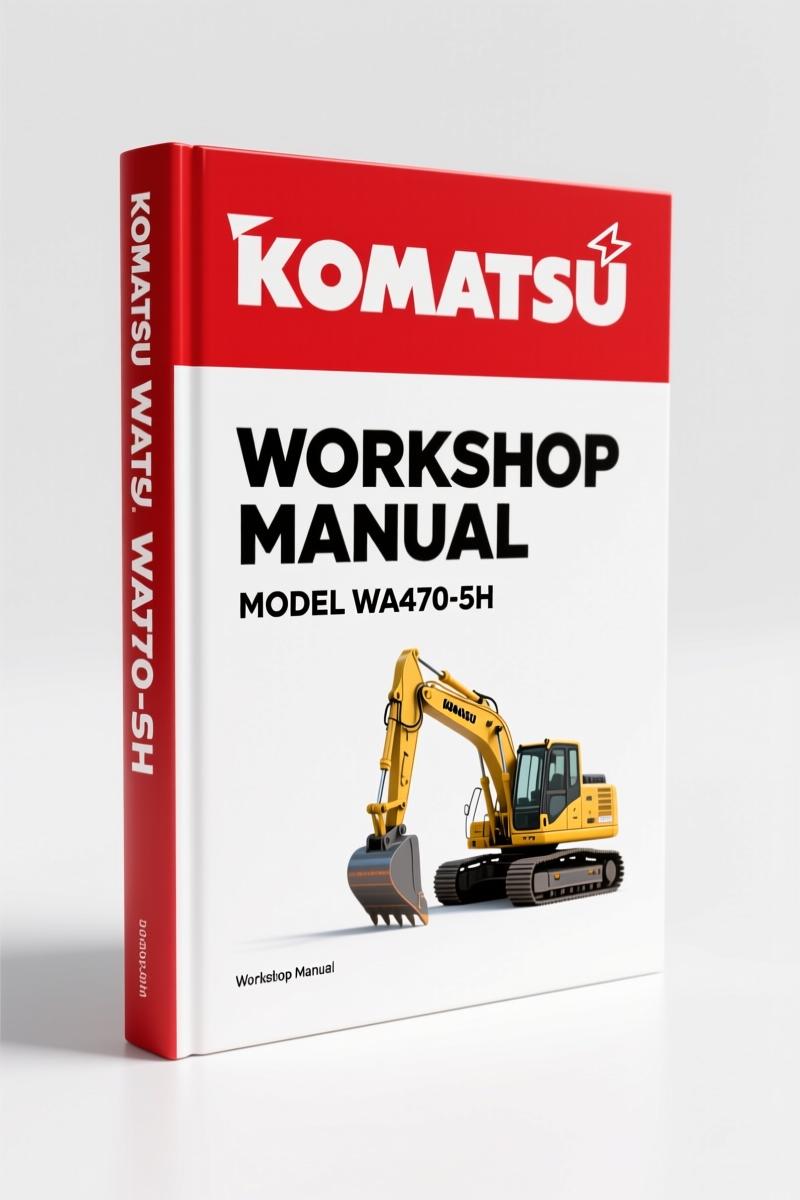
Komatsu WA470-5H, WA480-5H 2002 Workshop Manual – Factory Specs
Original price was: $102.05.$65.00Current price is: $65.00.
1302-page factory workshop manual for 2002 Komatsu WA470-5H and WA480-5H wheel loaders. Torque specs, transmission overhaul, axle diagnostics.
Description
Komatsu WA470-5H, WA480-5H 2002 Workshop Manual
I’ve lost count of how many loaders came into my shop with stripped flange bolts or misadjusted transmissions because some tech trusted a third-party PDF instead of the factory book. If you’re working on a Komatsu WA470-5H or WA480-5H wheel loader from 2002, the only numbers that matter are the ones Komatsu printed. This is the genuine Workshop Manual—1302 pages of OEM data, not a reprint or a scan job. I’ll tell you straight: without this binder on your bench, you’re gambling with your time and your customer’s machine.
Page 1 confirms the engine family—SAA6D125-3—and the serial number ranges (WA470H50051 and up, WA480H50051 and up). That means every torque spec, every circuit, every clutch pack clearance in this book matches the loader you’re standing next to. I’ve seen guys try to use a generic manual for a 2005 model on a 2002 chassis and wonder why the lock-up clutch chatters. Don’t be that guy.
Standard Tightening Torque: The Only Numbers You Should Trust
Torque values are where most aftermarket books drop the ball. This manual includes a dedicated section called Standard tightening torque with eight sub-tables: bolts and nuts, hose nuts, split flange bolts, flared nuts, and the entire 102 engine series (bolts, eye joints, tapered screws). I’ve flagged page 1 of the torque tables (inside the Safety chapter) more times than I can count—those values are what keep a split flange from weeping hydraulic oil. If you’re torquing a hose nut without checking that table, you’re asking for a leak. Period.
Every fastener gets a listed value in imperial units (lb-ft). No approximations. No “tighten to feel.” That’s the difference between a job that holds and a come-back.
Transmission and Torque Converter: Lock-Up Clutch Operation
The power train section covers both versions—with and without torque converter lock-up clutch. It walks through the F-R clutch (1st-4th), the 2nd-3rd clutch, and the ECMV (Electronic Control Modulation Valve) for speed and lock-up. I’ve seen more than one transmission come apart because a tech skipped the path-of-power diagrams. The manual lays out each gear: Forward 1st, 2nd, 3rd, 4th, Reverse 1st. You get the full flow—oil passages, solenoid logic, and the main relief valve settings. If you’re dealing with a shudder on lock-up, start in the Transmission control valve section, not by swapping parts.
Testing, Adjusting and Troubleshooting: A Step-by-Step Workflow
Every major component has its own Testing, Adjusting and Troubleshooting subsection. The brake valve, steering valve, steering relief valve—each one comes with a procedure list. For example, the steering relief valve operation is broken into function, operation, and demand valve logic. I tell my junior guys: read the “Operation” block first, then go to “Disassembly and Assembly.” That sequence saves you from pulling a valve body you didn’t need to open. The book also includes a Flow AMP section for the steering circuit—essential for diagnosing low-flow complaints.
What the 1302 Pages Cover
This is not a simplified guide. The table of contents on page 4 lists every system: radiator and oil cooler, axle (front and rear for both WA470-5 and WA480-5), differential (including anti-slip), final drive, steering piping, brake piping, parking brake, hydraulic piping, work equipment control, cooling fan motor, and a full Electric wire code section with color coding and thickness classification. You also get hoisting instructions, coating materials, and conversion tables. If it’s on the loader, it’s in here.
Need to rebuild the torque converter? The Torque converter chapter shows the path of power transmission for both clutch types. Want to adjust the slack adjuster on the brakes? There’s an entire Slack adjuster subsection with outline and operation.
For the electrical side, the Bucket positioner, lift arm kick-out section covers the proximity switch operation—critical for the proximity switch alignment that prevents bucket over-travel. The manual also includes ECMV diagnostic paths for when the transmission control valve throws a code.
OEM vs Aftermarket: Why This Manual Wins
I don’t trust any third-party manual when it comes to Komatsu hydraulics. Aftermarket books often omit the ECMV for speed clutch calibration steps or give generic pressure ranges. This factory document came from Komatsu’s own engineering department—printed in 2002, Europe, with all rights reserved. It includes official tolerances for the steering relief valve, the brake charge valve, and the emergency steering pump. You won’t find that in a $19.99 access from a reseller. The List of lubricant and coolant is also OEM-specified, which matters when you’re mixing fluids for the torque converter charging pump.
Who Needs This Manual
If you own a WA470-5H or WA480-5H and do your own repairs—or if you run a shop that sees these loaders—this book is the baseline. It’s not written for the weekend tinkerer; it’s written for the tech who needs to disassemble an axle without losing the preload. Every step assumes you have the right tools (torque wrench, puller, dial indicator) and the safety gear. The Safety section covers hoisting, precautions during work, and coating materials—stuff that keeps you from dropping a 5,000-pound transmission on your foot.
One more thing: the manual references the separate 125-3 Series Engine Shop Manual for the SAA6D125-3 engine. That’s fine—the engine book is a different document. But for the loader itself, this 1302-page workshop manual gives you the chassis, drivetrain, hydraulics, and electricals. The engine-specific torque specs (like the 102 engine series) are included here because they mount to the bell housing.
- Does the manual cover the SAA6D125-3 engine?
- It covers the engine mounts, piping, and related torque specs, but directs you to the separate 125-3 Series Engine Shop Manual for internal engine overhaul.
- Where do I find the correct torque for the transmission control valve bolts?
- Check the Standard tightening torque section in the Safety chapter—there are specific tables for bolts, hose nuts, and split flange bolts. The transmission itself lists torque values in its disassembly procedure notes. If you’re rebuilding the ECMV, the manual gives the calibration pressures, not just bolt torques. Use those numbers exactly; a few lb-ft off can shift the valve spool travel and cause clutch drag.
I’ve used this manual on three WA470-5H jobs this year alone. It saved me from ordering wrong seals, chasing hydraulic gremlins, and guessing on flange torque. You want the same result? Stop guessing. Access the Factory Manual and get back to work.
- Related Manuals:
If you are working on a Manual Transmission system, the manual covers the drive shaft and torque converter. For a deeper dive into gear ratios, the Manual Transmission chapter in the power train section explains the clutch pack operation.
Additional information
| Brand | Komatsu |
|---|---|
| Language | English |
2 reviews for Komatsu WA470-5H, WA480-5H 2002 Workshop Manual – Factory Specs
You may also like…
-
Sale!
Komatsu HD1200 1980 Workshop Manual – Factory Specs & Procedures
Original price was: $91.50.$75.00Current price is: $75.00. -
Sale!
Komatsu D65EX, D65PX, D65WX Workshop Manual – 2820 Pages
Original price was: $108.75.$75.00Current price is: $75.00. -
Sale!
Komatsu PC600LC-6 Workshop Manual – Factory Service Data for 732-Page Excavator Guide
Original price was: $112.80.$80.00Current price is: $80.00. -
Sale!
Komatsu PC5500E-6 Workshop Manual – 1378 Pages
Original price was: $150.00.$100.00Current price is: $100.00.
Related products
-
Sale!

Technical Manual – International DT 530 & HT 530 (118 Pages)
Original price was: $37.00.$25.00Current price is: $25.00. -
Sale!
Acura NSX 1991 Service Manual – 1420 Pages OEM
Original price was: $102.05.$65.00Current price is: $65.00. -
Sale!

2011 Parts Catalog – International 7400 SFA 6X6 – 1886 Pages of OEM Part Numbers
Original price was: $32.00.$25.00Current price is: $25.00. -
Sale!

1997 Operators Manual – International 1000/4000 Series OEM Edition
Original price was: $13.49.$9.99Current price is: $9.99.
James L. –
I am extremely satisfied with this manual. It is easily zoomable on my tablet without losing quality. It guided me to fix my Komatsu WA4705H, engine. Saves me hundreds of money.
Michael T. –
Perfect factory service manual. It is easily zoomable on my tablet without losing quality. It helped me to repair my Komatsu WA4705H, electrical system. Great value for money.