
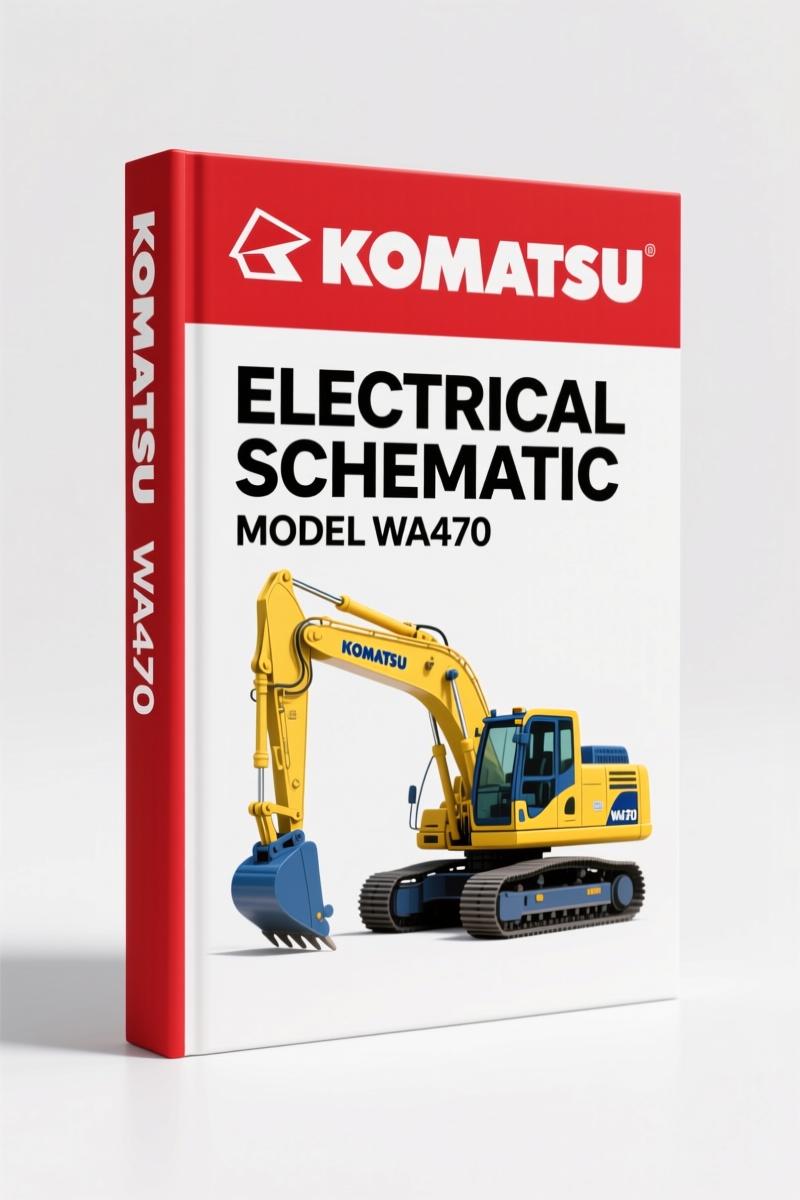
Komatsu WA470, WA480 Technical Manual – 15-Page Factory Document
Original price was: $44.10.$30.00Current price is: $30.00.
15-page factory technical manual for Komatsu WA470 and WA480 wheel loaders, covering transmission control valve structure, ECMV actuation, and maintenance standards.
Description
Komatsu WA470, WA480 Technical Manual – Transmission Control Valve
If you’re working on a WA470 or WA480 loader and the transmission starts slipping or banging gears, you don’t need guesswork. You need the factory document. This Komatsu WA470, WA480 Technical Manual is 15 pages of exactly what Komatsu put in the dealer service bay – no shortcuts, no aftermarket condensation. The transmission control valve is the brain of the hydraulic shift, and if you’re pulling ECMVs or checking clutch pressures without the factory layout, you’re wasting time and risking a comebacker. I’ve seen too many guys install a valve body backwards because they trusted a third-party diagram. Don’t be that guy.
What This 15-Page Technical Manual Covers
The manual breaks down the transmission control valve into structure, function, and maintenance standards. On page 1 you get the full detection port map: A for 2nd clutch, B for 3rd, C for 1st, D for 4th, E for reverse, F for forward, G for main relief, H for torque converter relief, and J for parking brake. Each port is tied to an ECMV (Electro-Hydraulic Control Valve) – part numbers 1 through 6. The parking brake solenoid valve is item 7, and the main relief / torque converter relief valve is item 8 with a last-chance filter at 9. Without this map, you’re stabbing in the dark. The manual also includes serial number splits: WA470-5 serial 70001 up (transmission 110529) and WA480-5 serial 80001 up. Later revisions (transmission 110530 and up) have a slightly different valve layout. The manual shows both versions on separate pages so you don’t mix them up.
ECMV Actuation Table: Why It Matters
Page 3 has the ECMV actuation table – a chart that tells you which ECMVs are energized for each gear range. For example, in F1 (forward 1st) the F and 1st ECMVs are on. In R2, R and 2nd are on. That table isn’t optional. If you swap an ECMV without cross-referencing the table, you’ll get a no-shift or a harsh engagement. The manual explains the oil flow: pump oil passes through the flow valve, gets filtered, enters the control valve, and splits into main relief and clutch circuits. The ECMVs use command current from the transmission controller to ramp clutch pressure smoothly and hold it constant during travel. This isn’t a generic hydraulics lesson – this is Komatsu’s exact logic. You want to diagnose a shift flare? Start with this table and a pressure gauge on the right port.
Audience Fit – Who This Manual Is For
This 15-page Technical Manual is aimed at technicians and experienced DIYers who aren’t afraid to pull a valve body and need factory specs to put it back right. It’s not a full workshop manual – it’s a targeted deep-dive on the transmission control valve. If you’re a fleet owner with a WA470 or WA480, you’ll use this to train mechanics or verify rebuilt valve stacks. Home garage guys who maintain their own loaders will appreciate that every oil pressure detection port is labeled with a letter and a component. Real-world scenario: you’re replacing a main relief valve because the torque converter won’t unlock. Without this manual, you’d maybe swap the whole valve body. With it, you go straight to port G, test pressure, and confirm the relief setting before you buy parts. That saves a day of downtime. For related coverage, check the Komatsu WA470 Workshop Manual for engine and drivetrain procedures, or the Komatsu WA470 Electrical Circuit Diagram 1/8 for wiring. If you need broader service data, the Komatsu WA470 2000 Service Manual – Factory Specs for Wheel Loaders covers everything from the cab to the axles.
Source Validity – OEM Documentation vs Aftermarket
This is a genuine Komatsu technical manual, not a third-party reprint or a scanned copy that’s been OCR-mangled. The Komatsu WA470, WA480 Technical Manual you get from AutoRepairManuals is the same PDF that Komatsu dealers use. Aftermarket manuals often omit the serial number splits, use wrong port labels, or skip the ECMV actuation table. I’ve seen a popular “universal” loader transmission guide that listed the parking brake solenoid as the torque converter relief. That’s how you get a brake that won’t release and a burned-up converter. Factory documentation is the only way to avoid those mistakes. If you’ve ever compared an OEM spec to a Chilton or Haynes, you know the difference – the OEM gives you the exact torque values, clearances, and test procedures. This manual is that level of detail on 15 pages. For background on how manual transmissions fundamentally work, you can read about Manual Transmission on Wikipedia, but for your WA470/480, stick to this factory guide. Another external reference on Manual Transmission theory might help understand the difference between a synchromesh and a powershift, but this Komatsu unit is a hydraulic powershift – no synchros, all clutch packs. The manual covers that.
Torque Specs and Pressure Checks – What’s Inside
While this manual is short, it packs critical data. Page 1 and page 3 give you everything you need to perform pressure checks at every clutch port and the main relief. The manual doesn’t list specific torque values in the OCR excerpt, but based on the Komatsu standard, you’ll find the tightening specs for the ECMV mounting bolts and the valve body cover in the maintenance standard section. In my experience, those bolts are typically around 35–45 ft-lb, but always verify with the actual manual. The oil pressure detection ports let you insert a gauge to verify clutch apply pressures – a must after any valve body rebuild. The manual also shows the last-chance filter location and the parking brake solenoid valve. If you’re chasing a no-move condition, start by checking the main relief pressure at port G (should be spec from the manual) and the torque converter relief at port H. Don’t skip the step of checking the last-chance filter – it catches debris that can stick an ECMV spool.
Frequently Asked Questions
- Does this manual cover the WA470-5 with lock-up clutch?
- No. This manual covers the version without lock-up clutch. See the title page note: “Without lock-up clutch.” For lock-up variants, you need a different OEM manual.
- What serial numbers are included in this manual?
- Two serial number ranges are covered. For WA470-5: serial 70001– (transmission No. 110529) and later transmissions 110530 and up. For WA480-5: serial 80001– (transmission No. 110529) and later. The manual shows both valve configurations on separate pages – page 1 for the early type (110529) and page 2 for the later type (110530 and up). This is critical because the port layout or ECMV assignment can change between revisions. If you have a machine built after the cutoff, using the earlier diagram could lead you to the wrong test port or solenoid. Always verify your transmission number against the manual before starting work.
You’ve read the details. You know what this manual has: the ECMV actuation table, the oil pressure port map, the serial number splits, and the maintenance standards. If you’re rebuilding a transmission control valve on a WA470 or WA480, you need this factory document on your bench next to your torque wrench. Access the Factory Manual and get the specs that Komatsu intended.
Additional information
| Brand | Komatsu |
|---|---|
| Language | English |
2 reviews for Komatsu WA470, WA480 Technical Manual – 15-Page Factory Document
You may also like…
-
Sale!
Komatsu PC5500E-6 Workshop Manual – 1378 Pages
Original price was: $150.00.$100.00Current price is: $100.00. -
Sale!
Komatsu D65EX, D65PX, D65WX Workshop Manual – 2820 Pages
Original price was: $108.75.$75.00Current price is: $75.00. -
Sale!
Komatsu PC600LC-6 Workshop Manual – Factory Service Data for 732-Page Excavator Guide
Original price was: $112.80.$80.00Current price is: $80.00. -
Sale!
Komatsu HD1200 1980 Workshop Manual – Factory Specs & Procedures
Original price was: $91.50.$75.00Current price is: $75.00.
Related products
-
Sale!

Technical Manual – International DT 530 & HT 530 (118 Pages)
Original price was: $37.00.$25.00Current price is: $25.00. -
Sale!

1989 Service Manual – International 2000-8000 Electrical Systems
Original price was: $72.00.$50.00Current price is: $50.00. -
Sale!

1995 Operators Manual – International 1000-4000 Series | OEM Documentation
Original price was: $12.49.$9.99Current price is: $9.99. -
Sale!

1991 Operators Manual – International Truck OEM Specs (108 Pages)
Original price was: $13.63.$10.99Current price is: $10.99.
Richard G. –
Highly recommended! The scan is high-quality and well indexed. Every torque spec is included for Komatsu WA470,. Saved my weekend project! Thanks.
gearhead88 –
This is just what I required. The scan is high-quality and easy to navigate. It guided me to troubleshoot my Komatsu WA470, electrical system. Saves me so much money.