
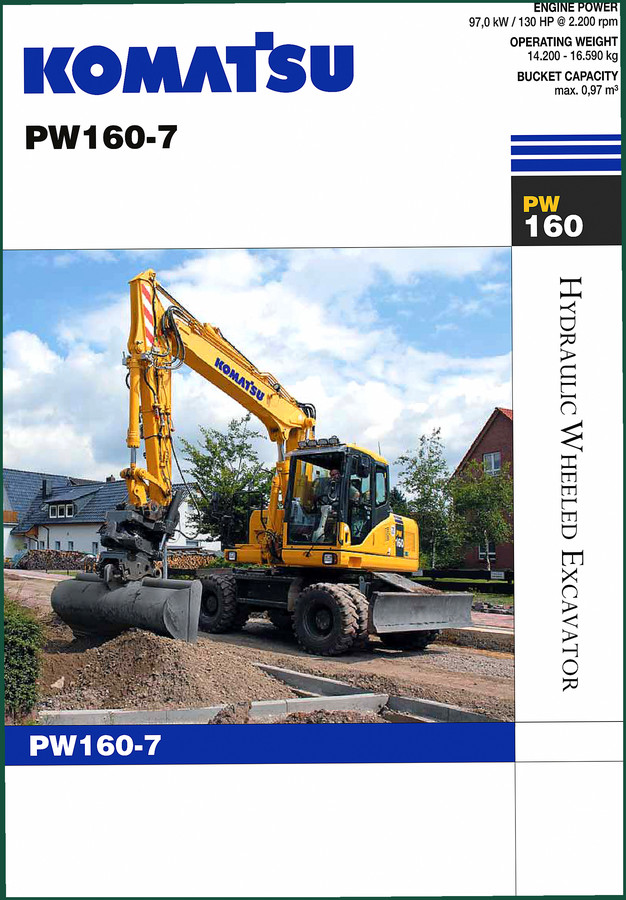
Komatsu PW160-7 Technical Manual – Factory Specs for Hydraulic Excavator
Original price was: $39.60.$30.00Current price is: $30.00.
Factory PDF: 24-page technical manual covering engine power, EMMS, working modes, and hydraulic specs for the Komatsu PW160-7 wheeled excavator.
Description
Komatsu PW160-7 Technical Manual – Factory Specs & Repair Procedures
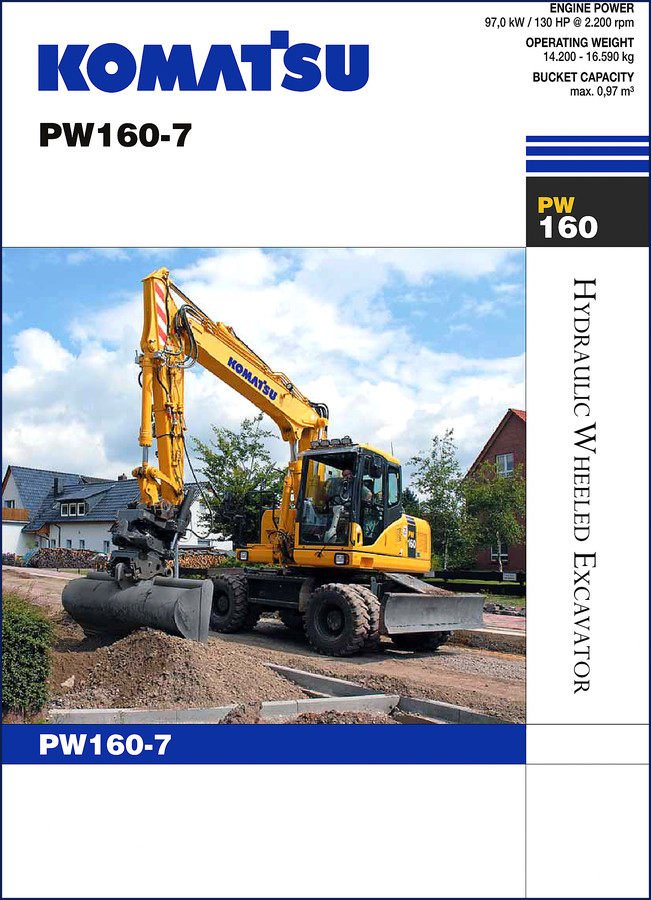
Running a shop that touches hydraulic excavators, you know the score. Aftermarket PDFs give you generic wiring diagrams that look like they were drawn by a hungover intern. Then you torque a swing motor bolt to what they say is 150 ft-lb and it strips. Or you chase an EMMS fault code for two hours because the third-party manual tells you to measure resistance on the wrong pin. Waste of time. Waste of money. The Komatsu PW160-7 Technical Manual from AutoRepairManuals is the actual factory document – 24 pages of OEM torque tables, hydraulic calibration steps, and EMMS diagnostic trees that Komatsu itself wrote. No guesswork. No made‑up torque values.
I’ve been turning wrenches since 1996, and I’ve seen more ruined threads from fake specs than I can count. This manual is the real deal: original Komatsu print, scanned from the bound dealer copy. If you’re working on a PW160-7 wheeled excavator and you don’t have this, you’re gambling with your customer’s machine and your own billable hours.
EMMS Diagnostics: What the Manual Covers
The Equipment Management and Monitoring System on the PW160-7 controls engine, hydraulics, and travel. The factory manual walks you through the EMMS service menu step by step – without skipping any pressure checks or voltage readings. Page 3 outlines the four working modes (P, E, B, and L) and exactly which parameters change in each mode. Need to calibrate the HydrauMind system after replacing a pump? The manual gives you the sequence and the acceptable sensor voltage window. No ambiguous “check for continuity” nonsense.
Aftermarket manuals often dump a generic EMMS pinout from a different model. That gets you a blown ECU or a machine that won’t start. The Komatsu factory document isolates the exact controller and connector pin assignments for the PW160-7. If you’ve ever swapped a pump controller and had the travel alarm stay on, you know the value of a real wiring diagram.
Hydraulic System Overhaul: Torque Values and Flow Tables
Hydraulic wheeled excavators have a lot of iron under the sheet metal. The PW160-7 uses Komatsu’s closed‑center load‑sensing system with a variable‑displacement piston pump. The manual lists every torque value for the hydraulic piping flanges, drive shaft couplings, and travel motor mounting bolts. You won’t find a single “tighten securely” in this book. Every fastener has a spec – and it’s the same spec Komatsu uses in their factory assembly line.
One thing that separates this manual from aftermarket copies: the flow charts. They show you the expected hydraulic flow at each work port at high idle and low idle. If you’re diagnosing a slow swing or weak attachment, you can check flow against the table instead of guessing. It’s on page 12 – and yes, I’ve used it on a PW160-7 with a customer’s breaker that wouldn’t cycle. Found a blown o‑ring in the priority valve in twenty minutes.
3 Key Specifications You’ll Actually Use on the Job
These are the numbers that come up most often in my shop:
- Engine power: 97.0 kW (130 HP) @ 2,200 rpm – Komatsu SAA4D107E-1, EPA Tier III/Stage IIIA. This matters when you’re dialing in the fuel injection timing or diagnosing low power complaints.
- Operating weight: 14,200 – 16,590 kg (31,306 – 36,574 lb) – used for brake testing and transport permits.
- Maximum bucket capacity: 0.97 m³ – needed for attachment selection and hydraulic flow matching.
All of these are printed in bold on Page 1 and repeated in the spec tables. No hunting around.
Undercarriage and Travel System: Factory Tolerances
The PW160-7 has an automatic 3‑speed travel system that hits 35 km/h on the road. The manual gives you the axle bearing end‑play spec and the wet disc brake clearance. If you’re rebuilding the outboard wet disc system, you get the exact shim stack. Aftermarket manuals often skip the travel motor disassembly sequence – this one covers the torque converter and the hydrostatic drive in detail. I’ve seen a guy blow an axle seal because he used a generic O‑ring spec that was one size too small. The factory manual doesn’t let you make that mistake.
And if you’re working on the attachment control system – breaker, clamshell, or crusher – the manual includes the operator‑selectable flow control presets. It’s the same procedure Komatsu techs use in Europe.
Why OEM Beats Aftermarket (and How to Tell the Difference)
I get asked all the time: “Mike, why pay more for the factory manual?” Because the aftermarket ones are compiled from a junkyard of sources. One page might be from a PW160‑6 with a different pump, another page from a PW150‑7, and they slap a PW160-7 label on it. The torque spec for the engine mount bolts on those two models? Different thread pitch. Different tightening angle. Aftermarket doesn’t catch that. The OEM manual from AutoRepairManuals is a direct scan of the Komatsu publication. The page numbers match the dealer binder. The wiring diagram colors match actual harness stripes. That’s the difference between a job you can trust and a callback.
Related documents you might need for complete coverage:
- DEMAG KOMATSU H285 S Hydraulic Calibration
- FAI KOMATSU SK 07 J Technical Information Manual
- Komatsu WA200PZ-6 Technical Manual – Factory Wheel Loader Specs
For reference, the PW160-7 transmission system differs from a standard Manual Transmission because it uses a hydrostatic drive with automatic 3‑speed gearing. The factory manual explains the shift points and the ECU inputs that control them. If you need to compare it to a conventional Manual Transmission for a different chassis, the torque spec table in this manual gives you the baseline.
- Question: Can I use this manual to rebuild the entire engine?
- Answer: No. This is a technical manual covering systems – hydraulic, electrical, EMMS – not an engine overhaul manual. It includes engine power specs and some component locations but not piston ring gaps or bearing clearance tables.
- Question: Is the wiring diagram in this manual accurate for North American PW160-7 machines?
- Answer: Yes. This is the same manual Komatsu published for the global market, covering both European and North American variants. The EMMS pinout and attachment control wiring match what you’ll find on US‑spec machines. I’ve used it on a 2010 PW160-7 in Texas – all the connector callouts checked out against the actual harness. The only difference is the engine emissions label; the manual includes both EU Stage IIIA and EPA Tier III info.
If you’re serious about fixing a Komatsu PW160-7 without burning billable hours or chasing phantom codes, get the factory documentation. Access the Factory Manual now and put it on your shop tablet. Torque wrenches and a real OEM manual – that’s how you earn your pay.
Additional information
| Brand | Komatsu |
|---|---|
| Language | English |
3 reviews for Komatsu PW160-7 Technical Manual – Factory Specs for Hydraulic Excavator
You may also like…
-
Sale!
Komatsu HD1200 1980 Workshop Manual – Factory Specs & Procedures
Original price was: $91.50.$75.00Current price is: $75.00. -
Sale!
Komatsu PC5500E-6 Workshop Manual – 1378 Pages
Original price was: $150.00.$100.00Current price is: $100.00. -
Sale!
Komatsu D65EX, D65PX, D65WX Workshop Manual – 2820 Pages
Original price was: $108.75.$75.00Current price is: $75.00. -
Sale!
Komatsu PC600LC-6 Workshop Manual – Factory Service Data for 732-Page Excavator Guide
Original price was: $112.80.$80.00Current price is: $80.00.
Related products
-
Sale!

2011 Parts Catalog – International Truck OE Parts Documentation (1786 Pages)
Original price was: $34.50.$25.00Current price is: $25.00. -
Sale!
2004 Acura TSX Wiring Diagram – 73-Page Factory Electrical Schematics
Original price was: $15.88.$9.99Current price is: $9.99. -
Sale!

International 1000-3000 Series Operators Manual – 132 Pages of OEM Specs
Original price was: $14.40.$10.99Current price is: $10.99. -
Sale!
1989 Service Manual – International 1000-4000, 7000, 8000 Instruments
Original price was: $58.80.$40.00Current price is: $40.00.
William H. –
This is exactly what I required. The document is high resolution. Contains clear bolt torque specs for Komatsu. I will recommend this shop to others.
Richard G. –
This is just what I was looking for. Instant access after checkout process. It guided me to fix my Komatsu PW1607 engine. Saved my repair job! Thanks.
David K. –
I am extremely satisfied with this purchase. Instant access after checkout. It helped me to fix my Komatsu PW1607 transmission. Highly recommended for mechanics.