
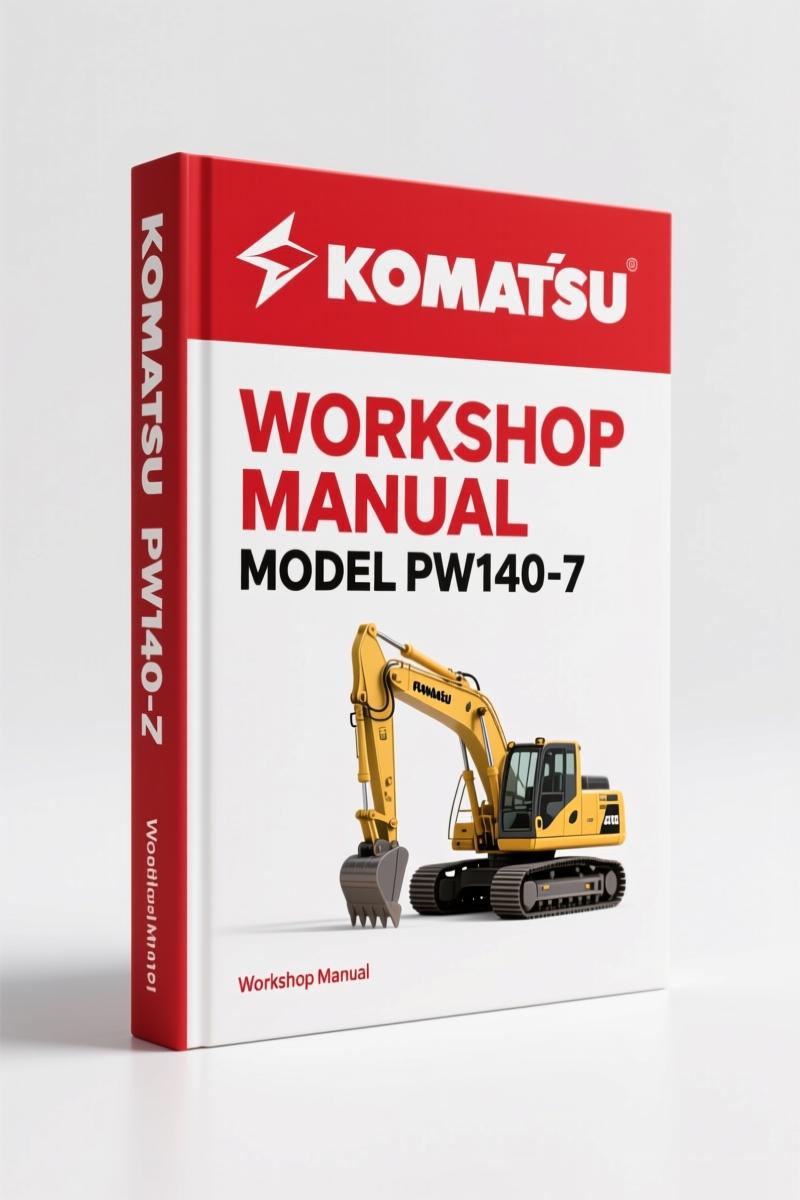
Komatsu PW140-7 2009 Workshop Manual – Factory Specs
Original price was: $96.85.$65.00Current price is: $65.00.
Factory-certified 2009 workshop manual for Komatsu PW140-7. 1144 pages of torque specs, CLSS hydraulics, and troubleshooting tables.
Description
Komatsu PW140-7 2009 Workshop Manual – Factory Specs for Hydraulic Excavator
Look, I’ve rebuilt enough Komatsu hydraulic systems to know that guessing on torque specs or hydraulic pressures is a fast way to blow a seal or snap a bolt. This isn’t a parts catalog – it’s the actual 2009 Komatsu factory workshop manual for the Komatsu PW140-7 2009 Workshop Manual, all 1144 pages of it. If you’re working on these wheeled excavators, you need this on your bench, not some aftermarket reprint that skips the details that get you fired. The manual covers serial numbers H55051 and up, with the SAA4D107E-1 engine, and it’s printed by Komatsu in Europe in 2009. That means every torque value, every hydraulic pressure spec, and every wire color code is straight from the factory – not a third-party guess.
Foreword Safety Section: Not Optional
Page 00-1 of this manual starts with safety. Komatsu doesn’t mess around. They call out proper service and repair techniques, and they mark safety precautions with a symbol you need to respect. The general precautions list includes wearing safety shoes and helmet, reading all decals before greasing or repairs, and not wearing loose clothes. I’ve seen too many techs skip this and pay the price. The manual also includes hoisting instructions, wire rope specs, and coating materials – all on page 00-1 and the surrounding foreword. Don’t ignore it.
Standard Tightening Torque: Why You Need Factory Data
One of the biggest lies in aftermarket manuals is torque specs. They copy a number from a 1990s Toyota and paste it into a Komatsu document. This manual lists standard tightening torque for bolts and nuts, hose nuts, split flange bolts, hose taper seal and face seal types, and a dedicated section for the 107 engine series. You’ll find torque for bolts, eye joints, and tapered screws – all in the foreword section. Page 00-? Actually, the exact page is listed in the table of contents under “Standard tightening torque.” When I rebuild a swing motor, I need those numbers. Aftermarket manuals don’t give you the split flange bolt torque. This one does.
7 Systems Covered in the Structure, Function, and Maintenance Standard
Section 10 of this manual (pages 10-1 onward) dives into every system. You get the power train, swing circle, swing machinery and motor, transmission, travel motor, axle, brakes, steering, hydraulic equipment layout, and the full CLSS (Closed-Center Load Sensing System) with pressure compensation valves, LS select valves, and unload valves. Each system gets specifications, function descriptions, and operation details. For example, the swing lock operation is explained, and the relief valve portion shows how pressure builds. If you’re trying to diagnose a slow swing, you need this section.
Testing and Adjusting – The 20 Series Section
This is the part that separates a pro from a parts-changer. Section 20 covers testing and adjusting, split into multiple subsections: general testing (20-101), troubleshooting (20-201), troubleshooting when a failure code is indicated (20-301), electrical system troubleshooting in E-Mode (20-501), error checking without monitor codes (20-601), and hydraulic/mechanical system troubleshooting in H-Mode (20-701). That’s over 600 pages of diagnostic procedures. If your PW140-7 throws a code or behaves weird, you don’t replace parts – you follow the flowcharts in this manual. I’ve used the E-Mode troubleshooting to chase a phantom code and it took me straight to a bad solenoid valve block.
Disassembly and Assembly Procedures
Section 30 (pages 30-1 and beyond) gives you the step-by-step for taking apart and rebuilding major components. No skipping ahead – they list the order, the special tools, and the clearances. For example, when you pull the swing motor, you need to know the correct sequence for loosening bolts to avoid warping the housing. This manual includes that. It also covers the hydraulic pump disassembly, including the LS valve, PC valve, and LS(PC)-EPC valve. If you’ve ever had a PC valve stick, you know why this matters.
CLSS Hydraulic System: Understand the Circuit Before You Cut
The CLSS section in the manual is detailed. It explains the unload valve, LS pressure introduction, pressure compensation valve area ratios, boom regeneration circuit, arm regeneration circuit, swing bleeding valve, variable pressure compensation valve, and LS select valve. Each subsection has operation descriptions and hydraulic circuit diagrams. The manual even includes the center swivel joint and solenoid valve block with 2-position 3-way valves. If you’re troubleshooting a boom drift, you need to understand the regeneration circuit. This manual gives you the theory and the practical checkpoints.
Audience Fit: Who Needs This Manual
If you’re a home garage enthusiast tackling a Komatsu wheeled excavator rebuild, this manual will keep you from ruining a $2,000 swing motor. If you’re a full-time diesel tech, this saves hours of diagnostic time. The manual assumes you have basic mechanical skills – it doesn’t hold your hand – but it gives you every spec. For beginners, the wiring diagrams and conversion tables (with imperial equivalents) are in the foreword. Don’t tackle a CLSS repair without it.
Source Validity: OEM vs Aftermarket
I’ve seen aftermarket manuals that claim to cover the PW140-7 but miss the entire CLSS section. This is a pure OEM document – Komatsu copyright 2009, printed in Europe. The electric wire code table (classification by thickness and color) is factory. The units are metric but the conversion table at the front includes imperial, and the manual consistently uses SI. When I reference a torque spec for a 107 series engine eye joint, I trust this manual. Aftermarket? I don’t trust them for wiring – they cross colors wrong and short out your harness.
Related manuals you might need for a fleet: Komatsu WA65-5 WA70-5 WA80-5 2005 Workshop Manual covers wheel loaders with similar hydraulic architecture. For compact excavators, see Komatsu WH609-1E0 WH613-1E0 WH713-1E0 WH714H-1E0 WH716-1E0 Workshop Manual. And if you run a PW95R-2, get Komatsu PW95R-2 Workshop Manual – 520 Pages of Factory Specs – same CLSS system but smaller frame.
For background on hydraulic vs. mechanical transmissions, check Manual Transmission principles on Wikipedia, and for shifting theory, Manual Transmission details.
FAQ
- Does this manual cover the SAA4D107E-1 engine in detail?
- Yes, but only for the installation and related components. For full engine overhaul specs, you need the separate 107 Series Engine Shop Manual. This manual references engine tightening torque values on the foreword pages and gives radiator/oil cooler/charge air cooler specs, but the internal engine disassembly is in a separate volume.
- Are the torque values in imperial units?
- The manual lists torque in Nm, but includes conversion tables at the front of the foreword. You can convert to ft-lb using the table – it’s on the same pages as the standard tightening torque section. I’d recommend keeping a calculator handy.
Stop paying a dealer $200/hour for something you can fix yourself. Access the Factory Manual and get the exact specs Komatsu intended. No guessing, no reprints, no outdated data.
Additional information
| Brand | Komatsu |
|---|---|
| Language | English |
2 reviews for Komatsu PW140-7 2009 Workshop Manual – Factory Specs
You may also like…
-
Sale!
Komatsu HD1200 1980 Workshop Manual – Factory Specs & Procedures
Original price was: $91.50.$75.00Current price is: $75.00. -
Sale!
Komatsu PC5500E-6 Workshop Manual – 1378 Pages
Original price was: $150.00.$100.00Current price is: $100.00. -
Sale!
Komatsu PC600LC-6 Workshop Manual – Factory Service Data for 732-Page Excavator Guide
Original price was: $112.80.$80.00Current price is: $80.00. -
Sale!
Komatsu D65EX, D65PX, D65WX Workshop Manual – 2820 Pages
Original price was: $108.75.$75.00Current price is: $75.00.
Related products
-
Sale!

2005 Parts Catalog – International NGD 3.0 L Engine (77 pages)
Original price was: $44.70.$30.00Current price is: $30.00. -
Sale!

2011 Parts Catalog – International Truck OE Parts Documentation (1786 Pages)
Original price was: $34.50.$25.00Current price is: $25.00. -
Sale!

1993 Operators Manual – International Bus 1000-3000 OEM Specs
Original price was: $12.30.$7.99Current price is: $7.99. -
Sale!
1996 Operators Manual – International 1000-4000 Series (246 pages)
Original price was: $15.28.$9.99Current price is: $9.99.
John S. –
Highly recommended! It is very easy to read on my laptop without losing quality. Contains precise wiring diagrams for Komatsu. Highly recommended for mechanics.
Robert M. –
Excellent factory service manual. It is very easy to read on my tablet without blur. Contains clear wiring diagrams for Komatsu. Highly recommended for mechanics.