
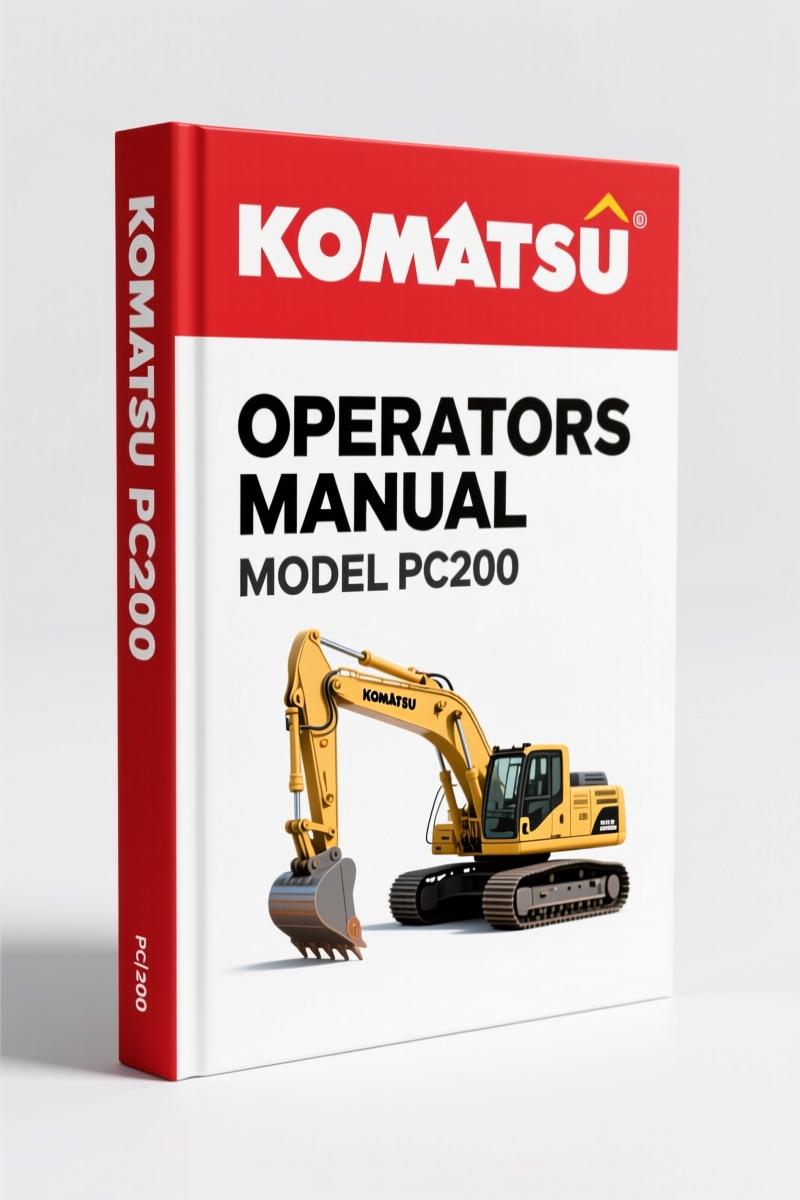
Komatsu PC200, PC200LC, PC220, PC220LC Workshop Manual – 1082 Pages
Original price was: $54.00.$36.00Current price is: $36.00.
OEM Komatsu workshop manual for PC200, PC200LC, PC220, PC220LC excavators. 1082 pages of factory specs, testing procedures, and troubleshooting.
Description
Komatsu PC200, PC200LC, PC220, PC220LC Workshop Manual
If you’re working on a Komatsu PC200, PC200LC, PC220, or PC220LC, you need the Komatsu PC200, PC200LC, PC220, PC220LC Workshop Manual on your bench. Not a scan of a scan, not a third-party rewrite that gets the valve clearances wrong. This is the factory-issued file – 1082 pages of what Komatsu actually put in the binder for their techs. I’ve seen too many guys lose a whole afternoon because they trusted a generic torque chart. Don’t be that guy.
Every page comes from the OEM release – original publication numbers SEN00084-07 through the series. The manual covers serial number ranges: PC200-8 from 300001, PC200LC-8 from 300001, PC220-8 from 70001, PC220LC-8 from 70001. That means you’re getting the exact procedures Komatsu trained their dealer mechanics on. No condensed version, no missing sections.
Komatsu PC200, PC200LC, PC220, PC220LC Workshop Manual: 1082 Pages of Factory Data
You get the full Table of Contents broken into four main groups: Index and Foreword, Specification, Structure/Function/Maintenance Standard, and then the heavy stuff – Testing & Adjusting, Standard Value Tables, and Troubleshooting. The manual opens with safety notices and handling instructions for electrical equipment and hydraulic components. If you’ve ever zapped a controller because you didn’t disconnect the battery right, you’ll appreciate the warnings on page 4 of the foreword section.
Inside the Specification section you’ll find dimension drawings, working range diagrams, weight tables, and the table of fuel, coolant, and lubricants. That’s the stuff you need before you even pull a wrench – wrong oil weight kills pumps.
Engine and Cooling System – Detailed Disassembly and Inspection
Section 10 kicks off with the engine and cooling system. It covers engine-related parts, radiator, oil cooler, aftercooler, and fuel cooler. The manual doesn’t just tell you to replace a part – it gives you the structure, function, and maintenance standard. That means you learn how the system operates before you tear it down. For a DIY guy in a home garage, that context saves you from reassembling something backwards.
Power train, final drive, swing machinery, and swing circle are all in there. Undercarriage sections cover track frame, recoil spring, idler, carrier rollers, track rollers, and track shoe adjustment. If you’re replacing track shoes, the standard value table gives you the wear limits. No guesswork.
Get the Right Torque Values from the Standard Tightening Torque Table
Torque specs live in the Standard Tightening Torque Table inside the Index and Foreword. This is an OEM table – not something a parts store printed on a laminated card. You get torque for bolts, nuts, and even special fasteners used on Komatsu machines. I’ve watched a rookie crack a swing motor housing because he used a generic spec. Don’t do that. Open this manual, find the fastener, hit the number. It’s right there.
That table applies across the whole machine – engine mounts, hydraulic pump flanges, final drive covers. The manual also includes a conversion table for units, so if your torque wrench reads in ft-lb and the spec is in N·m, you don’t need a separate calculator.
Does This Manual Cover the Hydraulic System Testing?
Yes, and it splits the hydraulic system into three parts. Part 1 covers the hydraulic equipment layout drawing, tank and filter, pump, and pilot oil filter. Part 2 gets into the control valve, CLSS (Closed-center Load Sensing System), and functions/operation by valve. Part 3 covers swing motor, center swivel joint, travel motor, PPC valves (work equipment, swing, travel, service), valve control, solenoid valve, PPC accumulator, return oil filter, attachment circuit selector valve, and hydraulic cylinders. That’s every major hydraulic component on the machine.
For testing, section 30 – Testing and Adjusting – lists the required tools for each procedure. Need to measure boost pressure? It tells you the gauge range. Adjusting valve clearance? It shows the feeler gauge thickness and the sequence. There’s a procedure for bleeding air from the fuel circuit, releasing residual pressure from the hydraulic circuit, and checking cab tipping stoppers. The manual expects you to have the right tools. It names them.
3 Major Sections: Testing, Adjusting, and Troubleshooting
Section 30 is split into three parts. Part 1 covers tools, measuring engine speed, intake air pressure, exhaust gas color, valve clearance, compression pressure, blow-by pressure, engine oil pressure, fuel pressure, and fuel return rate. It also includes air conditioner compressor belt tension, fan belt replacement, swing circle bearing clearance, track shoe tension, and oil pressure measurements in work equipment, swing, and travel circuits. There’s even a procedure for checking parts that cause hydraulic drift of work equipment – a common problem on older excavators.
Part 2 covers special functions of the machine monitor – that’s your go-to for understanding what the dash lights are telling you. Part 3 covers high-voltage circuit handling for the engine controller, troubleshooting preparation for the electrical system, diode testing procedures, and PM clinic service. Section 40 – Troubleshooting – gives you failure code tables, fuse locations, and general troubleshooting sequence. If your machine throws a code, you flip to the failure code table and start working through the checklist.
That’s how you solve a problem without replacing parts at random. Follow the manual’s sequence of events – check before you replace.
What About Wiring and Electrical Control?
The Electrical System chapter covers engine control, electrical control system, monitor system, sensors, and the KOMTRAX terminal system. The manual includes electric wire code explanations, so you can trace a wire color to its function. For deeper diagnostics, you’ll need a multimeter and the troubleshooting steps in part 2 and 3. The manual doesn’t assume you’re an electrical engineer – it gives you a procedure for testing diodes and handling connectors.
If you’re working on the cab, the air conditioner piping section shows the layout. Not a generic schematic – the actual routing for this machine series.
FAQ
- What torque value should I use for the cylinder head bolts?
- Refer to the Standard Tightening Torque Table in the manual – never use generic values.
- Why should I pay for this when free manuals are online?
- Free manuals are often missing pages, have low-resolution diagrams, and contain errors. This factory PDF includes all 1082 pages, full-size diagrams, and the exact specs Komatsu engineering approved. One wrong torque and you’re looking at a leak or a cracked block. You pay for the peace of mind that comes with correct data. Plus, this version includes the official SEN00093-07 document with serial number ranges – free copies often skip the serial number verification, so you might get a manual for a different machine generation. Don’t risk a mismatch.
- Related Manual: Komatsu PC200 PC200LC Workshop Manual
- Related Manual: KOMATSU PC200 PC210 Hydraulic Excavator Parts Catalog
- Related Manual: Komatsu PC200 PC220-7 Service Manual
- External Resource: Manual Transmission
- External Resource: Manual Transmission
Stop reaching for that worn-out photocopy. Access the Factory Manual now and get the right specs on your screen – no more guessing, no more wasted time.
Additional information
| Brand | Komatsu |
|---|---|
| Language | English |
4 reviews for Komatsu PC200, PC200LC, PC220, PC220LC Workshop Manual – 1082 Pages
You may also like…
-
Sale!
Komatsu HD1200 1980 Workshop Manual – Factory Specs & Procedures
Original price was: $91.50.$75.00Current price is: $75.00. -
Sale!
Komatsu PC5500E-6 Workshop Manual – 1378 Pages
Original price was: $150.00.$100.00Current price is: $100.00. -
Sale!
Komatsu D65EX, D65PX, D65WX Workshop Manual – 2820 Pages
Original price was: $108.75.$75.00Current price is: $75.00. -
Sale!
Komatsu PC600LC-6 Workshop Manual – Factory Service Data for 732-Page Excavator Guide
Original price was: $112.80.$80.00Current price is: $80.00.
Related products
-
Sale!

Acura Integra 1998 Service Manual – 1891 Pages Factory OEM Documentation
Original price was: $31.75.$25.00Current price is: $25.00. -
Sale!

1995 Operators Manual – International 1000-4000 Series | OEM Documentation
Original price was: $12.49.$9.99Current price is: $9.99. -
Sale!

2012 Service Manual – Body Builder Electrical Systems 480 Pages
Original price was: $48.28.$34.00Current price is: $34.00. -
Sale!

2005 Parts Catalog – International NGD 3.0 L Engine (77 pages)
Original price was: $44.70.$30.00Current price is: $30.00.
Michael T. –
This is just what I needed. Instant access after checkout process. It assisted me to rebuild my Komatsu PC200, transmission. Worth every penny.
diy_master –
This is exactly what I required. Immediate link after payment. Contains precise schematics for Komatsu. Saved my repair job! Thanks.
Thomas B. –
This is exactly what I needed. Quick access after checkout process. Contains detailed schematics for Komatsu. Saved my weekend project! Thanks.
David K. –
Excellent workshop guide. The file quality is excellent. A must-have for any Komatsu PC200, mechanic doing maintenance. Worth every penny.