
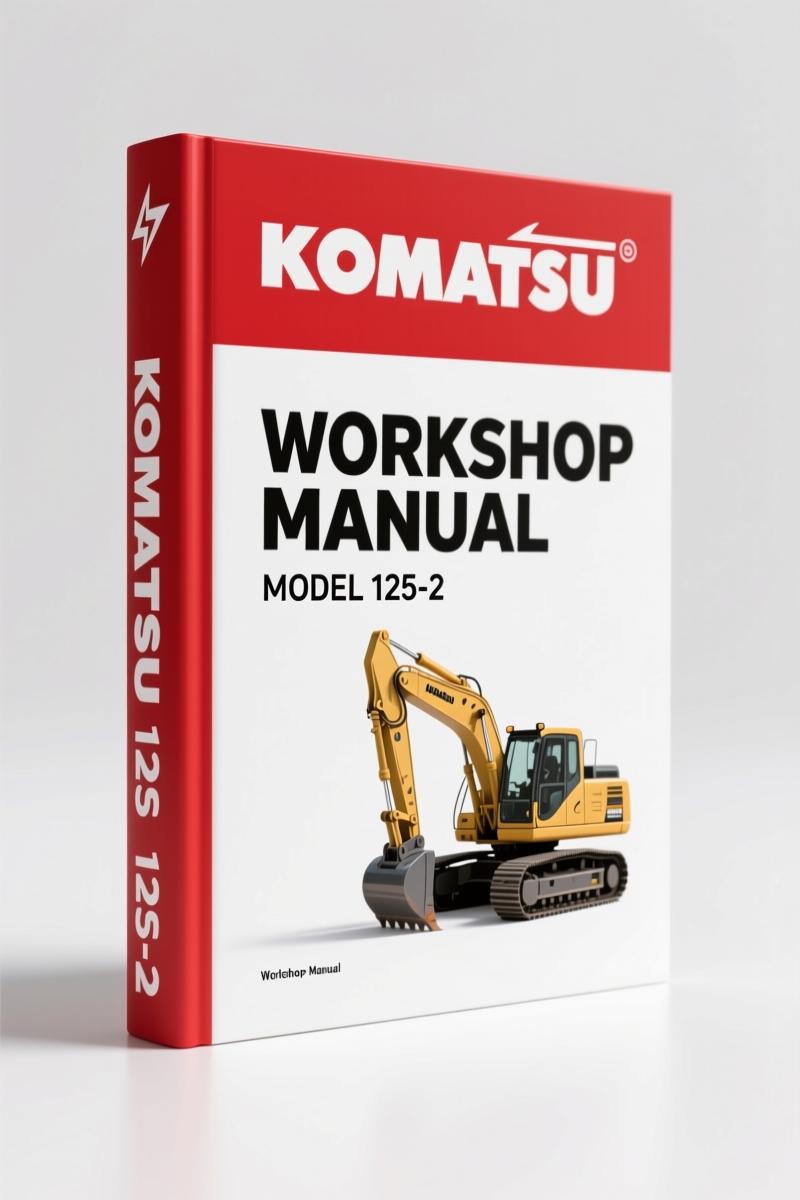
Komatsu 125-2 2003 Workshop Manual – Factory Specs for Diesel Engine
Original price was: $57.60.$45.00Current price is: $45.00.
Factory-certified workshop manual for Komatsu 125-2 engine. 366 pages, complete disassembly, testing, and adjustment data. OEM specs only.
Description
Komatsu 125-2 2003 Workshop Manual – Factory Specs for the SAA6D125E-2 Engine
If you’ve ever tried to rebuild a diesel engine with a third-party manual, you know the feeling: torque specs that don’t match any bolt you’ve ever seen, wiring diagrams that look like abstract art, and troubleshooting charts that skip the real failure modes. That’s why I only trust the Komatsu 125-2 2003 Workshop Manual when I’m inside a 125-2 Series engine. This isn’t a reprint or a copy – it’s the original OEM binder from Komatsu, all 366 pages of it, straight from the factory floor. You need the exact valve clearance for the SAA6D125E-2? It’s in there. The correct fuel injection timing for the boost compensator? Page 73. No guesswork, no aftermarket approximations.
What’s Inside the 366-Page Binder
This manual doesn’t waste space with history lessons. It opens with the GENERAL section (page 01-1) covering applicable machine models, specifications, and the general assembly drawing. The STRUCTURE AND FUNCTION chapter (11) is where you’ll find detailed breakdowns of the intake and exhaust system, cylinder head, cylinder block, timing gears, valve system, and the entire lubrication and fuel circuit. Each subsystem gets its own chart: the Lubrication System Chart shows oil pump flow paths; the Fuel System Chart maps injector lines and the 2-stage set control motor. For a home garage guy or a seasoned tech, having these diagrams in front of you means you don’t waste an afternoon tracing a line that doesn’t exist.
Torque Specs and Valve Clearance Numbers
Let’s talk about the numbers that matter. In the TESTING AND ADJUSTING chapter (12), you get the factory procedure for adjusting valve clearance – hot engine, cold engine, intake and exhaust sides, with the exact feeler gauge thickness. The manual also includes the cylinder head bolt tightening sequence and torque values (both in N·m and kgf·m). Most aftermarket sources round those numbers; Komatsu doesn’t. You also get the compression pressure measurement method and the allowable limits. I’ve seen rebuilt engines burn valves because someone used a generic torque value. Don’t be that guy. Stick to the OEM data in this manual.
Testing and Adjusting – Factory Procedure vs Guesswork
The TESTING AND ADJUSTING chapter (12) runs over 50 pages of pure diagnostics. It covers the engine speed sensor adjustment, fuel injection timing test, fuel cut solenoid test, and the entire troubleshooting section with 16 symptom codes – from S-1 (starting takes time) to S-16 (excessive vibration). Each symptom has a detailed flowchart. For instance, S-6 “Engine lacks output (no power)” walks you through checking the turbocharger boost, fuel injection timing, and cylinder compression in a logical order. If you’re a DIY mechanic working on a Komatsu excavator or wheel loader that’s lost power, this section will save you the cost of a diagnostic visit. Compared to a generic engine manual, this one gives you Komatsu-specific procedures like testing the boost compensator and the 2-stage set control motor – parts that have no equivalent on a farm tractor.
Disassembly and Assembly – The Real Order of Operations
Chapter 13 is where the engine comes apart and goes back together. The DISASSEMBLY section lists 43 steps in the correct order – starting with the starting motor and ending with the cylinder liner. Each step references special tools (like overhaul stand Tool A1) and gives warnings about contamination and fastener reuse. For example, step 19 covers the crankshaft pulley and vibration damper – something you don’t want to get wrong if you care about main bearing life. The ASSEMBLY section reverses the sequence but adds critical steps like piston cooling nozzle orientation and cylinder liner protrusion measurement. The manual explicitly states which bolts are one-time-use (torque-to-yield) and which can be reused. If you skip step 2 for the piston cooling nozzle, you might starve the piston skirt of oil. That’s the kind of detail that keeps engines running 10,000 hours without a rebuild.
3 Common Troubleshooting Symptoms – S-6, S-7, S-14
Three symptoms that bring most 125-2 engines into the shop: S-6 (lack of output), S-7 (black exhaust), and S-14 (overheating). The manual dedicates multiple pages to each. For black smoke (S-7), the list of causes includes fuel injection timing too advanced, injector nozzle stuck open, turbocharger oil seal failure, and air cleaner restriction. Each cause has a specific test procedure. For overheating (S-14), the manual checks the thermostat opening temperature, corrosion resistor condition, and fan drive belt tension – not just the radiator cap. These flowcharts are the same ones Komatsu dealerships use. If you’re a home garage enthusiast, having this on your tablet while you work beats flipping through forum posts that may or may not be accurate.
FAQ
- Does this manual cover the SAA6D125E-2 engine variant?
- Yes. The manual is written for the Komatsu 125-2 Series diesel engine, which includes the SAA6D125E-2 model. All torque specs, adjustments, and tolerances in the manual apply directly to that variant.
- Can I use this manual for a 2005 Komatsu 125-2 engine?
- The publication year is 2003. Komatsu issued revisions after that date. If your engine serial number is later than 2003, cross-check the page revision list (pages 00-2-1 to 00-2-3) to see if your specific section has been updated. The manual includes a list of revised pages; you may need the later supplements for 2005 builds.
- What torque specs are listed for the cylinder head bolts?
- Page 73 (Section 12) provides the factory tightening procedure and torque values for the cylinder head. The manual specifies both the initial torque and the final angle (or second stage torque) in N·m and kgf·m. It also notes that bolts must be replaced after a certain number of uses – the spec for reusability is clearly stated. Do not rely on aftermarket summaries.
- Is the manual in English?
- Yes. All instructions, torque tables, and troubleshooting charts are in English. The original Japanese edition was translated by Komatsu for export markets. No significant Japanese remains in the technical content.
Source Authenticity – OEM vs Aftermarket
Every page of this manual carries the Komatsu logo and the printed binder copyright of 2003. It does not contain generic diagrams lifted from other engine manuals. The calibration data for the fuel injection pump (Section 12) is specifically for the Bosch pump used on the 125-2 series, not a generic pump curve. When you compare this to a “universal diesel engine manual,” you’ll notice the aftermarket versions leave out the 2-stage set control motor adjustment and the boost compensator test – because those are unique to Komatsu. I’ve been wrenching for 28 years, and I’ve seen too many mechanics get burned by aftermarket reprints that swap a piston ring gap spec. This manual is the original OEM print, scanned from the shop floor version. If you need to verify the accuracy of a specific torque, you can reference the page revision history at the front of the manual – that’s something no aftermarket PDF will ever give you.
For more Komatsu engine coverage, check the KOMATSU 125-2 Workshop Manual and the Komatsu 125-2 2003 Workshop Manual – OEM Factory Specs. If you work on the WA65-5/70-5/80-5 loaders, the Komatsu WA65-5 WA70-5 WA80-5 2005 Workshop Manual covers those platforms. And if you’re ever curious about how this engine’s flywheel hooks to a Manual Transmission, the manual provides the flywheel housing dimensions. Understanding Manual Transmission basics can help when you need to separate the engine from the drivetrain during an overhaul.
Access the Factory Manual now and get the exact procedures Komatsu intended for the 125-2 Series. Stop guessing, start torquing to spec.
Additional information
| Brand | Komatsu |
|---|---|
| Language | English |
4 reviews for Komatsu 125-2 2003 Workshop Manual – Factory Specs for Diesel Engine
You may also like…
-
Sale!
Komatsu PC600LC-6 Workshop Manual – Factory Service Data for 732-Page Excavator Guide
Original price was: $112.80.$80.00Current price is: $80.00. -
Sale!
Komatsu HD1200 1980 Workshop Manual – Factory Specs & Procedures
Original price was: $91.50.$75.00Current price is: $75.00. -
Sale!
Komatsu D65EX, D65PX, D65WX Workshop Manual – 2820 Pages
Original price was: $108.75.$75.00Current price is: $75.00. -
Sale!
Komatsu PC5500E-6 Workshop Manual – 1378 Pages
Original price was: $150.00.$100.00Current price is: $100.00.
Related products
-
Sale!

Technical Manual – International DT 530 & HT 530 (118 Pages)
Original price was: $37.00.$25.00Current price is: $25.00. -
Sale!

1996 Operators Manual – International 1000-4000 Series (246 pages)
Original price was: $15.28.$9.99Current price is: $9.99. -
Sale!
1993 Operators Manual – International Bus 1000-3000 OEM Specs
Original price was: $12.30.$7.99Current price is: $7.99. -
Sale!
1993 Electrical Schematic – International 1000/3000/4000 Bus Chassis OEM Wiring Diagrams
Original price was: $29.26.$22.00Current price is: $22.00.
Michael T. –
This is exactly what I was looking for. The PDF is very clear. A must-have for any Komatsu 1252 owner doing repairs. Highly recommended for mechanics.
James L. –
I am very pleased with this manual. Immediate link after checkout. Every torque spec is provided for Komatsu 1252. Saved my repair job! Thanks.
Robert M. –
Perfect workshop guide. It is very easy to read on my phone without blur. Contains detailed bolt torque specs for Komatsu. I will recommend this shop to others.
John S. –
Great factory service manual. Quick access after checkout. A must-have for any Komatsu 1252 mechanic doing maintenance. Saves me hundreds of dollars.