
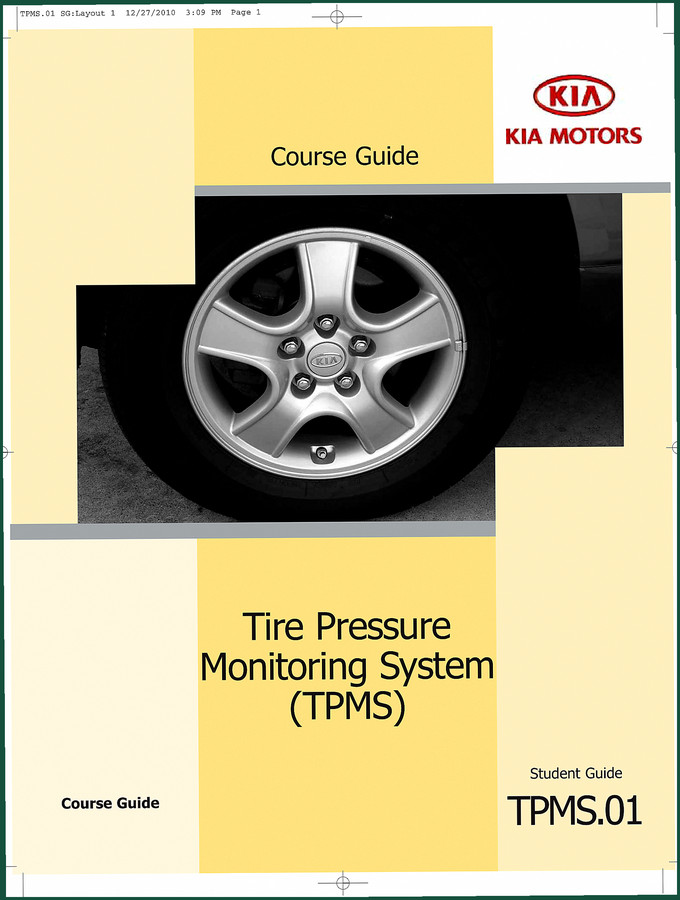
Kia TPMS.01 2011 Training Manual – 132 Pages of Factory Tire Pressure Monitoring Diagnostics
Original price was: $44.70.$30.00Current price is: $30.00.
132-page Kia TPMS.01 training manual (2011). OEM diagnostic flowcharts, sensor ID procedures, and warning lamp logic for certified technicians.
Description
Kia TPMS.01 2011 Training Manual – Tire Pressure Monitoring System Course Guide
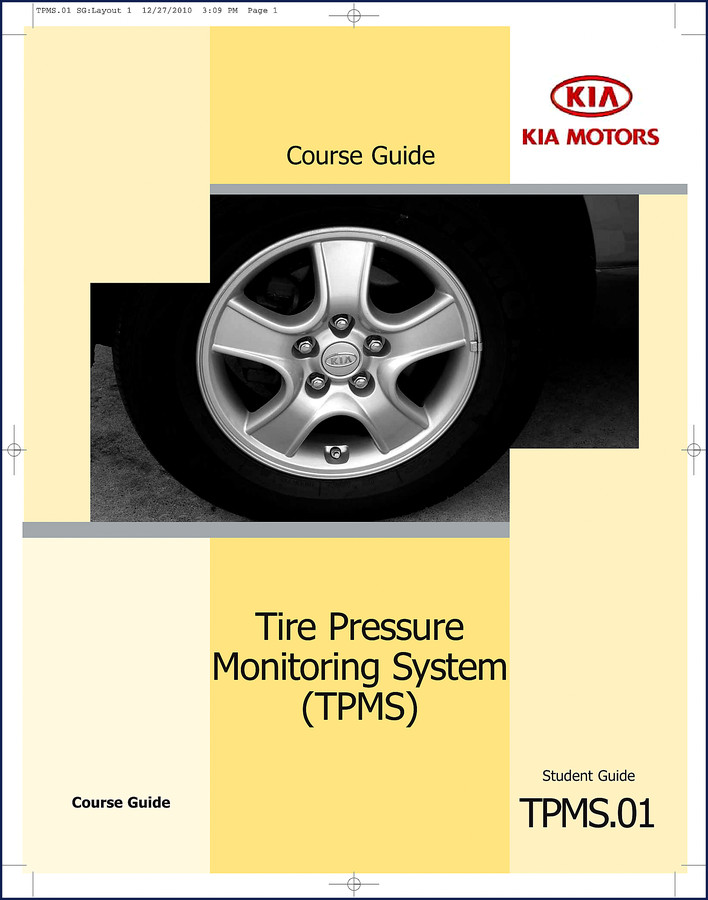
If you’ve ever wasted an afternoon chasing a TPMS light that refuses to reset, you already know the value of factory documentation. Aftermarket summaries leave out the safety steps and the specific relearn sequences that Kia engineers built into the system. This Kia TPMS.01 2011 Training Manual is the real thing – a 132-page OEM course written by the people who designed the system, not some third party rewriting a Chilton page from memory.
The manual opens with a safety section on page 2 that covers the basics: wear safety glasses, use jack stands, keep clear of moving parts, and never smoke near a fuel system. That page also defines the difference between a Note, a Caution, and a Warning. If you skip reading that, you’re risking tools or your own skin. The training module runs through every part of the tire pressure monitoring system – sensors, receivers, warning logic, and the mandatory reset procedures after a tire rotation or sensor replacement.
Safety First: Understanding the Page 2 Warnings
Every person who cracks this manual needs to read page 2 before they touch a car. It lists ten specific safety rules. Among them: set the parking brake, keep the ignition switch off unless the procedure says otherwise, and avoid contact with hot exhaust components. The manual also explains when to work in a well‑ventilated area – not a suggestion, a requirement when the engine is running. These aren’t generic disclaimers. They’re the same instructions Kia gives its own dealership technicians. Ignoring them turns a routine TPMS sensor swap into a burn injury or a car dropped off a jack.
The definitions on page 2 are worth memorizing. A Note helps you work faster. A Caution warns about damage to parts or tools. A Warning tells you that someone could die. That hierarchy dictates how you approach every step. If the manual labels something with a Warning, you stop and verify your method. No shortcuts.
TPMS.01 Course: What’s Inside the 132 Pages
This training manual covers the 2011 Kia TPMS system from the ground up. You get the theory of operation, diagnostic flow charts, sensor identification codes, and the exact procedures for triggering a sensor ID relearn. The course is structured as a self‑study module with quizzes built in – but even if you don’t take the tests, the procedures are laid out in a linear sequence that matches shop workflow. You start with system activation, move through fault code interpretation, and end with the final system verification. No fluff, no skipping steps.
Need the torque specification for the sensor nut? It’s listed in the component replacement section. The manual also specifies the correct tire valve core torque and the sealant requirements for sensor grommets. Aftermarket manuals often round those numbers to “tighten securely” – which strands you with a slow leak or a stripped thread. Factory data is exact, and this manual gives it in Imperial units as used in North America.
Source Authenticity: Why Kia Motors America OEM Matters
This isn’t a reprint of a generic service manual. It’s published directly by Kia Motors America, Inc. (KMA) in 2011, with a copyright notice on page 3 that reserves all rights. The document is the same one Kia University issued to dealer technicians. That matters because the TPMS.01 system has proprietary reset sequences that vary by model year and system generation. If you work on a 2011 Kia Optima, a Sportage, or a Sorento, the diagnostic strategies in this manual match exactly what the dealer’s scan tool expects. Third‑party documentation gets the pinouts wrong or omits the two‑step relearn needed after a sensor replacement. This manual doesn’t.
For transmission‑related diagnostics, see the Hyundai Kia Transaxle Training Manual. If you need the PDI checklist for a new Optima, the Kia Optima Training Manual – PDI Certification Guide (26 Pages) covers that. The Kia Multi-Media Technology KMMT Course Guide handles infotainment system repairs. Each of those manuals follows the same factory‑spec structure.
Who Should Use This Training Manual
Home garage enthusiasts who rotate their own tires and maintain their own TPMS sensors will get the most out of this manual. It assumes you already know how to use a multimeter and a scan tool, but it walks you through the diagnostic decisions step by step. If you’ve replaced a tire and the TPMS light stayed on, this manual gives you the official procedure to force a relearn. It also tells you what to do if the sensor battery dies and the part number cross‑reference for the correct sensor.
Professional mechanics will appreciate the precise fault code descriptions. The manual explains what each DTC means, the conditions that set it, and the order of checks to perform. That saves billable hours because you don’t have to guess between a dead sensor and a wiring break. Safety warnings are repeated throughout – a reminder that even experienced techs need to follow the procedure exactly when dealing with systems that have RF signals and lithium batteries.
For a broader view of automotive systems, the Automotive Industry Overview covers regulatory changes like the TREAD Act that mandated TPMS. And although this manual focuses on TPMS, the same safety principles apply when working on a Manual Transmission or any other drivetrain component.
Notes, Cautions, Warnings – The Definitions That Keep You Safe
The back cover of the safety section (page 2 again) defines those three terms. A Note is for efficiency. A Caution is for equipment. A Warning is for life. Every procedure in this 132‑page manual uses those labels correctly. When you see a Warning, you stop and make sure the battery is disconnected or the tire is fully deflated before you pop the sensor off the rim. Aftermarket manuals sometimes skip the Caution about using the correct socket depth, which cracks the sensor housing. This manual doesn’t.
If you’ve ever wondered why some TPMS sensors die after a tire shop mounts a new tire, it’s because the tech used an impact gun without an adapter. That mistake is specifically addressed in this manual. It tells you the required tool to remove the sensor nut and the torque sequence when installing the new one. Follow it, and the system works. Ignore it, and you buy a new sensor.
- Does this manual cover TPMS for all Kia models?
- It covers the TPMS.01 system used on 2011 Kia vehicles. Later models may use TPMS.02 or different sensor frequencies. Check the system version on your vehicle before buying.
- What safety warnings are included?
- Page 2 lists ten specific safety rules, including eye protection, jack stands, and engine running precautions. The manual uses Notes, Cautions, and Warnings throughout.
- Is this a service manual or training manual?
- Training manual. It teaches the theory and diagnostic procedures for the TPMS system. It is not a full vehicle repair manual, but it includes step-by-step procedures for sensor replacement and system activation.
- Can I use this manual for aftermarket TPMS sensors?
- You can use the diagnostic flow charts and wiring information, but the sensor programming procedures are specific to OEM sensors. Aftermarket sensors require different relearn steps not covered here. If you plan to install aftermarket, supplement this with the sensor manufacturer’s instructions.
Access the Factory Manual and keep it in your shop or home garage. The 132 pages of OEM procedures will pay for themselves the first time you avoid a misdiagnosed sensor or a broken valve stem. Print the safety section and tape it to your toolbox – it belongs there.
Additional information
| Brand | Kia |
|---|---|
| Language | English |
3 reviews for Kia TPMS.01 2011 Training Manual – 132 Pages of Factory Tire Pressure Monitoring Diagnostics
You may also like…
-
Sale!
Kia Theta, Gamma 2011 Training Manual – Dual CVVT System
Original price was: $43.75.$35.00Current price is: $35.00. -
Sale!
Kia 21218K370041 2009 Training Manual – Suspension & Alignment Specs
Original price was: $46.08.$32.00Current price is: $32.00. -
Sale!

Kia Carnival Workshop Manual (1999-2001) – 1020 Pages of Factory Specs
Original price was: $51.20.$40.00Current price is: $40.00. -
Sale!
Kia Diesel 1 2007 Training Manual – Factory Diagnostics & Injection Systems
Original price was: $49.46.$31.50Current price is: $31.50.
Related products
-
Sale!

1991 Operators Manual – International Truck OEM Specs (108 Pages)
Original price was: $13.63.$10.99Current price is: $10.99. -
Sale!

1995 Operators Manual – International 1000-4000 Series | OEM Documentation
Original price was: $12.49.$9.99Current price is: $9.99. -
Sale!

2006 Service Manual – International DT 466E, 530E Diesel Engine
Original price was: $67.50.$50.00Current price is: $50.00. -
Sale!
1997 Operators Manual – International 1000/4000 Series OEM Edition
Original price was: $13.49.$9.99Current price is: $9.99.
Thomas B. –
This is exactly what I required. It is very easy to read on my phone without blur. A must-have for any Kia TPMS.01 owner doing repairs. Worth every penny.
William H. –
This is just what I needed. The text is searchable and easy to navigate. It assisted me to troubleshoot my Kia TPMS.01 engine. Saves me so much time.
diy_master –
This is just what I needed. It is very easy to read on my tablet without losing quality. A must-have for any Kia TPMS.01 owner doing repairs. Saves me a lot of money.